Bayraktar TB2: Specifications, Weapons, Exports and History
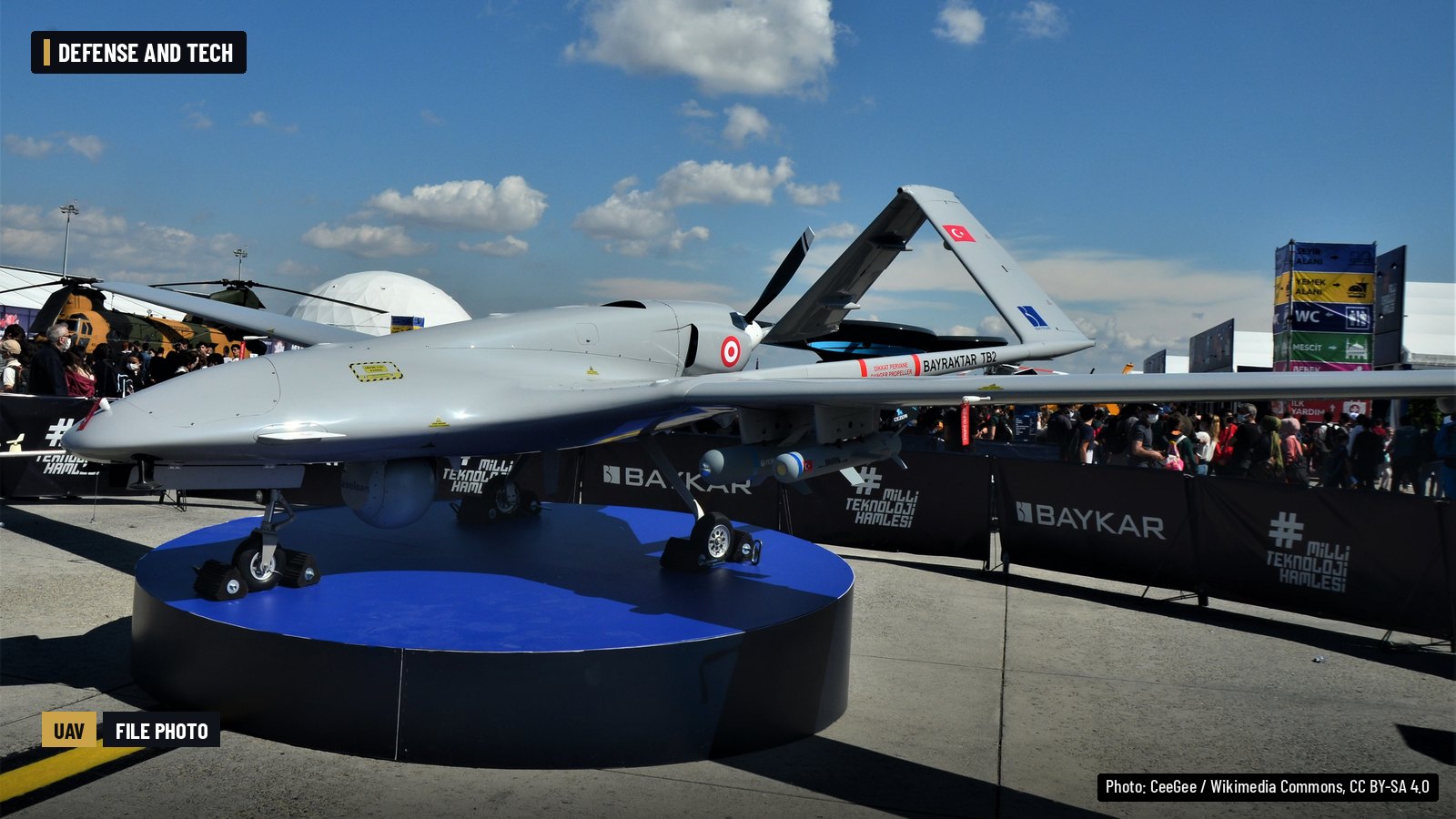
The Bayraktar TB2 is a medium-altitude, long-endurance (MALE) armed drone built by Türkiye’s Baykar for reconnaissance, surveillance and precision strike. Baykar lists a 700 kg maximum take-off weight, a 150 kg payload, a 100 hp piston engine, more than 18 hours’ endurance and a 27-hour 3-minute flight record. In January 2026 the company said it had signed TB2 export contracts with 36 countries. The figures on this page come from Baykar, Türkiye’s Presidency of Defence Industries (SSB) and the defence ministries of Poland and Romania (Baykar, Baykar, 31 January 2026).
- Maker: Baykar, Türkiye; developed under the SSB tactical UAV programme
- Role: MALE armed UAV for ISR and precision strike, runway take-off, fully autonomous flight phases
- Baykar figures: 700 kg MTOW, 150 kg payload, 100 hp engine, 90–110 KTAS, 18+ h endurance (record 27 h 3 min)
- First export to Qatar in 2018; Baykar reported TB2 export contracts with 36 countries on 31 January 2026
- Published contracts include Poland (24 aircraft), Romania (18 aircraft, about US$321m) and Kuwait (US$367m)
What is the Bayraktar TB2?
The TB2 is a twin-boom, single-engine unmanned aircraft with a pusher propeller, flown from a runway and controlled from a ground station. Baykar describes it as a combat-proven MALE platform for intelligence, surveillance and reconnaissance (ISR) that is also configured for precision strike with guided munitions on underwing hardpoints. Its triple-redundant autopilot handles taxi, take-off, cruise and landing automatically, and the company says it can navigate on internal sensor fusion without depending on GPS (Baykar).
The TB2 is the aircraft that made Baykar an exporter. It followed the hand-launched Bayraktar Mini UAV and sits below the much heavier Bayraktar AKINCI in Baykar’s range. The Bayraktar TB3 is a separate, larger design with folding wings for operation from short-deck ships.
Bayraktar TB2 specifications
The table shows the figures on Baykar’s official product page, checked on 3 November 2026.
| Parameter | Bayraktar TB2 (Baykar figures) |
|---|---|
| Class / role | MALE armed UAV: ISR and precision strike |
| Maximum take-off weight | 700 kg |
| Payload capacity | 150 kg |
| Engine | 100 hp internal combustion engine |
| Speed | 90 KTAS (travel) to 110 KTAS (maximum) |
| Endurance | 18+ hours; flight record 27 h 3 min |
| Service ceiling / operational altitude | 20,000 ft / 16,000 ft |
| Wingspan / length / height | 12 m / 6.4 m / 2.2 m |
| Communication | Line of sight (LOS) and beyond line of sight (BLOS) |
| Take-off, landing, cruise, taxi | Autonomous |
| ISR payload | Simultaneous EO/IR/laser designator, or surveillance radar |
| Munition types | Laser-guided, INS/GPS-guided and IR-guided munitions; mini cruise missiles |
| Versions listed | TB2-A, TB2-B, TB2-C, TB2-D |
Published figures are not fully consistent, so a few differences need flagging. Baykar’s page banner shows a “max altitude” of 22,000 ft, while its specification list gives a 20,000 ft service ceiling. The earlier version of this article gave 20+ hours’ endurance and a 6.5 m length; Baykar now lists 18+ hours and 6.4 m. Buyers’ own figures also differ. Poland’s defence ministry described a 650 kg take-off weight, a 6.5 m length and endurance of up to 27 hours when it signed its contract in 2021, and Romania’s ministry gives endurance of “up to 24 hours, depending on the load” (Polish MoD, Romanian MoD). Endurance falls as weapons and sensors are added, and the configurations behind each number are not published. This page uses Baykar’s current list as the reference.
Baykar names four versions, TB2-A to TB2-D, but publishes no separate data for them, so Defense and Tech covers them inside this article rather than on separate pages.
Sensors, munitions and ground station
The standard ISR fit is an electro-optical/infrared turret with a laser designator; a surveillance radar can be carried instead. Poland’s contract included SAR radars alongside the aircraft (Polish MoD). The best-known weapons are ROKETSAN’s MAM-L and MAM-C smart micro-munitions, which Poland bought with its TB2s; our guide to Türkiye’s smart bombs covers them in more detail.
Baykar’s mobile ground control station is built to the NATO ACE-III shelter standard, with pilot, payload-operator and image-exploitation consoles and a hydraulic antenna mast that rises to 12 m. The company says this lets TB2s take off and land at forward bases far from central command centres. Video is distributed through Baykar’s web-based BGAM system, which records imagery in 30-minute files and lets several users watch live feeds at once (Baykar).
Development history and the SSB’s role
Baykar’s own timeline starts research on tactical UAV systems in 2007. A tactical UAV made its first flight with automatic take-off, cruise and landing in 2009, contract negotiations for the Tactical UAV Project began in 2010, and development and production started in 2012. The TB2 completed its first fully autonomous flight test in 2014, and the first set was delivered that year, with a second set and a Turkish National Police order following in 2015. The first live munition firing demonstration also took place in 2015 (Baykar history).
The programme sits under the SSB’s “Tactical, Operational and Strategic UAV” project, which aimed to develop and procure national armed UAVs able to carry indigenous munitions, laser-designate for friendly aircraft and be controlled via satellite. The SSB lists the TB2 as in inventory and in active use (SSB). Baykar recorded the 500th TB2 leaving the production line in 2023, passed 1 million fleet flight hours in 2024, and retired the first TB2 it had deployed in the same year. Its product page now cites more than 1.25 million operational flight hours (Baykar history, Baykar).
A newer derivative, the TB2T-AI, made its first flight in 2025 and set what Baykar calls a class altitude record of 37,096 ft that year. Baykar has not yet published a full specification sheet for it.
Foreign components and localisation
The TB2’s early export success exposed two foreign dependencies. In October 2020 Canada suspended export permits for military goods to Türkiye, and on 12 April 2021 it cancelled them, saying it had found “credible evidence” that Canadian technology was used in Nagorno-Karabakh (Global Affairs Canada). The government’s review said the TB2’s sensors were “most likely” made by Wescam, and also concluded that Baykar itself had not violated any of its end-use assurances (GAC final report). In the same month BRP, the Canadian owner of the Austrian engine maker Rotax, said it was suspending aircraft-engine deliveries to “countries with unclear usage” after learning that Rotax engines were used in military UAVs (CBC).
The domestic answer on sensors came quickly. On 5 November 2020 a TB2 carried out its first test firing with ASELSAN’s CATS electro-optical targeting system, which laser-designated a target for an inert ROKETSAN MAM-L (Baykar). On the engine, Baykar’s product page gives only “100 hp internal combustion engine” and does not name the supplier, so the origin of the engine in current production cannot be confirmed from official sources.
Exports and operators
Baykar recorded its first TB2 export, to Qatar, in 2018, followed the same year by Ukraine and in 2020 by Azerbaijan (Baykar history). By 31 January 2026 the company said it had signed TB2 export contracts with 36 countries. Those are signed contracts, not confirmed deliveries, and Baykar does not publish a country-by-country delivery list. The contracts with officially published details are:
| Customer | What was ordered | Value (official) | Status |
|---|---|---|---|
| Poland | 4 sets, 24 aircraft, MAM-L/MAM-C, mobile GCS, SAR radars, simulators, training; technology transfer for servicing engines, ground stations and cameras | About US$67m per set (MoD) | Signed 24 May 2021; all four sets delivered by 16 May 2024 |
| Romania | 3 systems, 18 aircraft, plus munitions, logistics and training equipment, for the Land Forces | About US$321m in total, including support package | Signed April 2023; deliveries scheduled June 2024, September 2024 and January 2025 |
| Kuwait | TB2 systems with arming, electronic-warfare equipment, NATO-compatible mobile GCS, facilities, maintenance and logistics | US$367m (Kuwaiti MoD) | Announced 13 June 2023; aircraft numbers not disclosed |
Sources: Polish MoD, Romanian MoD, Kuwaiti MoD via Baykar. Package values include support and are not unit prices.
Baykar says the TB2 has operated in Karabakh, Libya, Syria and Ukraine. Independent confirmation is uneven: Canada’s review found credible evidence of TB2 use in Nagorno-Karabakh, Libya and Syria. For the TB2’s place among Turkish platforms see What drones does Türkiye have?, and for a doctrine comparison with Iran’s one-way attack drone see Bayraktar TB2 vs Shahed-136.
Why the TB2 matters to buyers
The TB2’s appeal has been price, availability and a complete package rather than top-end performance. Poland’s contract shows what a buyer receives: aircraft, ground stations, sensors, munitions, simulators, training and a local maintenance capability through technology transfer. The trade-offs are also clear from the figures. At 700 kg and about 110 knots, the TB2 is slower and lighter than larger MALE drones, and its survivability depends heavily on the air defences it faces. Heavier, satellite-linked aircraft such as the AKINCI, compared in our AKINCI vs MQ-9 Reaper guide, sit in a different price and capability class.
Frequently asked questions
Who makes the Bayraktar TB2?
Baykar of Türkiye, which says it has financed its UAV projects from its own resources. The TB2 was developed and procured for Türkiye under the SSB’s tactical UAV programme.
How long can the Bayraktar TB2 fly?
Baykar lists endurance of more than 18 hours and a record flight of 27 hours 3 minutes, set in Kuwait in 2019. Actual endurance depends on the payload carried.
How many countries use the Bayraktar TB2?
Baykar said on 31 January 2026 that it had signed TB2 export contracts with 36 countries. That is a contract count, not a confirmed list of operators.
How much does a Bayraktar TB2 cost?
There is no official unit price. Poland’s defence ministry put the value of one set (six aircraft plus ground equipment) at about US$67 million in 2021, and Romania’s three-system package was about US$321 million including support.
What weapons can the TB2 carry?
Baykar lists laser-guided, INS/GPS-guided and IR-guided munitions and mini cruise missiles. Customers including Poland have bought ROKETSAN’s MAM-L and MAM-C.
Sources
- Baykar – Bayraktar TB2 product page (accessed 3 November 2026)
- Baykar – company history
- Baykar – “Baykar remains global UCAV export leader in 2025”, 31 January 2026
- SSB – Tactical, Operational and Strategic UAV project
- Polish Ministry of National Defence, 24 May 2021 and delivery completion, May 2024
- Romanian Ministry of National Defence
- Kuwaiti Ministry of Defence statement, via Baykar, 14 June 2023
- Global Affairs Canada, 12 April 2021 and final report on export permits to Türkiye
- Baykar – CATS test firing, 6 November 2020
- CBC / Radio Canada International – BRP engine statement, 25 October 2020
Last updated: 3 November 2026.