TOS-1A Heavy Flamethrower System Specs, Range and Operators
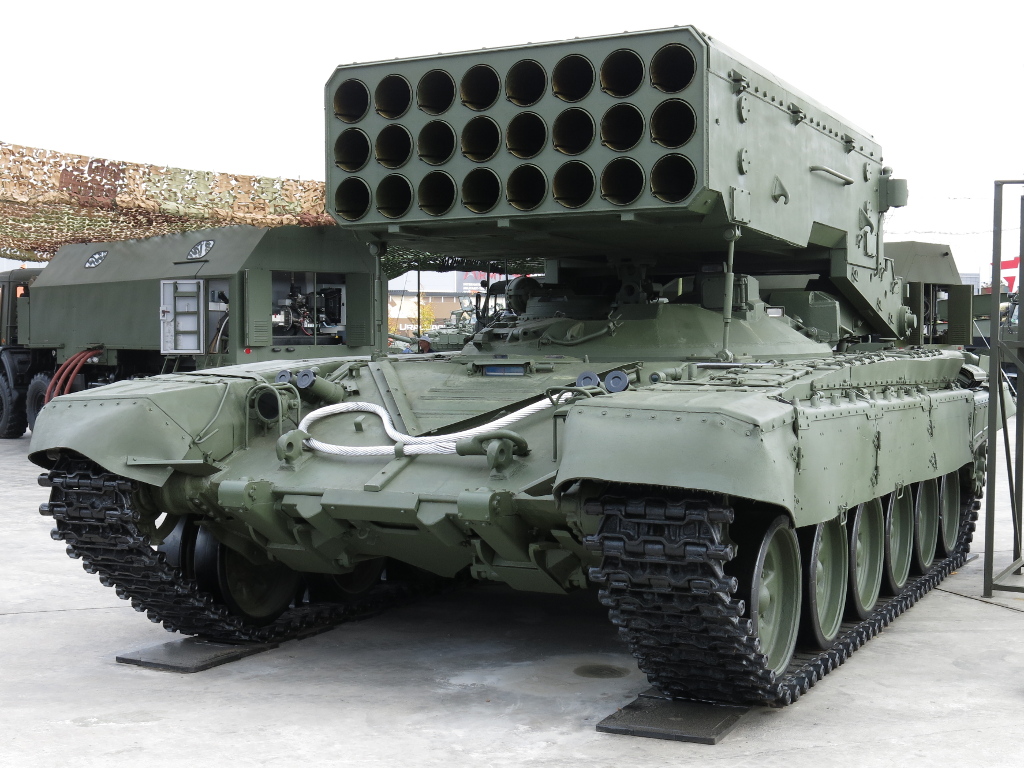
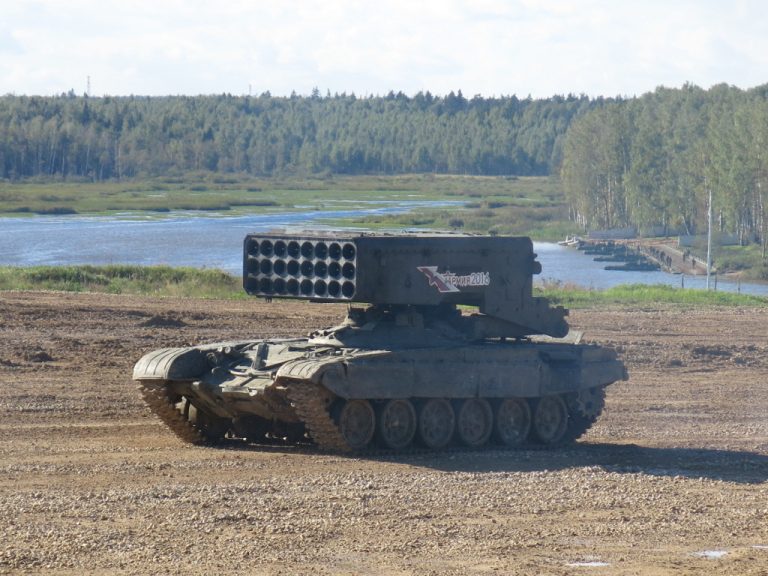
The TOS-1A is a Russian heavy flamethrower system that fires 220mm thermobaric rockets from a 24-tube launcher mounted on a T-72 tank chassis, with a manufacturer-claimed range of about 6 kilometers. Despite the historical “flamethrower” label, it is in practice a short-range rocket artillery system built to destroy fortifications, trench lines and buildings with blast and overpressure rather than flame.
What is the TOS-1A
The TOS-1A Solntsepyok, or “blazing sun,” is the modernized version of the Soviet TOS-1 Buratino developed at Omsktransmash in the late Cold War. Russia classes it as a “heavy flamethrower system” and assigns it to radiological, chemical and biological defense troops rather than conventional artillery, a doctrinal quirk dating to the flamethrower units it replaced. The system entered Russian service in the early 2000s and became one of the country’s more marketable export products.
Unlike long-range multiple rocket launchers, the TOS-1A is meant to work close to the forward edge, which is why its launcher rides on an armored tank hull instead of a truck. A complete set includes the BM-1 launch vehicle and TZM-T reload vehicles, also on T-72 chassis, each carrying spare rockets and a crane.
TOS-1A specifications
| Specification | Value |
|---|---|
| Role | Heavy flamethrower system (short-range thermobaric rocket artillery) |
| Chassis | Modified T-72 main battle tank hull |
| Combat weight | About 46 tons |
| Crew | 3 |
| Launcher | 24 tubes, 220mm |
| Rocket types | Thermobaric and incendiary unguided rockets |
| Range | Roughly 0.6 to 6 km; improved rockets reportedly up to ~10 km (manufacturer claims) |
| Salvo time | Full 24-rocket ripple in under 12 seconds, per Russian sources |
| Reload | TZM-T transloader vehicle with crane, two per launcher typical |
How thermobaric rockets work
A thermobaric, or fuel-air, warhead disperses a fuel mixture into the surrounding air and then ignites it, producing a longer-duration blast wave and intense overpressure that flows into trenches, bunkers and buildings. Against protected infantry the effect is far deadlier than an equivalent weight of conventional high explosive, which is the entire logic of the TOS family, a short-range weapon whose ammunition compensates for its limited reach.
The same physics also make the weapon controversial. Human rights organizations have repeatedly criticized thermobaric use near civilians, and the TOS-1A’s area-effect nature leaves little room for precision. It remains legal under the laws of armed conflict when directed at military targets, and Russia has shown no hesitation in employing it.
TOS-1A variants, TOS-1 to TOS-2
The original TOS-1 Buratino of the 1980s carried 30 tubes and shorter-range rockets, reportedly reaching only about 3.5 kilometers. The TOS-1A of 2001 cut the tube count to 24 but introduced longer rockets and improved fire control. The newest member, the TOS-2 Tosochka, moves the launcher to a 6×6 truck, drops the reload crane requirement and, according to Russian state media, fires improved rockets to greater ranges, trading armor for mobility in a drone-saturated battlefield. A navalized or export-modified variant has been marketed at arms shows, but the tracked TOS-1A remains the most widely fielded version.
Which countries use the TOS-1A
| Country | Status |
|---|---|
| Russia | Primary operator, TOS-1, TOS-1A and TOS-2 in service |
| Iraq | Delivered from 2014, used against ISIS |
| Azerbaijan | Operated since the 2010s, used in the 2020 Karabakh war |
| Algeria | Reported operator via Russian export contracts |
| Kazakhstan | Operates a small number |
| Armenia | Reported operator |
| Saudi Arabia | Ordered per Russian statements; delivery status unclear |
| Syria | Russian systems observed in use during the civil war |
TOS-1A combat record
The TOS family has seen combat from Afghanistan in the late 1980s through Chechnya, Iraq, Syria, Nagorno-Karabakh and Ukraine. In Ukraine both the system’s power and its weaknesses have been on display. Ukrainian forces have destroyed or captured a number of TOS-1A vehicles, since its short range forces it within reach of artillery and FPV drones, the same pressure that has reshaped tactics for systems like the Iskander at the opposite end of the range spectrum. Russian channels routinely publish TOS strike footage, while Ukrainian units prize captured examples; specific claims of effect from either side are operator-reported and hard to verify.
Short-range air defense has also struggled to protect it, a task that falls to escorting systems such as Tor and Pantsir, both stretched thin along the front.
TOS-1A frequently asked questions
Is the TOS-1A a flamethrower?
Not literally. The name is a Russian doctrinal holdover; it fires 220mm thermobaric and incendiary rockets rather than projecting flame.
What is the range of the TOS-1A?
Roughly 6 kilometers with standard rockets, per manufacturer claims, with improved rockets reportedly reaching about 10 kilometers.
Are thermobaric weapons legal?
They are not banned as a class. Their use against military targets is lawful, though employment near civilians draws strong criticism under the rules on indiscriminate attacks.
How many rockets does a TOS-1A carry?
24 tubes of 220mm rockets, which can ripple-fire in under 12 seconds according to Russian sources.
Has the TOS-1A been destroyed in Ukraine?
Yes. Multiple losses to artillery and drones have been visually documented, and Ukraine has captured and reused several vehicles.
- Wikipedia – TOS-1 (accessed October 2026)
- SIPRI Arms Transfers Database
- Rostec and Russian state media statements (manufacturer claims noted)
- Open-source loss documentation from the war in Ukraine