
Navantia Company Profile, Products, Employees and Revenue

Navantia is the Spanish state-owned naval shipbuilder, headquartered in Madrid, that designs and builds frigates, submarines, amphibious ships and offshore wind structures for the Spanish Navy and export customers. In 2025 the group reported revenue of about €1.98 billion and 6,761 employees.
Navantia is owned by SEPI, the Spanish state industrial holding, and works from shipyards in Ferrol, Fene, Cádiz and Cartagena in Spain plus four yards in the United Kingdom acquired from Harland & Wolff in January 2025. Its order backlog reached €12.826 billion at the end of 2025, according to defensa.com, and its best-known programmes are the F-100 and F-110 frigates, the S-80 Plus submarines and the Juan Carlos I amphibious ship.
What Does Navantia Do?
Navantia designs, builds, repairs and supports naval vessels, and supplies combat management systems and other naval technology. Its customer base is led by the Spanish Navy, but it has also built ships for Australia, Norway and Saudi Arabia. The company also sells offshore wind foundations, and it does repair and in-service support work for the Spanish Navy and the US Navy, according to its 2025 results as reported by defensa.com.
| Item | Detail |
|---|---|
| Headquarters | Madrid, Spain |
| Established | 2005, from the military assets of the IZAR group |
| Owner | SEPI (Spanish state industrial holding) |
| Employees | 6,761 in the group, of which 5,113 in the parent company (end of 2025) |
| Revenue | €1,978 million consolidated; €1,728.5 million parent company (2025) |
| Net result | −€149 million consolidated; −€119 million parent company (2025) |
| Order backlog | €12,826 million (end of 2025) |
| President | Ricardo Domínguez García-Baquero |
| Main sites | Ferrol, Fene, Cádiz, Cartagena; UK: Belfast, Appledore, Methil, Arnish |
How Many Employees Does Navantia Have?
The Navantia group had 6,761 employees at the end of 2025, and 5,113 of them worked for the Spanish parent company, according to defensa.com. The gap is mostly the international subsidiaries, which now include the four UK yards taken over in 2025. Navantia also reported that its activity generated 29,435 direct, indirect and induced jobs in Spain that year.
Navantia Revenue and Financial Results
Consolidated revenue rose 30% to €1,978 million in 2025, and the parent company reported €1,728.5 million, up 23%. The group still lost money. The consolidated result was −€149 million, against −€121 million in 2024, which the company attributed to its international subsidiaries, mainly in the UK, in the first year of integrating the acquired assets. The parent company lost €119 million, an improvement of 9.6%.
| Metric | 2024 | 2025 |
|---|---|---|
| Consolidated revenue | — | €1,978 million |
| Consolidated result | −€121 million | −€149 million |
| Order backlog | €8,163 million | €12,826 million |
| New orders signed | — | €6,627 million |
The company said it expects revenue of around €3 billion in 2027 and profitability in that year. That is a company forecast, not a result.
What Are Navantia’s Main Products?
| Programme | Type | Notes |
|---|---|---|
| F-100 Álvaro de Bazán class | Air-defence frigate | Five ships in Spanish service, commissioned 2002 to 2012; AN/SPY-1D radar and 48-cell Mk 41 launcher |
| F-110 class | Frigate | Five Flight I ships planned for Spain, three under construction; two Flight II ships also planned |
| S-80 Plus class | Submarine | Four boats; S-81 Isaac Peral commissioned 30 November 2023; bioethanol air-independent propulsion |
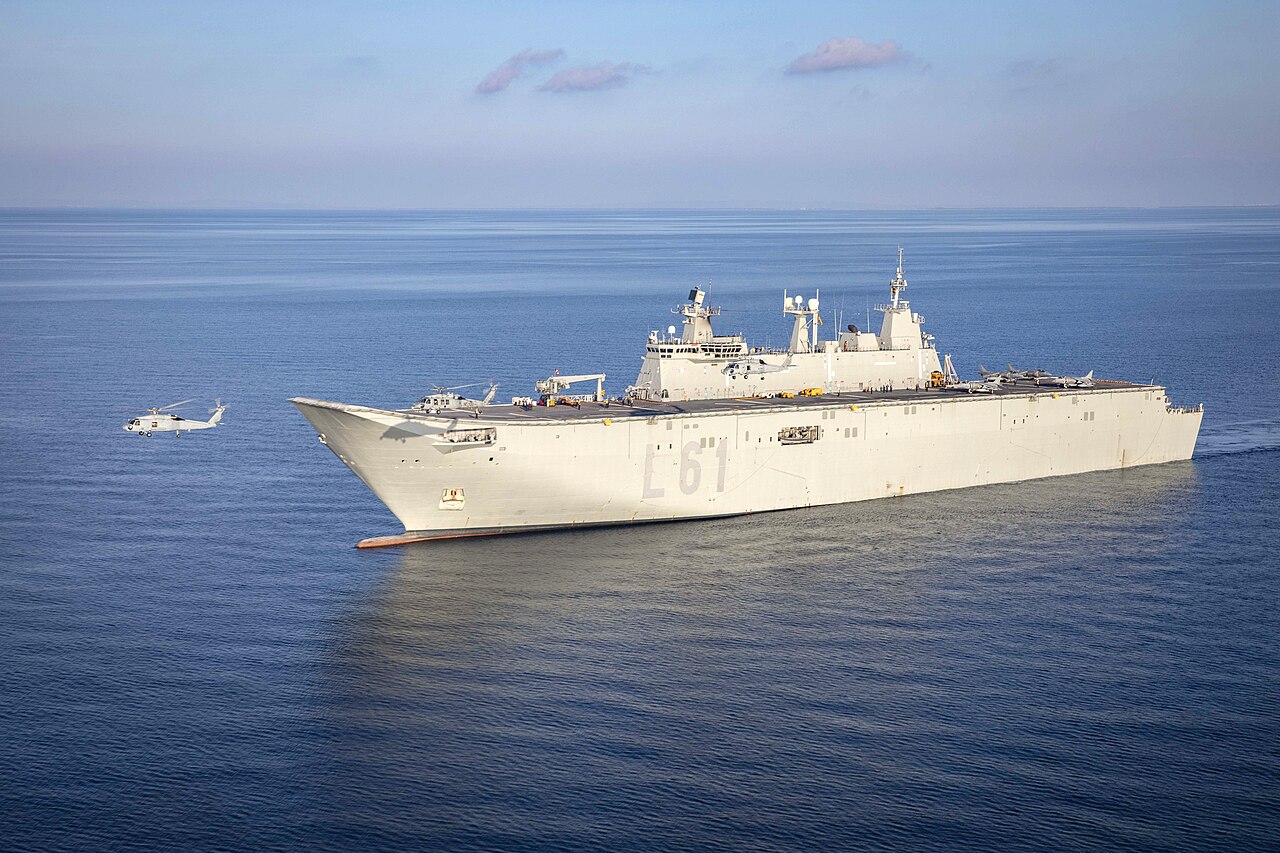
| Juan Carlos I (L-61) | Amphibious assault ship | 26,000 tonnes, 230.8 m; commissioned 30 September 2010; cost €462 million |
| Hobart class | Destroyer (Australia) | Three ships based on the F-100 design; commissioned 2017 to 2020 |
| Canberra class | Amphibious assault ship (Australia) | Two ships based on Juan Carlos I; built under licence by BAE Systems Australia |
| Al Jubail class | Corvette (Saudi Arabia) | Avante 2200 design built at Cádiz; agreement worth about €2 billion signed July 2018 |
| Offshore wind | Foundations and structures | Marketed through Navantia Seanergies |
The F-110 is the newest surface programme. Navantia is offering a 64-cell Flight II version for air and missile defence, as described in the F-110 Flight II report. The S-80 Plus is Spain’s first submarine designed and built entirely at home, and the second boat is covered in the S-82 Narciso Monturiol trials report.
Who Owns Navantia and Which Countries Buy From It?
SEPI, the Spanish state industrial holding, owns 100% of Navantia, according to Wikipedia. Spain’s Ministry of Defence is the largest customer. Abroad, Australia bought the Hobart-class destroyers and the Canberra-class amphibious ships, both based on Navantia designs. Norway received the five Fridtjof Nansen-class frigates, derived from the F-100, and Saudi Arabia is buying Avante-class corvettes. Venezuela received Avante-family patrol vessels earlier.
What Is Navantia’s Harland & Wolff Acquisition?
Navantia UK completed the purchase of Harland & Wolff’s four shipyards in January 2025, after the group’s administration in September 2024 and an announcement on 19 December 2024. The yards are Belfast in Northern Ireland, Appledore in England, and Methil and Arnish in Scotland. The UK Defence Journal reported in February 2026 that Navantia UK is working on a £1.6 billion contract for three Fleet Solid Support ships for the Royal Fleet Auxiliary and running a £115 million investment programme across its UK yards.
Navantia History Timeline
| Year | Event |
|---|---|
| 1947 | Empresa Nacional Bazán is formed |
| 2000 | IZAR is created from the merger of Astilleros Españoles and Bazán |
| 2002 | First F-100 frigate, Álvaro de Bazán, enters service |
| 2005 | Navantia is established as a separate military shipbuilder |
| 2007 | Australia selects the Navantia-based design for its Hobart-class destroyers |
| 2010 | Juan Carlos I is commissioned |
| 2018 | Agreement with Saudi Arabia worth about €2 billion for corvettes |
| 2023 | S-81 Isaac Peral is commissioned on 30 November |
| 2025 | Navantia UK acquires Harland & Wolff’s four yards (January) |
Recent Navantia Developments
Navantia used DALO Industry Days in Denmark on 27 August 2026 to show a model of the F-110 Flight II, as covered in our Flight II report. That ship pairs Navantia’s hull with Lockheed Martin’s AN/SPY-7 radar, which also features in the Japan ASEV Aegis contract, and Navantia lists Kongsberg’s Naval Strike Missile among the planned weapons (see the Kongsberg profile).
On the submarine side, S-82 Narciso Monturiol completed its first dive to maximum operating depth in September 2026, with delivery to the Spanish Navy still planned for the end of the year, per our S-82 report. Spain’s Indra is also developing the SILAEM point-defence system for the fleet, and the integrated version connects to SCOMBA, the combat management system developed by Navantia, as described in the SILAEM report.
Navantia FAQ
What does Navantia do?
Navantia designs and builds warships, submarines and other naval vessels, and also supplies offshore wind structures and ship repair and support services.
Who owns Navantia?
SEPI, the Spanish state industrial holding, owns 100% of Navantia.
Where is Navantia headquartered?
In Madrid, Spain. Its main shipyards are in Ferrol, Fene, Cádiz and Cartagena.
How many employees does Navantia have?
The group had 6,761 employees at the end of 2025, of which 5,113 worked for the Spanish parent company.
What is Navantia’s revenue?
Consolidated revenue was €1,978 million in 2025, up 30% on 2024.
Did Navantia buy Harland & Wolff?
Navantia UK completed the acquisition of Harland & Wolff’s four shipyards in January 2025.
What ships has Navantia built for other countries?
Hobart-class destroyers and Canberra-class amphibious ships for Australia, Fridtjof Nansen-class frigates for Norway and Al Jubail-class corvettes for Saudi Arabia.
What submarines does Navantia build?
The S-80 Plus class for the Spanish Navy, four boats named Isaac Peral, Narciso Monturiol, Cosme García and Mateo García de los Reyes.
- defensa.com – Navantia 2025 results and order backlog (3 July 2026): defensa.com
- UK Defence Journal – Navantia UK targets 500 apprentices (9 February 2026): ukdefencejournal.org.uk
- Navalia – Navantia and Harland & Wolff cooperation (2020): navalia.es
- Wikipedia – Navantia; Harland and Wolff; Hobart-class destroyer; Juan Carlos I; S-80 Plus-class submarine; Álvaro de Bazán-class frigate; Al Jubail-class corvette