Thermobaric Weapons Explained, How They Work and Who Fields Them
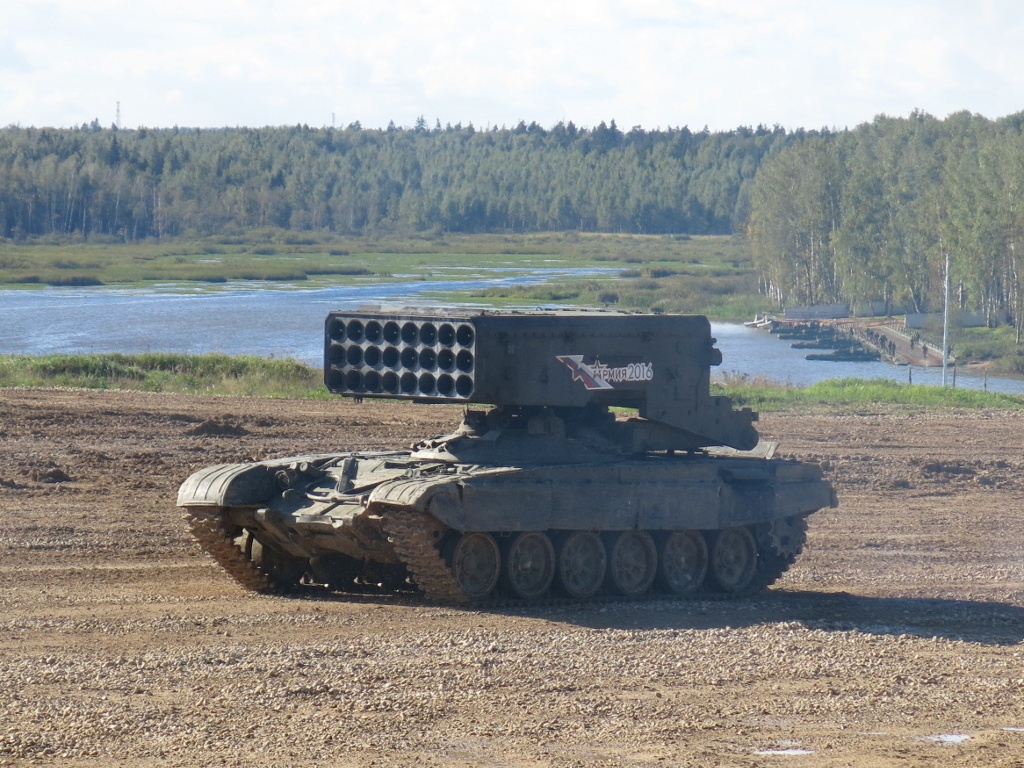
Thermobaric weapons generate a longer, hotter pressure wave than conventional explosives by burning dispersed fuel with the surrounding air, and Russia’s 24-tube TOS-1A is the most heavily used system of the type in service today. Fielded from shoulder-fired rockets to heavy glide bombs, these munitions are neither new nor banned, but their effects in enclosed spaces make them among the most scrutinized weapons in modern war.
How do thermobaric weapons work
A conventional high-explosive warhead carries both fuel and oxidizer in one solid charge and releases its energy in a microsecond spike. A thermobaric charge instead carries fuel rich in metals such as aluminum and draws much of its oxygen from the surrounding air. On detonation, the fuel disperses and burns through the air around the target, producing a lower peak but far longer-lasting blast wave and intense heat.
That sustained overpressure is what makes the type effective against bunkers, caves, trenches and buildings: the pressure wave flows around corners and through openings, and in enclosed spaces the effects are severe for anyone inside. Older two-stage fuel-air explosives work on the same principle with a separate dispersal and ignition sequence, while modern single-charge thermobarics are more compact and reliable.
Thermobaric vs conventional explosives
| Characteristic | Thermobaric | Conventional HE |
|---|---|---|
| Oxygen source | Mostly atmospheric air | Contained oxidizer |
| Blast profile | Lower peak, much longer duration | Sharp, brief peak |
| Thermal effect | Large sustained fireball | Brief flash |
| Best targets | Enclosed spaces, fortifications, personnel | Structures, armor, point targets |
| Limitations | Degraded by wind, rain and thin air; poor against armor | Less effective around corners and in tunnels |
TOS-1A Solntsepyok explained
The TOS-1A, nicknamed Solntsepyok or “scorching sun,” mounts 24 tubes for 220mm thermobaric rockets on a T-72 tank chassis, a pairing that signals its role: it fires from just a few kilometers behind the front, inside artillery range, so it needs armor. Russian industry states a range of about 6 km for the improved rockets, with newer munitions claimed to reach 10 km or more, figures that remain manufacturer claims. Russia classifies it as a “heavy flamethrower system” and assigns it to radiological, chemical and biological defense troops, a doctrinal quirk dating to its Soviet origins.
A wheeled successor, the TOS-2 Tosochka, trades armor for mobility and longer claimed range. At the lighter end of the Russian inventory sit the RPO-A Shmel shoulder-fired rocket and thermobaric warheads for RPG-7 launchers, while ODAB-series aerial bombs, now fitted with glide kits, deliver the largest effects.
Which countries have thermobaric weapons
| Country | Systems |
|---|---|
| Russia | TOS-1A, TOS-2, RPO-A Shmel, TBG-7 rounds, ODAB glide bombs |
| United States | AGM-114N Hellfire, SMAW-NE rocket, BLU-118/B bomb |
| China | PF-97 shoulder-fired system and rocket warheads, per reported data |
| TOS-1A export users | Iraq, Azerbaijan, Armenia, Kazakhstan and Algeria, as reported |
| Others | Various thermobaric grenades and rocket warheads in many arsenals |
The US arsenal illustrates the Western approach: niche munitions for specific targets, such as the AGM-114N metal-augmented-charge Hellfire used against buildings and the BLU-118/B dropped on Afghan cave complexes in 2002, rather than massed launchers. Russia is the only power that built a dedicated armored thermobaric artillery branch.
Thermobaric weapons in Ukraine
TOS-1A use in Ukraine has been extensively documented by open-source investigators since 2022, including in urban assaults such as Mariupol, and Ukraine has captured and reportedly operated at least a handful of the launchers itself. Russian state media credit the system with breaking fortified positions, claims that should be read as such. The launcher’s short range has proved costly: numerous TOS-1As have been destroyed by artillery and loitering munitions, losses that are operator-reported on both sides.
Russia has also scaled up ODAB thermobaric glide bombs delivered by aircraft from standoff range, part of the same glide-bomb campaign that reshaped the front in 2024 and 2025. Against that backdrop, Western militaries have mostly doubled down on precision rather than blast mass, using systems like GMLRS-armed launchers to hit fortifications with accuracy instead of area pressure.
Thermobaric weapons frequently asked questions
What is a thermobaric weapon?
A munition that disperses and burns fuel using atmospheric oxygen, producing a longer-duration blast wave and intense heat, especially effective in enclosed spaces.
Are thermobaric weapons banned?
No treaty specifically bans them. Like all weapons, their use is governed by international humanitarian law, which prohibits indiscriminate attacks on civilians.
What is the range of the TOS-1A?
About 6 km with improved rockets per manufacturer figures, with newer munitions claimed to reach 10 km or more.
Does the US have thermobaric weapons?
Yes, including the AGM-114N Hellfire variant, the SMAW-NE rocket and the BLU-118/B bomb used in Afghanistan in 2002.
Why is the TOS-1A on a tank chassis?
Its short range forces it to fire from near the front line, so it uses a T-72 hull for protection against counter-fire.
- Open-source investigations of TOS-1A employment in Ukraine
- Wikipedia – Thermobaric weapon and TOS-1 (accessed October 2026)
- Russian manufacturer and state media statements (claims noted as such)
- US military munitions data sheets
- Defence & Tech reporting on the Ukraine war