
GaN Radar Technology, the Chip Change Behind New Radars
Gallium nitride is the semiconductor quietly deciding which radars rule the next decade. GaN chips pump out several times the power of the gallium-arsenide parts they replace, run hotter without failing and shrug off radiation, which is why every flagship radar program from Patriot’s new LTAMDS to Gripen’s fighter radar now leads with the three-letter acronym. Here is what GaN actually changes, and what it does not.
What is GaN and why radar cares
Gallium nitride is a wide-bandgap semiconductor: its 3.4 electron-volt bandgap, versus 1.4 for gallium arsenide and 1.1 for silicon, means its transistors switch more voltage, tolerate more heat and waste less energy. In a radar’s transmit/receive module those properties convert directly into transmitted watts. An AESA radar is thousands of small transmitters; make each one several times stronger at the same size and the whole array sees farther, or shrinks, or both.
GaN vs GaAs vs silicon
| Property | Silicon | GaAs | GaN |
|---|---|---|---|
| Bandgap | 1.1 eV | 1.4 eV | 3.4 eV |
| Power density | Low | Moderate | High, several times GaAs |
| Heat tolerance | Degrades ~150 C | Moderate | Operates toward ~400 C |
| Radiation hardness | Poor-moderate | Good | Very good, suits space |
| Radar role | Processing, not RF power | 1990s-2000s AESA modules | Current-generation modules |
What GaN changes in a real radar
Three practical wins. Range: more watts per module pushes detection envelopes out, the headline behind claims like Erieye ER’s 70 percent improvement. Cooling and size: higher efficiency and heat tolerance ease the thermal design that actually limits arrays, letting the same performance fit a smaller antenna, which is how GaN radars reached fighter noses, artillery-locating trucks and even missile seekers. Reliability and growth: modules loafing below their limits fail rarely and leave headroom for software-defined upgrades. What GaN does not change: physics of the horizon, clutter, stealth geometry, or the price of the exquisite packaging around the chips.
Where GaN is already fielded
| System | Domain | Note |
|---|---|---|
| Thales Ground Master 400 | Ground surveillance | Early adopter; tens of thousands of GaN transmitters in service by 2021 |
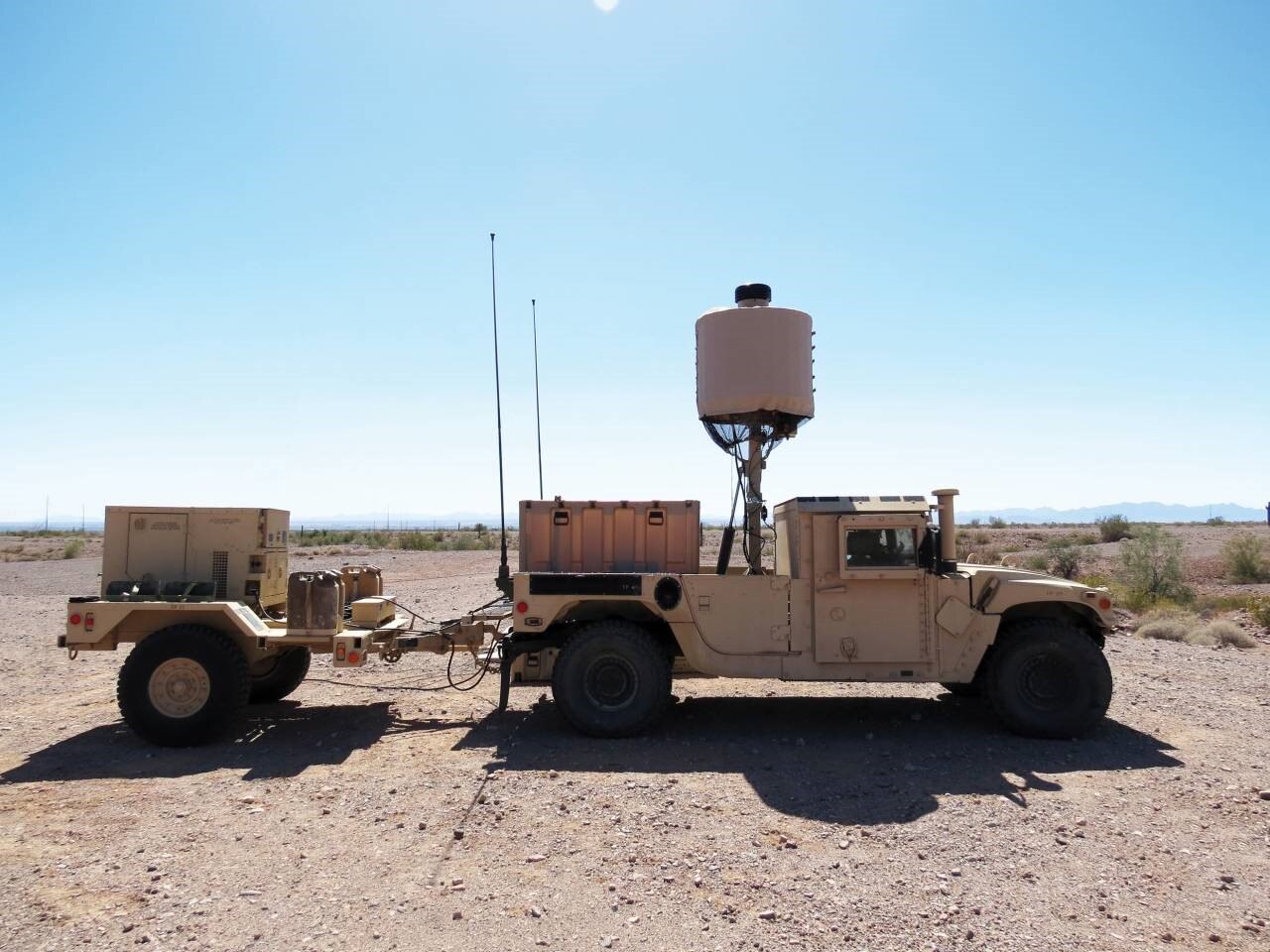
| Lockheed Martin AN/TPQ-53 | Counter-fire / counter-drone | US Army’s fielded GaN conversion |
| Saab ES-05 Raven (Gripen E) | Fighter | GaN AESA in service from 2020s deliveries |
| Patriot LTAMDS / GhostEye | Air and missile defense | 360-degree GaN replacement for Patriot’s radar |
| Erieye ER (GlobalEye) | AEW&C | GaN behind the extended-range claim |
| Hensoldt TRML-4D | Air defense (IRIS-T SLM) | GaN AESA proven over Ukraine with IRIS-T SLM |
The EW and comms spillover
Radar is only the loudest customer. The same GaN amplifiers power modern jammers, whose game is watts-per-kilogram in a pod, high-bandwidth military datalinks and satellite terminals, and the counter-drone microwave weapons now entering tests. That overlap is why GaN shows up in electronic-warfare budget lines as often as radar ones, and why analysts track foundry capacity as an arms-race metric: the chip that lets a fighter see farther is the same chip that lets its escort shout louder than the defender’s receiver can bear. The directed-energy trials the Pentagon is running lean on the identical supply chain.
Manufacturing, the hard part
GaN’s bottleneck is industrial, not conceptual. Military-grade parts are mostly GaN grown on silicon-carbide substrates, a supply chain of a handful of trusted foundries, capacity contested by 5G, power electronics and EV demand, and wrapped in export controls because the same amplifiers serve radar and jamming alike. That scarcity is strategy: national programs in the US, Europe, China, India, with its GaN-based Virupaaksha fighter radar, and elsewhere fund domestic GaN lines precisely because whoever owns the modules owns the sensor roadmap. For buyers the practical takeaway is simple: in 2026 a new radar without GaN inside is a radar bought a generation late.
Frequently asked questions
What does GaN stand for in radar?
Gallium nitride, the wide-bandgap semiconductor used in modern transmit/receive modules of AESA radars.
Why is GaN better than GaAs?
Several times the power density, far higher heat tolerance and better efficiency, which translate into longer radar range or smaller antennas.
Which radars use GaN today?
Patriot’s LTAMDS, Saab’s Gripen E radar and Erieye ER, Thales GM400, Lockheed’s TPQ-53 and Hensoldt’s TRML-4D, among many.
Does GaN help against stealth?
Indirectly: more power and sensitivity improve detection margins, but GaN does not repeal stealth shaping physics.
Why is GaN export controlled?
High-power RF amplifiers are dual-use for radar, jamming and communications, and fabrication capacity is strategically scarce.
- Wikipedia – Gallium nitride (accessed October 2026)
- Program documentation for LTAMDS, GM400, TPQ-53, ES-05 and TRML-4D
- Defence & Tech AESA and air defense coverage