M7 Rifle Explained: The US Army’s New 6.8mm Service Rifle, Specs and Controversy
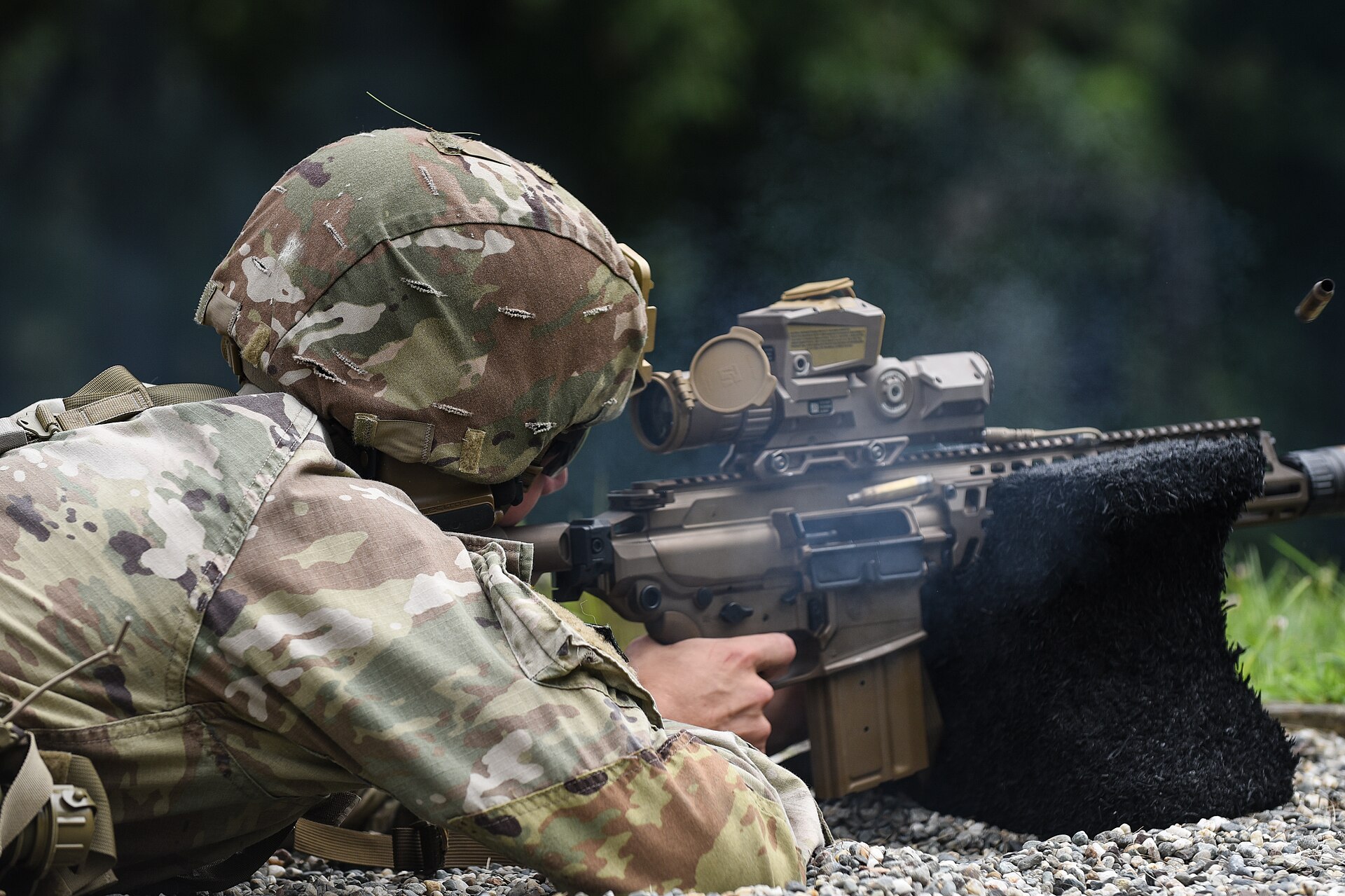

For more than three decades, American infantry have gone to war with 5.56mm rifles: first the M16, then the M4 carbine. That is changing. The US Army is fielding the M7, a heavier-hitting 6.8mm rifle from SIG Sauer, to its close combat troops. Supporters say it restores overmatch against modern body armour. Critics say it is too heavy and carries too little ammunition.
- Winner of the Next Generation Squad Weapon (NGSW) competition in April 2022
- Made by SIG Sauer; developed as the XM7, now designated M7
- Fires the 6.8x51mm Common Cartridge with a hybrid steel-brass case
- Fitted with a suppressor and the XM157 computerised fire control optic
- Intended for about 100,000 close combat soldiers, alongside the M250 automatic rifle
Why the Army wanted a new rifle
The 5.56mm round was chosen in the 1960s for light weight and controllable recoil. But Army studies found that it struggles at longer ranges and against modern ceramic body armour issued by peer adversaries such as China and Russia. The Next Generation Squad Weapon programme set out to give infantry a rifle and machine gun that could defeat that armour at distance.
The 6.8mm cartridge
The heart of the system is its ammunition. The 6.8x51mm round uses a hybrid case with a steel base and brass body, allowing chamber pressures of around 80,000 psi, far higher than conventional rifle rounds. The result is higher velocity and more energy on target, which the Army says improves penetration of protected targets at several hundred metres.
Specifications
The M7 is based on SIG’s MCX Spear design. It uses a short-stroke gas piston, a folding stock and 20-round magazines. Unloaded, it weighs roughly 3.8 kg (8.4 lb) before the suppressor and optic are added, noticeably more than an M4. Every rifle comes with a suppressor to reduce noise, flash and signature. The XM157 fire control, built by Vortex, combines a variable-power optic with a laser rangefinder, ballistic calculator and digital display.
Fielding
The first units, starting with the 101st Airborne Division, began receiving the rifle in 2024. The plan is to equip close combat formations such as infantry, Rangers, Special Forces, combat engineers and scouts, while support troops keep the M4.
The controversy
Critics point to three issues: weight, magazine capacity and recoil. A soldier with an M7, optic and seven 20-round magazines carries more weight but fewer rounds than one with an M4 and 30-round magazines. Some also question whether the 80,000 psi cartridge will wear barrels faster. Budget pressure has added to the debate, and the Army has signalled that the pace of purchases may change.
Verdict
The M7 is the biggest change to the American infantry rifle since the 1960s. It trades capacity and weight for range and armour penetration, a bet on high-intensity war against well-equipped opponents. Whether that trade pays off will be decided by soldiers in training and, eventually, in combat.
Featured image: Sgt. 1st Class Terra C. Gatti / Public domain, via Wikimedia Commons