Top 10 Best Combat Drones in the World in 2026
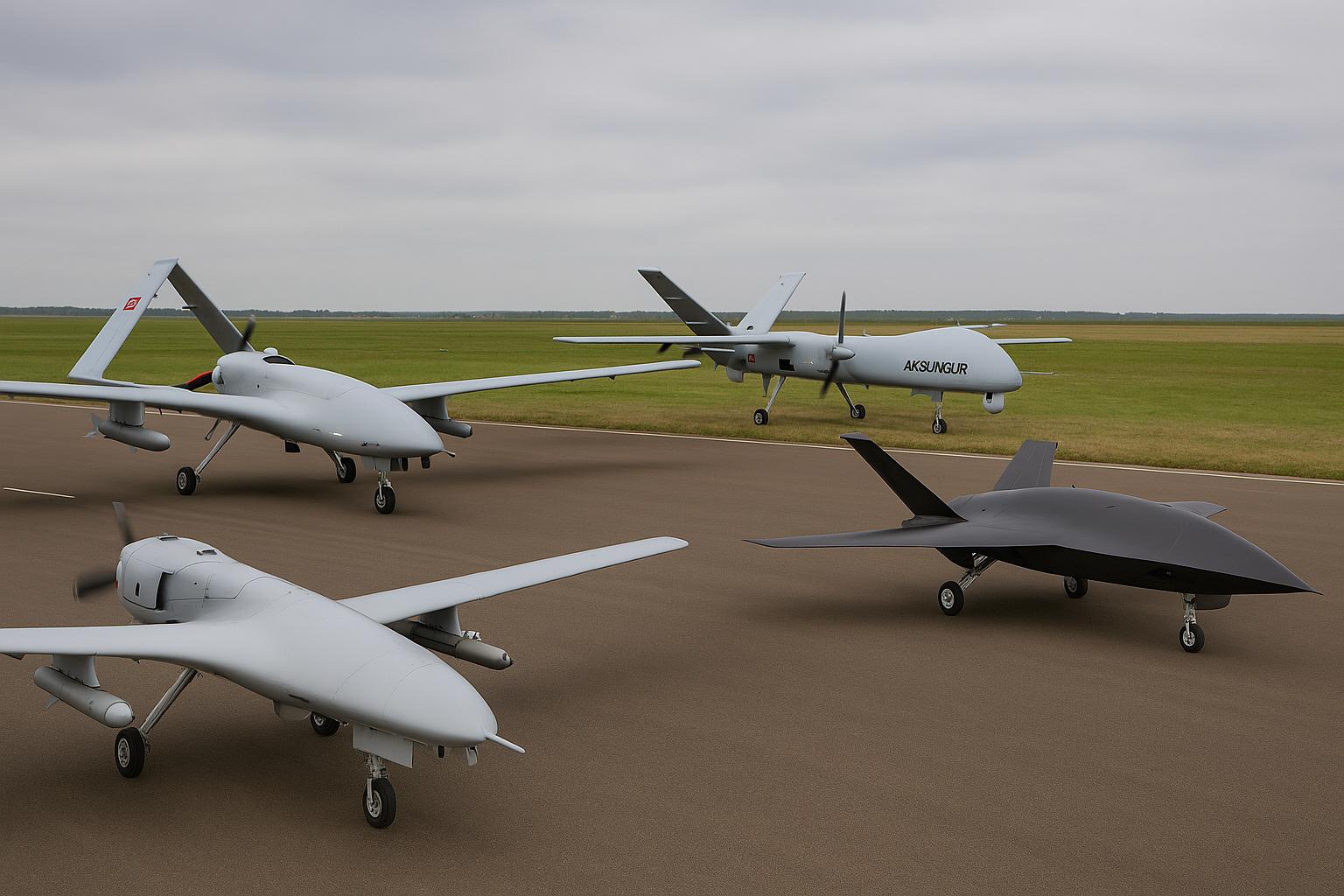
The best combat drones in 2026 include the Bayraktar AKINCI and the General Atomics MQ-9 Reaper at the top of the field, followed by the AKSUNGUR, Wing Loong II, CH-5 Rainbow, Heron TP, Bayraktar TB2, ANKA-S, MQ-1C Gray Eagle and Mojave STOL. This ranking scores each system on payload, endurance, sensor suite, weapon integration, operational maturity, export success, range/SATCOM capability and cost-effectiveness. Full methodology, technical data, sources and images for every platform are below.
Methodology
This ranking evaluates 11 combat-capable unmanned aerial systems currently in production or active service. Each candidate is scored out of 100 across eight weighted criteria. “Best” here means highest weighted score, not superiority on every single metric — a lower-ranked system can still lead the field in one category (e.g. altitude, endurance, or cost). Those trade-offs are called out explicitly in each profile.
| Criterion | Weight |
|---|---|
| Payload | 15 |
| Endurance | 15 |
| Sensor suite | 15 |
| Weapon integration | 15 |
| Operational maturity | 10 |
| Export success | 10 |
| Range / SATCOM | 10 |
| Cost-effectiveness | 10 |
Candidate pool evaluated: Bayraktar AKINCI, MQ-9 Reaper, AKSUNGUR, Wing Loong II, CH-5 Rainbow, Heron TP (Eitan), Bayraktar TB2, ANKA-S, MQ-1C Gray Eagle, Mojave STOL, Kronshtadt Orion. The lowest-scoring candidate (Orion) is covered as an honorable mention below the main ten. This pool will be expanded in future updates.
Quick Comparison
| Rank | System | Country | Main role | Key advantage |
|---|---|---|---|---|
| 1 | Bayraktar AKINCI | Turkey | Heavy strike / HALE UCAV | Best balance of payload, weapon diversity and cost |
| 2 | MQ-9 Reaper | USA | Hunter-killer MALE UAV | Longest combat pedigree, highest service ceiling |
| 3 | AKSUNGUR | Turkey | Heavy MALE / maritime patrol | Longest endurance among Turkish systems (up to 50h) |
| 4 | Wing Loong II | China | Export MALE UCAV | Broadest export footprint of any Chinese UCAV |
| 5 | CH-5 Rainbow | China | Heavy strike UAV | Largest claimed payload and ferry range in class |
| 6 | Heron TP (Eitan) | Israel | Strategic ISR / HALE | Top-tier sensor suite and altitude ceiling |
| 7 | Bayraktar TB2 | Turkey | Tactical MALE UCAV | Most combat-proven and most exported armed drone |
| 8 | ANKA-S | Turkey | National MALE UCAV | First Turkish UAV cleared for air-to-air missiles |
| 9 | MQ-1C Gray Eagle | USA | Army MALE UCAV | Improved variant reaches 45–50h endurance |
| 10 | Mojave STOL | USA | Expeditionary STOL UCAV | Operates from austere strips and ships, no catapult |
#1 — Bayraktar AKINCI
Country: Turkey | Manufacturer: Baykar | Type: Heavy strike / HALE UCAV | First flight: 2019 | Status: In serial production, combat-proven, in service with Turkish Armed Forces and multiple export customers

| Feature | Data |
|---|---|
| MTOW | 6,000 kg |
| Payload | 1,500 kg |
| Endurance | 24+ hours |
| Maximum altitude | ~40,000 ft |
| Cruise / max speed | 150 / 240 KTAS |
| Range | ~6,000 km |
| Engine | Twin turboprop/turbofan configuration |
| Sensors | Electro-optical/infrared turret, synthetic aperture radar, optional AESA radar |
| Weapons | MAM-series smart micro-munitions, KGK-series guided bombs, SOM-A cruise missile, Gökdoğan/Bozdoğan air-to-air missiles |
Why it ranks here: AKINCI combines the payload class of a heavy MALE/HALE platform with a weapons menu that spans precision-guided bombs, stand-off cruise missiles and air-to-air missiles — a combination few competitors in this list match. It has been combat-employed since 2021 and is now in serial production for both the Turkish Armed Forces and a growing export customer base, which pushes its operational-maturity and export scores well above most rivals its size.
Its cost-effectiveness score benefits from Turkey’s vertically integrated munitions ecosystem (MAM-series weapons are also produced domestically), which lowers total ownership cost relative to Western systems using imported precision munitions.
Main advantages: Wide weapon diversity including a cruise missile and air-to-air missiles; strong domestic sensor and radar suite; rapid export ramp-up since 2022.
Limitations: Lower service ceiling (~40,000 ft) than the MQ-9 Reaper (50,000 ft); shorter combat track record than the Reaper, which has been in service since 2007.
Operators: Turkey (TSK, MİT); export customers/agreements reported with Azerbaijan, Turkmenistan, Kazakhstan, Kuwait, Saudi Arabia, Algeria, Ethiopia, Somalia and others at varying contract stages.
Estimated price / contract context: Unit price not officially disclosed; total system/contract value depends heavily on munitions package, ground control stations and training — treat any single “per aircraft” figure in the press with caution.
Image sourcing: Baykar official press kit (bayraktar-akinci page) or Wikimedia Commons — Category:Bayraktar Akıncı, example file: Baykar_Akinci.jpg. Alt text: “Bayraktar AKINCI UCAV on the runway.” Verify license terms on the individual file page before use.
Sources: Airforce Technology, Wikipedia, Army Recognition.
For a deeper look at the Turkish UCAV ecosystem and AKINCI’s export customers, see Envanter Medya’s detailed AKINCI profile.
#2 — MQ-9 Reaper
Country: United States | Manufacturer: General Atomics Aeronautical Systems | Type: Hunter-killer MALE UAV | First flight: 2001 | Status: Fully operational since 2007, in service with the US Air Force, US Navy, and multiple NATO air forces

| Feature | Data |
|---|---|
| Payload | 1,746 kg total (up to 1,361 kg external stores) |
| Endurance | 27 hours (up to 34 hours on the Extended Range variant) |
| Maximum altitude | 50,000 ft |
| Speed | 240 KTAS |
| Mission radius | ~1,200 nautical miles (BLOS via SATCOM extends further) |
| Sensors | Multi-spectral targeting system (MTS-B), synthetic aperture radar, signals intelligence options |
| Weapons | AGM-114 Hellfire, GBU-12/38 precision-guided bombs, AIM-9X Sidewinder (air-to-air integration) |
Why it ranks here: The Reaper has the longest combat record of any system on this list — in continuous operational use since 2007 — and the highest service ceiling, which gives it a survivability and sensor-standoff edge AKINCI cannot yet match. Its sensor suite (MTS-B and associated targeting pods) is widely regarded as best-in-class for this aircraft category, refined over nearly two decades of real-world strike missions.
It loses ground mainly on cost-effectiveness: unit and sustainment costs are significantly higher than Turkish or Chinese competitors, and export is restricted to close US allies under arms-control rules, which caps its export-success score relative to more freely exported systems.
Main advantages: Highest altitude ceiling in this list; unmatched combat hours and sensor maturity; extensive integration with NATO munitions and data links.
Limitations: High acquisition and sustainment cost; export tightly controlled, limiting its footprint compared with Turkish and Chinese systems.
Operators: United States (USAF, USN), United Kingdom, France, Italy, Spain, the Netherlands, Belgium, and other allied air forces.
Estimated price / contract context: Program and unit costs vary widely by contract, ground control stations, and support package; General Atomics does not publish a standard per-unit price, so headline figures reported in the press should be treated as package estimates, not aircraft-only prices.
Image sourcing: General Atomics press kit or Wikimedia Commons — Category:General Atomics MQ-9 Reaper, example file: MQ-9_Reaper_taxis.jpg. Alt text: “MQ-9 Reaper taxiing before a mission.”
Sources: General Atomics official MQ-9A page, Wikipedia.
#3 — AKSUNGUR
Country: Turkey | Manufacturer: Turkish Aerospace Industries (TAI/TUSAŞ) | Type: Heavy MALE UCAV / maritime patrol | First flight: 2019 | Status: In service with Turkish Naval and Air Forces, including an anti-submarine warfare variant
.jpg)
| Feature | Data |
|---|---|
| Length / wingspan | 12.5 m / 24.2 m |
| MTOW | 3,300 kg |
| Payload | 750+ kg (up to 12 munitions across six stations) |
| Endurance | Up to 50 hours (design maximum); 28-hour flight demonstrated fully loaded at 20,000 ft |
| Maximum altitude | 40,000 ft |
| Engine | Twin PD-170 turbocharged diesel engines (170 hp each) |
| Weapons | MAM-series smart micro-munitions, up to 12 munitions simultaneously |
Why it ranks here: AKSUNGUR’s twin diesel-engine layout gives it the longest endurance of any Turkish system in this ranking and strong fuel efficiency, which supports both long-range strike and maritime patrol/ASW roles. Its six-station weapons layout lets it carry a larger simultaneous munitions load than AKINCI on some mission profiles.
It scores lower than AKINCI and Reaper mainly on export success (still nascent) and sensor sophistication relative to AKINCI’s radar options.
Main advantages: Longest endurance in the Turkish UCAV family; efficient diesel powerplant; dual-role strike/ASW capability.
Limitations: Export program still early-stage compared with TB2 and AKINCI; payload below AKINCI’s 1,500 kg ceiling.
Operators: Turkey (Turkish Naval Forces, Turkish Air Force).
Estimated price / contract context: Not publicly disclosed.
Image sourcing: TAI/TUSAŞ official press materials; verify licensing before use in absence of a dedicated Wikimedia Commons category. Alt text: “AKSUNGUR UCAV on a maritime patrol mission.”
Sources: Naval Technology, Army Recognition.
Envanter Medya covers AKSUNGUR delivery numbers and naval deployment in detail — see their AKSUNGUR deliveries overview.
#4 — Wing Loong II
Country: China | Manufacturer: Chengdu Aircraft Industry Group (CAIG/AVIC) | Type: Export MALE UCAV | First flight: 2016 | Status: In production and combat use across multiple export operators

| Feature | Data |
|---|---|
| MTOW | 4,200 kg |
| Payload | ~400 kg internal, up to 480 kg across six hardpoints |
| Endurance | 32 hours |
| Maximum altitude | 9,000 m (29,527 ft) |
| Speed | Up to 370 km/h |
| Range / radius | Reported operational radius ~1,500 km |
| Weapons | Blue Arrow-series precision-guided missiles and bombs |
Why it ranks here: Wing Loong II has the broadest export footprint of any Chinese UCAV, in service or combat use across the Middle East and Africa, which drives strong export and operational-maturity scores. Its 32-hour endurance is competitive with much larger platforms.
Its payload and sensor suite are modest next to AKINCI or the Reaper, and independent, non-manufacturer verification of avionics performance is more limited than for Western or Turkish systems — a transparency gap reflected in its sensor score.
Main advantages: Long endurance for its weight class; low reported unit cost; wide export customer base.
Limitations: Payload roughly a third of AKINCI’s; sensor and avionics performance data rely heavily on manufacturer claims rather than independent verification.
Operators: Reported operators/customers include Pakistan, Saudi Arabia, the UAE, Egypt, and others across the Middle East and Africa.
Estimated price / contract context: Not officially disclosed; third-party estimates vary widely and should be treated as unverified.
Image sourcing: Wikimedia Commons — Category:Chengdu Wing Loong, example file: Wing_Loong_II_fron_view.jpg. Alt text: “Wing Loong II UCAV displayed at an airshow.”
Sources: Army Recognition, Wikipedia.
#5 — CH-5 Rainbow
Country: China | Manufacturer: China Aerospace Science and Technology Corporation (CASC) | Type: Heavy strike UAV | First flight: 2015 | Status: In production and export service

| Feature | Data |
|---|---|
| Wingspan | 21 m |
| MTOW | Over 3,000 kg |
| Payload | Manufacturer claims up to 1,000–1,200 kg (export brochure figures for CH-5A/B are more conservative) |
| Endurance | Manufacturer claims up to 60 hours |
| Range | Manufacturer claims up to 10,000 km ferry range |
| Maximum altitude | ~9,000 m |
| Weapons | Manufacturer claims up to 16 munitions across multiple hardpoints |
Why it ranks here: On paper, CH-5’s payload and range figures are among the largest of any system in this list, which gives it a strong theoretical score on those two criteria. It ranks below Wing Loong II overall because its performance claims are less independently verified — publicly available reporting notes that CASC’s own export specification sheets for the CH-5A/B variants are notably more conservative than the figures cited in Chinese state media.
Main advantages: Large claimed payload and range; substantial weapons-carriage claims.
Limitations: Headline specifications not independently verified and vary significantly between sources; export track record and sensor transparency lag behind Wing Loong II.
Operators: Reported export customers in the Middle East and Africa; specific operator list not comprehensively confirmed in open sources.
Estimated price / contract context: Not publicly disclosed.
Image sourcing: Verify against CASC official materials or licensed Wikimedia Commons files before publishing; no dedicated Commons category confirmed at time of writing. Alt text: “CH-5 Rainbow UAV on static display.”
Sources: The Diplomat, Wikipedia.
— Heron TP (Eitan)
Country: Israel | Manufacturer: Israel Aerospace Industries (IAI) | Type: Strategic ISR / HALE UAV | First flight: 2006 | Status: Operational with the Israeli Air Force; leased to Germany (as “Heron TP”) and other operators

| Feature | Data |
|---|---|
| Wingspan | 26 m |
| Payload | ~1,000 kg mission equipment (higher figures reported for some configurations) |
| Endurance | 30+ hours published; longer figures reported in some trade press |
| Maximum altitude | 50,000 ft |
| Engine | PT6A-67A turboprop, 1,200 hp |
| Weapons | Not officially confirmed by IAI for the export “Heron TP” configuration; primarily marketed as a surveillance platform |
Why it ranks here: Heron TP has an exceptional sensor suite and one of the highest service ceilings on this list, reflecting Israel’s deep ISR expertise. It ranks below the top five mainly because its weapon-integration score is capped: IAI markets it primarily as a multi-mission surveillance aircraft, and armed use is not officially confirmed for export configurations — a meaningful gap against dedicated strike platforms like AKINCI or the Reaper.
Main advantages: High-altitude, long-endurance ISR performance; mature sensor and SATCOM architecture; combat-tested airframe.
Limitations: Weapon integration not officially confirmed for export use; export customer base smaller than Turkish or Chinese competitors; high acquisition cost.
Operators: Israel (IAF); Germany (leased, as part of its UAS program); India (in service in ISR role).
Estimated price / contract context: Not publicly disclosed; German lease-based acquisition model differs from a direct purchase price.
Image sourcing: Wikimedia Commons — Category:IAI Eitan, example file: IAI_Eitan_Heron_TP_220_ILA_2016.jpg. Alt text: “IAI Eitan (Heron TP) on display at ILA Berlin.”
Sources: Aviation Week, Airbus (German Heron TP program).
#7 — Bayraktar TB2
Country: Turkey | Manufacturer: Baykar | Type: Tactical MALE UCAV | First flight: 2014 | Status: In serial production; the world’s most combat-proven and most exported armed drone

| Feature | Data |
|---|---|
| Payload | 150 kg |
| Endurance | 24 hours standard; record flight of 27h03m |
| Maximum altitude | 27,030 ft |
| Speed | 70–120 kt |
| Range | ~150–300 km depending on configuration and data link |
| Engine | 100 hp piston engine, two-blade variable-pitch propeller |
| Weapons | MAM-L / MAM-C smart micro-munitions |
Why it ranks here: No system on this list has TB2’s combat record or export reach: it is reportedly operated by roughly three dozen countries and has logged the highest cumulative operational flight hours of any armed drone in service, shaping outcomes in conflicts from Libya to Nagorno-Karabakh to Ukraine. Its cost-effectiveness is also the strongest in the field — its low unit and operating cost relative to capability is a large part of its export success.
It ranks below the top six mainly because of scale: at 150 kg payload and a tactical-class range, it simply cannot match the payload, altitude or sensor depth of the larger HALE/MALE platforms above it. This is a size-class trade-off, not a reliability gap.
Main advantages: Unmatched combat track record and export count; lowest cost-per-effect in this ranking; simple logistics footprint.
Limitations: Payload and range far below larger MALE/HALE systems; more limited sensor suite than AKINCI, Reaper, or Heron TP.
Operators: Reported in service with roughly 30+ countries, including Turkey, Ukraine, Azerbaijan, Qatar, Poland, and others.
Estimated price / contract context: Unit price not officially disclosed; open-source estimates based on export contracts suggest a per-aircraft figure in the low single-digit millions of dollars, with full system packages (multiple aircraft, ground control station, munitions, training) reported in the tens of millions — treat any single number as a package estimate, not a confirmed price.
Image sourcing: Wikimedia Commons — Category:Bayraktar TB2, example file: Bayraktar_TB2.jpg. Alt text: “Bayraktar TB2 tactical UCAV on the runway.”
Sources: Army Technology, Wikipedia.
For pricing context and a full list of export customers, see Envanter Medya’s Bayraktar TB2 price and operators breakdown.
#8 — ANKA-S
Country: Turkey | Manufacturer: Turkish Aerospace Industries (TAI/TUSAŞ) | Type: National MALE UCAV | First flight: 2016 (ANKA-S variant) | Status: In service with the Turkish Armed Forces since 2018, combat-proven

| Feature | Data |
|---|---|
| Payload | 200 kg |
| Endurance | 24+ hours (up to 30 hours reported at reduced payload) |
| Maximum altitude | 30,000 ft |
| Cruise speed | ~204 km/h |
| Range | ~250 km line-of-sight; effectively unlimited beyond-line-of-sight via SATCOM |
| Weapons | MAM-L smart micro-munitions, KGK-series guided bombs; first Turkish UAV cleared to carry Gökdoğan/Bozdoğan air-to-air missiles |
Why it ranks here: ANKA-S was the first Turkish UAV integrated with SATCOM and national flight-control software, and it holds a notable technical distinction as the first Turkish platform cleared for air-to-air missile integration. Its long, proven service history with the Turkish Armed Forces gives it a strong operational-maturity score.
Its 200 kg payload — the lowest among the Turkish systems in this ranking — caps its overall score relative to AKINCI and AKSUNGUR.
Main advantages: Fully national avionics and SATCOM stack; long in-service history since 2018; air-to-air missile integration.
Limitations: Lowest payload among the Turkish entries in this list; shorter LOS range than some competitors.
Operators: Turkey (Turkish Armed Forces); reported export interest/agreements with select regional partners.
Estimated price / contract context: Not publicly disclosed.
Image sourcing: TAI/TUSAŞ official press materials; no dedicated Wikimedia Commons category confirmed — verify licensing before use. Alt text: “TAI ANKA-S UCAV in flight.”
Sources: Airforce Technology, Wikipedia.
#9 — MQ-1C Gray Eagle
Country: United States | Manufacturer: General Atomics Aeronautical Systems | Type: Army MALE UCAV | First flight: 2004 | Status: In service with the US Army; Improved Gray Eagle and STOL variants in development/testing
.jpg)
| Feature | Data |
|---|---|
| MTOW | 1,633 kg |
| Payload | 488 kg standard (Improved Gray Eagle raises internal payload to ~240 kg plus external stores) |
| Endurance | 25 hours standard; up to 45–50 hours on the Improved Gray Eagle with external tanks |
| Maximum altitude | 29,000 ft |
| Speed | Up to 167 KTAS |
| Weapons | AGM-114 Hellfire |
Why it ranks here: The Improved Gray Eagle’s endurance gains (up to 45–50 hours) are a major leap for this airframe class, and the type has a long, mature US Army service record. It ranks below the top eight mainly on payload (well below AKINCI, Reaper or CH-5) and export reach, since US export-control rules limit its customer base largely to close allies (e.g., Croatia, Taiwan approvals).
Main advantages: Long US Army service record and logistics maturity; major endurance gains in the Improved variant; STOL derivative (see Mojave, below) adds operational flexibility.
Limitations: Lower payload than most systems above it in this ranking; export limited by US arms-control policy.
Operators: United States Army; export approvals reported for Croatia and Taiwan among others.
Estimated price / contract context: Not publicly disclosed.
Image sourcing: Wikimedia Commons — Category:MQ-1C Gray Eagle. Alt text: “MQ-1C Gray Eagle preparing for a mission.”
Sources: General Atomics official Gray Eagle page, Army Technology.
#10 — Mojave STOL
Country: United States | Manufacturer: General Atomics Aeronautical Systems | Type: Expeditionary STOL UCAV | First flight: 2021 (demonstrator) | Status: Demonstrator/early operational integration; capabilities being folded into the Gray Eagle STOL program
| Feature | Data |
|---|---|
| Length / wingspan | 9 m / 16 m |
| MTOW | 3,175 kg |
| Payload | 1,633 kg |
| Engine | 450 hp turboprop |
| Takeoff run | ~400 ft (ISR configuration) to ~1,000 ft (armed with 12 Hellfire missiles) |
| Weapons | Up to 16 Hellfire or equivalent missiles |
Why it ranks here: Mojave’s short-takeoff capability is genuinely novel — it can operate from austere strips, dirt fields, or ships without a catapult, a flexibility none of the other systems in this list offer. Its payload (1,633 kg) rivals much larger platforms.
It ranks last mainly because it is the least operationally mature entry here: it began as a demonstrator and is still transitioning into fielded use through the Gray Eagle STOL program, with no export customers yet and a shorter track record than every other system on this list.
Main advantages: Runway-independent operations; large payload and weapons load for its size; shares avionics heritage with the combat-proven Reaper and Gray Eagle.
Limitations: Still early in operational fielding; no confirmed export customers; endurance not a primary design focus compared with Reaper or Gray Eagle.
Operators: United States (demonstrator/early integration phase, being merged into the Gray Eagle STOL program).
Estimated price / contract context: Not publicly disclosed.
Image sourcing: General Atomics official press kit; verify against a licensed source before use, as no dedicated Wikimedia Commons category was confirmed at time of writing. Alt text: “General Atomics Mojave STOL drone during a short takeoff demonstration.”
Sources: General Atomics official Mojave page, Airforce Technology.
Honorable mention: Kronshtadt Orion

Russia’s Kronshtadt Orion (Inokhodets) family was evaluated but did not score into the top 10. The baseline Orion-E carries a modest 200 kg payload over a ~1,440 km range with 24-hour endurance at reduced payload; the Sirius variant extends this to a 450 kg combat load and 40-hour endurance. Its export and sensor scores are held back by sanctions limiting foreign sales and by more limited independent verification of its combat performance, which has been reported in the context of the war in Ukraine with notable attrition. Source: Army Recognition.
Detailed Technical Comparison
| System | Payload | Range | Max speed | Endurance | Price / estimate |
|---|---|---|---|---|---|
| Bayraktar AKINCI | 1,500 kg | ~6,000 km | 240 KTAS | 24+ h | Not disclosed |
| MQ-9 Reaper | 1,746 kg | ~1,200 nm radius | 240 KTAS | 27–34 h | Not disclosed |
| AKSUNGUR | 750+ kg | Long-range (diesel engine) | N/A (patrol profile) | Up to 50 h | Not disclosed |
| Wing Loong II | 400–480 kg | ~1,500 km radius | 370 km/h | 32 h | Not disclosed (unverified estimates circulate) |
| CH-5 Rainbow | 1,000–1,200 kg (claimed) | 10,000 km ferry (claimed) | N/A | Up to 60 h (claimed) | Not disclosed |
| Heron TP | ~1,000 kg | BLOS via SATCOM | N/A | 30+ h | Not disclosed |
| Bayraktar TB2 | 150 kg | 150–300 km | 120 kt | 24–27 h | Low single-digit millions USD per aircraft (est., unconfirmed) |
| ANKA-S | 200 kg | 250 km LOS / unlimited BLOS | 204 km/h cruise | 24–30 h | Not disclosed |
| MQ-1C Gray Eagle | 488 kg (up to ~240 kg internal on Improved variant + external) | N/A | 167 KTAS | 25 h (45–50 h Improved) | Not disclosed |
| Mojave STOL | 1,633 kg | N/A | N/A | Not endurance-optimized | Not disclosed |
Note: figures marked “claimed” or “not verified” come from manufacturer or state-media statements without independent confirmation. All prices are package-dependent; no manufacturer in this list publishes a standard per-unit retail price.
Suggested chart data (payload vs. endurance)
Use this table to build an original bar/scatter chart in your CMS or design tool — do not copy charts from other sites.
| System | Payload (kg) | Endurance (h, max reported) |
|---|---|---|
| Bayraktar AKINCI | 1,500 | 24 |
| MQ-9 Reaper | 1,746 | 34 |
| AKSUNGUR | 750 | 50 |
| Wing Loong II | 480 | 32 |
| CH-5 Rainbow | 1,200 | 60 |
| Heron TP | 1,000 | 30 |
| Bayraktar TB2 | 150 | 27 |
| ANKA-S | 200 | 30 |
| MQ-1C Gray Eagle | 488 | 50 |
| Mojave STOL | 1,633 | N/A |
Frequently Asked Questions
What is the best military drone in the world?
By this ranking’s methodology — payload, endurance, sensors, weapon integration, operational maturity, export success, range and cost-effectiveness — the Bayraktar AKINCI scores highest, narrowly ahead of the MQ-9 Reaper. “Best” depends heavily on mission: the Reaper leads on altitude and combat pedigree, while the TB2 leads on export count and cost-effectiveness.
Which drone has the longest range?
On manufacturer-claimed figures, the CH-5 Rainbow’s 10,000 km ferry range is the largest in this list, though this figure is not independently verified. Among verified/officially stated figures, AKINCI’s ~6,000 km range is among the longest.
Is the Bayraktar TB2 better than the MQ-9 Reaper?
They are different classes: the TB2 is a lightweight tactical UCAV with a 150 kg payload and short-to-medium range, while the Reaper is a much larger, higher-altitude hunter-killer platform. The TB2 wins on cost-effectiveness and export success; the Reaper wins on payload, altitude and sensor depth.
How much does a combat drone cost?
Manufacturers rarely publish a fixed per-aircraft price. Reported figures usually describe a full system package — aircraft, ground control stations, munitions, spares and training — rather than the airframe alone, so cross-country price comparisons should be treated with caution.
Which countries produce armed drones?
The systems in this ranking are produced by Turkey (Baykar, TAI/TUSAŞ), the United States (General Atomics), China (CASC, AVIC/CAIG), and Israel (IAI). Russia also produces armed drones (see the Kronshtadt Orion honorable mention above).
This ranking will be updated as new production figures, export contracts, and technical disclosures become publicly available. Last updated: August 2026.