F-47 Design Explained: Canards, No Tail and Altered Images
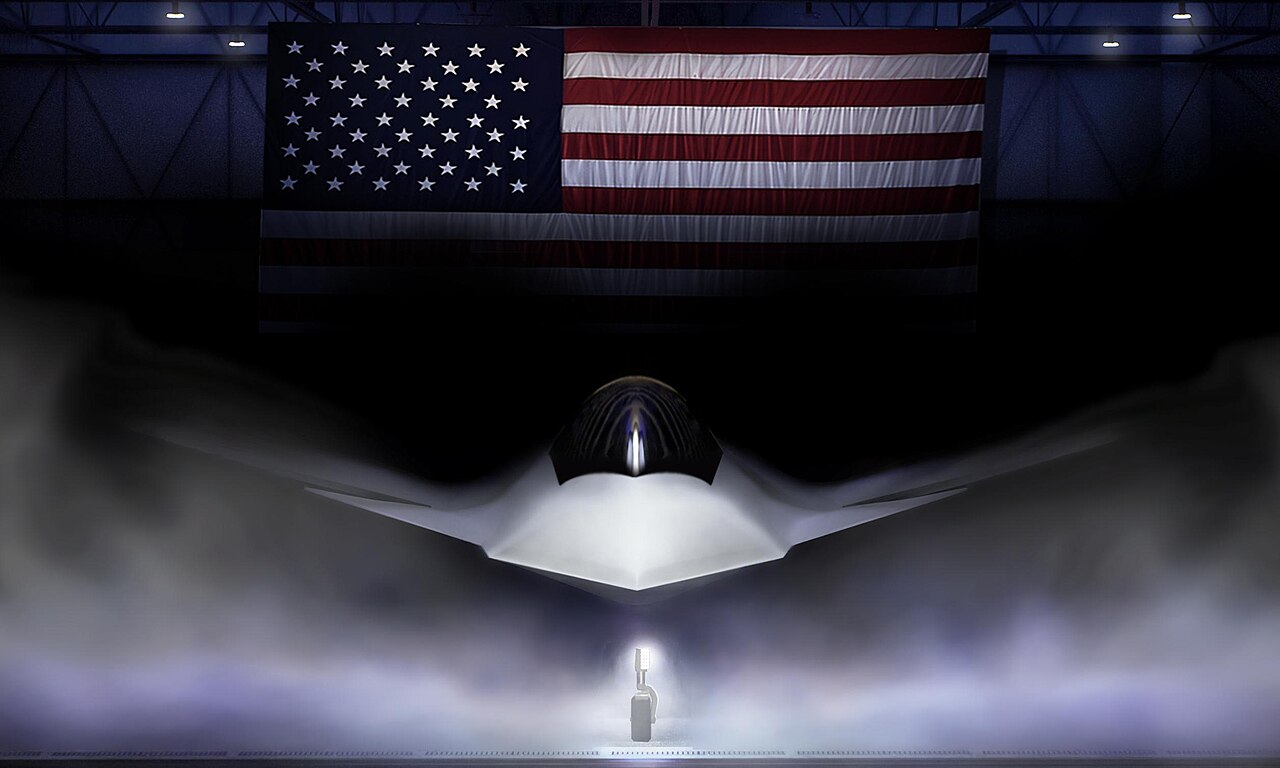
The two official images of the F-47 show an aircraft with small foreplanes beside the cockpit, wings that angle upwards and no visible tail fins. They also come with a warning. An Air Force official told The Aviationist that the pictures should be “taken with a large grain of salt” and added: “We aren’t giving anything away in those pictures.” Air & Space Forces Magazine reported that Boeing’s artists distorted some features and that the Air Force then altered the images further.
So the design is known only in outline. This article explains what the images show, why canards on a stealth aircraft surprised many observers, and how far any conclusion can be pushed.
What the official images show
Both images were released on 21 March 2025. One shows the aircraft nose-on in a hangar, half in shadow. The other shows it in flight, partly hidden by a vapour cloud. The rear of the aircraft, the engine exhausts and the full wing shape cannot be seen in either.
Several features are visible. The nose is broad and flattened, sometimes described as shovel-shaped. The cockpit has a bubble canopy for a single pilot. The wings appear to rise from root to tip, a feature called dihedral. And ahead of the wings sit two small surfaces: canards.
No vertical or horizontal tail can be seen. If the real aircraft has none, the F-47 would be the first American fighter designed without them. That would fit long-standing expectations for the NGAD programme, and it fits the Chinese J-36 and J-50, which are also tailless.
What canards are and why they matter
A canard is a small wing mounted ahead of the main wing. It can do the job a tailplane does on a conventional aircraft, which is to control pitch, raising or lowering the nose. Canards give strong control at high angles of attack and can help an aircraft take off in a shorter distance.
They are common on European fighters. The Eurofighter Typhoon, the Dassault Rafale and the Saab Gripen all use them. So does China’s J-20, the only operational stealth fighter with canards.
American stealth designers have avoided them until now. The F-22, F-35 and B-21 have none. The reason is radar. Every extra surface adds edges that can reflect radar energy, and a moving surface at the front of the aircraft sits in the direction from which an enemy radar is most likely to be looking.
| Aircraft | Canards | Tail surfaces | Stealth design |
|---|---|---|---|
| F-22 | No | Two fins, two tailplanes | Yes |
| F-35 | No | Two fins, two tailplanes | Yes |
| J-20 | Yes | Two fins | Yes |
| Typhoon, Rafale, Gripen | Yes | One fin | Reduced signature only |
| F-47 (official images) | Yes | None visible | Yes |
Why Boeing might use them
If the canards are real, the most likely explanation is the missing tail. Removing the tail fins and tailplanes cuts radar reflections from the side and rear, which matters for an aircraft that must survive deep inside defended airspace. It also removes the surfaces a fighter normally uses to steer.
Something has to replace that control. Designers can use split flaps on the wing, engines with steerable exhausts, or foreplanes. Canards would give the F-47 pitch control and agility without a tail, at some cost to its signature from the front.
That cost can be managed. Edges can be aligned with the wing so reflections go in a few narrow directions. Flight-control software can hold the canards at a low-signature angle in cruise and move them freely only in a fight. The J-20 uses this approach. How well it works on any aircraft is not public.
Or are the canards a decoy?
There is another reading. Because the Air Force has said the images are unreliable, some analysts argue that the canards may have been added or exaggerated to mislead foreign intelligence. The US has done this before. Early official images of the B-21 hid its intakes and exhausts, and the first released photograph of the F-117 in 1988 was deliberately blurred.
Neither reading can be confirmed. Boeing has said nothing about the configuration. Our article on the secret X-planes explains that even the demonstrators have never been shown.
What can be said is narrower. The Air Force’s own graphic rates the F-47’s stealth as better than the F-22’s, which it marks as “stealth++” against “stealth+”. Whatever the real shape is, the service is claiming that it does not give up low observability. We look at that claim in F-47 stealth explained.
Other design clues
Size is the easiest inference. A combat radius above 1,000 nautical miles needs a great deal of internal fuel, so the F-47 is probably larger than the F-22. The Air Force has not given dimensions or weight.
A top speed above Mach 2 points to two powerful engines and intakes designed for supersonic flight, as our speed explainer sets out. The engines will come from the NGAP programme. Weapons will be carried internally to preserve stealth, though the bay layout is unknown.
The nose shape suggests room for a large radar, and the single canopy confirms one pilot. The broad, flat fuselage is consistent with lift being generated by the body as well as the wings. Each of these is a reasonable reading of an image that its publisher says should not be trusted.
Frequently asked questions
Does the F-47 have canards?
The official images show canards beside the cockpit. The Air Force has said those images were altered, so it is not confirmed that the real aircraft has them.
Does the F-47 have a tail?
No tail fins are visible in the official images. A tailless design is widely expected but has not been officially confirmed.
Are canards bad for stealth?
They can be, because they add edges and moving surfaces at the front of the aircraft. Careful shaping and flight-control software can reduce the effect.
Why would a stealth fighter have canards?
To provide pitch control and agility if the aircraft has no tail.
Are the F-47 pictures real?
They are official artist’s impressions, not photographs. An Air Force official said they give nothing away.
How big is the F-47?
Dimensions have not been released. Its stated range suggests it is larger than the F-22.
- The Aviationist – NGAD’s Images Might Not Show Any Real Feature of the F-47: theaviationist.com
- The National Interest – The Boeing F-47’s Canards, Explained: nationalinterest.org
- 19FortyFive – Boeing’s F-47 Fighter ‘Canards’ Could Be a Trick: 19fortyfive.com
- Spectrum News – Trump announces Boeing will build the F-47: baynews9.com
- The War Zone – New Views Of China’s Next Generation Fighters: twz.com