Almaz-Antey Company Profile, Products, Sanctions and Revenue
Almaz-Antey is Russia’s state-owned air defense concern, the maker of the S-300, S-400 and S-500 families and the Buk missile system, with a claimed S-400 engagement range of up to 400 km. Formed in 2002 by merging Russia’s main surface-to-air missile design bureaus, it has been under US and EU sanctions since 2014, which matters more now that its systems are being fought over in Ukraine.
What is Almaz-Antey
Almaz-Antey, formally the Almaz-Antey Air and Space Defence Corporation, is a Moscow-based holding that dominates Russian ground-based air defense. It grew out of the Almaz Central Design Bureau, the Antey design bureau and a group of related factories and research institutes that built the Soviet Union’s surface-to-air missile network. The 2002 merger was meant to stop those bodies competing and to give Russia a single prime contractor for strategic air defense.
| Item | Detail |
|---|---|
| Full name | Almaz-Antey Air and Space Defence Corporation (Concern VKO Almaz-Antey) |
| Base | Moscow, Russia |
| Formed | 2002, from the Almaz and Antey design organizations and affiliated plants |
| Ownership | Russian state |
| Core business | Long- and medium-range surface-to-air missile systems, radars, command systems |
| Sanctions | US and EU measures since 2014, widened after February 2022 |
Who owns Almaz-Antey
The Russian state owns Almaz-Antey. Unlike many of its peers it sits outside Rostec, the state corporation that holds much of the country’s other defense industry, and reports through the federal property and industry authorities. That separation reflects its strategic role: air defense of Moscow and of Russia’s nuclear forces has long been a priority task. Its customer is overwhelmingly the Russian Ministry of Defense, with exports handled through the state arms-export channel.
Almaz-Antey products and claimed performance
| System | Role | Claimed range (manufacturer claims) |
|---|---|---|
| S-300 family (S-300PMU, S-300V4) | Long-range area air defense | Roughly 150 to 400 km depending on variant and missile |
| S-400 Triumf | Long-range air and missile defense | Up to 400 km with the 40N6 missile |
| S-500 Prometheus | Anti-ballistic and anti-satellite ambitions | Up to about 600 km, per Russian state media |
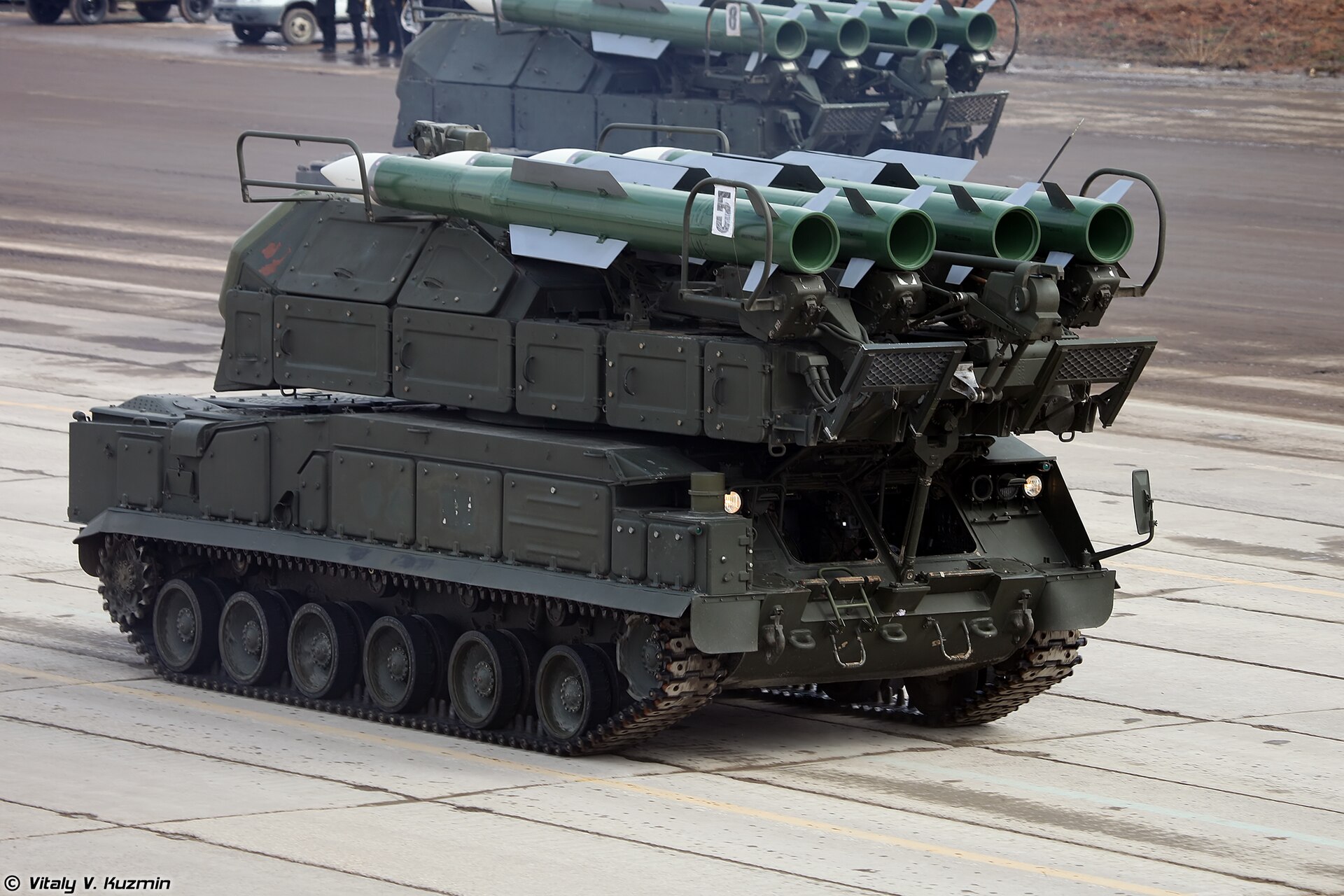
| Buk-M2 and Buk-M3 | Medium-range air defense | Around 45 to 70 km, per Russian sources |
| S-350 Vityaz | Medium-range replacement for older S-300 units | Around 120 km, per Russian sources |
The flagship is the S-400 Triumf, which entered Russian service in 2007 and mixes four missile types in one battery. It is usually compared with the US Patriot system, and the S-500 is set against THAAD. Russia says the S-500 has begun limited deployment, but public evidence of its combat performance is thin. The Buk family, meanwhile, is one of the most widely exported Russian air defense systems.
Who buys Almaz-Antey systems
Russia has sold S-300 and S-400 systems to a short list of customers that can afford them and accept the political cost. China bought the S-400 under a deal signed around 2014 with deliveries reported from 2018. India signed a roughly $5 billion contract in 2018 for five regiments. Turkey took delivery of S-400 components in 2019, which triggered US sanctions on its procurement agency and removal from the F-35 program. Belarus also operates the system, and older S-300 variants are in service across Asia, the Middle East and the former Soviet space.
Exports now face two obstacles: Russian factories are busy replenishing domestic stocks, and buyers worry about secondary sanctions. India’s deliveries have reportedly run late, and the Russian missile industry’s priorities have shifted to its own war needs.
Almaz-Antey sanctions, MH17 and the war in Ukraine
The company first drew sanctions in 2014 after the shoot-down of Malaysia Airlines Flight 17. A Dutch-led international investigation concluded that the airliner was hit by a Buk missile fired from territory held by Russian-backed separatists. Almaz-Antey, which designs the missile, has disputed parts of that finding. The US and EU widened restrictions after the 2022 invasion, limiting the company’s access to Western electronics and financing.
In Ukraine, Russian S-300, S-400 and Buk batteries have been used both against aircraft and, improvised, against ground targets. Ukrainian officials have claimed strikes on S-400 radars and launchers in Crimea and on Russian territory, though those reports are operator-reported and rarely backed by independent imagery. The war has also shown the cost of layered air defense: each battery is expensive, and cheap drones can force a defender to spend costly missiles.
Almaz-Antey revenue and outlook
Russian media have put the group’s annual revenue in the hundreds of billions of rubles, but the company’s accounts are not open to outside audit, so the figure should be treated with caution. Demand is not the problem. Russia wants more air defense, and the S-500 and S-350 are still in rollout. The constraint is supply: microelectronics, machine tools and skilled labor are harder to secure under sanctions.
Almaz-Antey frequently asked questions
What does Almaz-Antey make?
Long- and medium-range surface-to-air missile systems, including the S-300, S-400, S-500, Buk and S-350, along with radars and command vehicles.
Who owns Almaz-Antey?
The Russian state. It is not part of Rostec.
Is Almaz-Antey sanctioned?
Yes. The US and EU have sanctioned it since 2014, and restrictions were widened after 2022.
What is the range of the S-400?
Russia claims up to 400 km with the 40N6 missile. That is a manufacturer claim, and operational ranges against real targets are likely lower.
Does Almaz-Antey make the Pantsir?
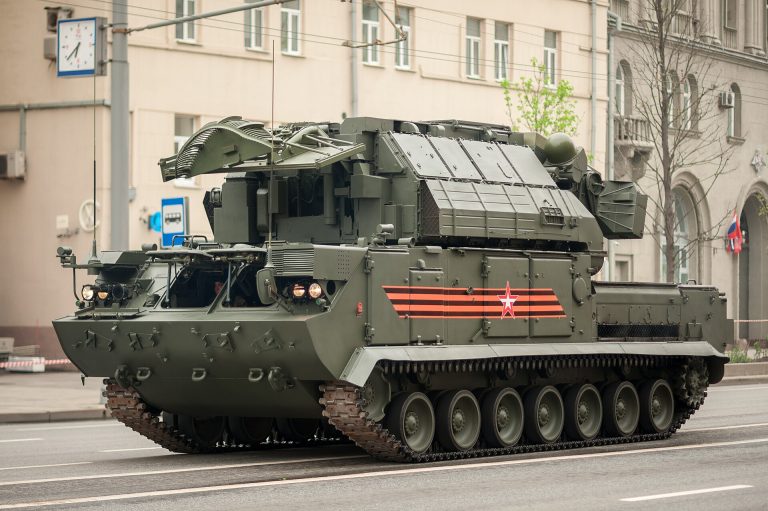
No. The Pantsir short-range system comes from KBP in Tula, part of Rostec. Almaz-Antey’s short-range offering is the Tor family, built by a subsidiary.
- Company information published by Almaz-Antey and Russian state media (manufacturer claims)
- Dutch Safety Board and Joint Investigation Team reports on MH17
- SIPRI Arms Transfers Database
- Wikipedia – Almaz-Antey (accessed October 2026)
- Defence & Tech reporting on Russian air defense