
The Move That Frightens Greece: A New Act for Bayraktar TB3! It Will Shift Balances in Europe


 React
React
The rapid ascent of the Turkish defense industry continues to reverberate across Europe. The newly established strategic partnership between Turkey’s Baykar and Italy’s Leonardo, aimed at introducing the Bayraktar TB3 to the European theater, has significantly amplified the global reach of Turkish technology. This joint venture has triggered visible anxiety in the Greek press, sparking intense debates in Athens over the shifting balance of power in the Aegean and Eastern Mediterranean.
As the Turkish defense sector consistently makes headlines with its indigenous, high-tech platforms, Baykar’s latest international milestone has firmly anchored its presence on the European continent. Already recognized as one of the world’s premier exporters of unmanned combat aerial vehicles (UCAVs), Baykar is no longer merely breaking export records; it is actively forging strategic alliances with the titans of European defense.
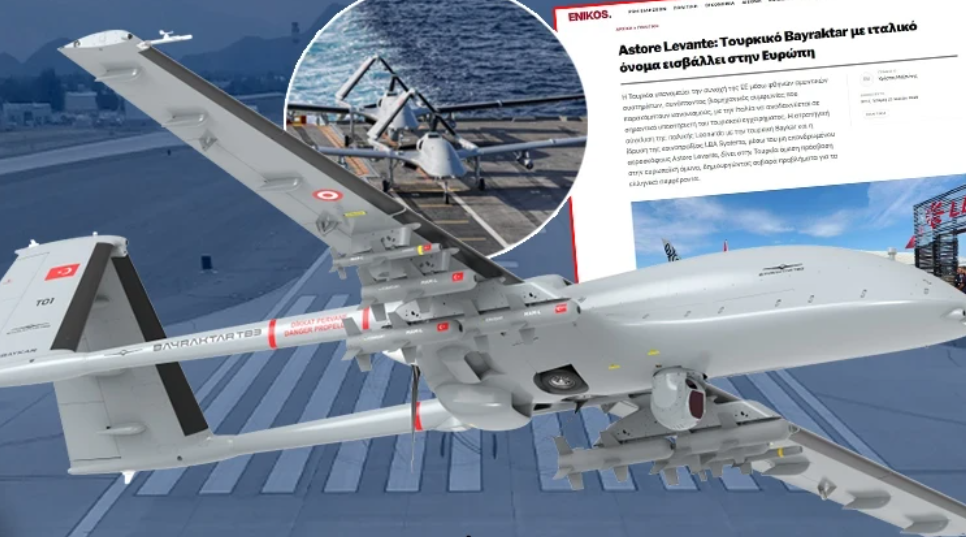
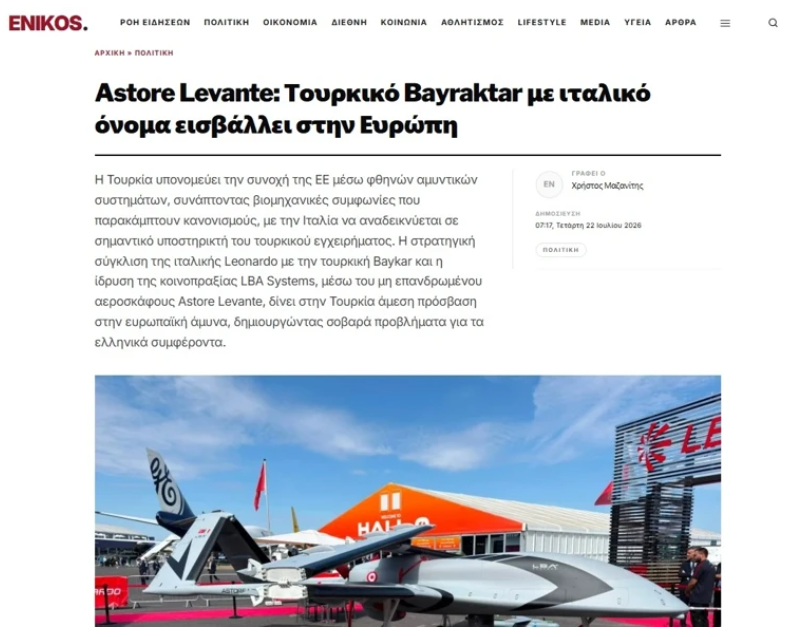
The most critical link in this expansion is the recent joint venture established with the Italian defense giant Leonardo, named LBA Systems. Following this Turkish-Italian partnership, the Bayraktar TB3 was formally introduced to the European market under the designation ‘Astore Levante.’ While this move is celebrated as a monumental step for Turkish defense exports, it has generated widespread apprehension and strategic alarm in neighboring Greece.
The Countdown for the First Delivery Begins
Production of the initial batch of Astore Levante systems is already underway, with the first deliveries to Italian end-users scheduled before the end of the year. The Bayraktar TB3 is specifically engineered for maritime operations, possessing the unique capability to autonomously launch from and recover on short-runway aircraft carriers. Beyond its primary intelligence, surveillance, and reconnaissance (ISR) roles, the TB3 is a highly lethal asset capable of executing precision strikes using smart munitions integrated under its wings.
Equipped with both Line-of-Sight (LOS) and Beyond Line-of-Sight (BLOS) communication architectures, the system offers unparalleled operational flexibility, allowing it to be commanded over vast distances for both near-shore and blue-water missions.
“The Partnership Could Extend to Civil Aviation”
Commenting on the strategic depth of the agreement, retired Intelligence Colonel and defense analyst Coşkun Başbuğ noted that Turkey has crossed a critical threshold in unmanned systems. “Unmanned technology is a sector where Turkey has truly paved the way,” Başbuğ stated. “While other nations have experimented in this field, Turkey was the first to successfully integrate land, air, and sea unmanned assets on this massive scale.”
Highlighting the synergy between Baykar and Leonardo, Başbuğ added, “Leonardo is a deeply rooted company and a pioneer in various technologies. When two powerhouses with such strong capabilities in range, speed, payload capacity, and radar technology merge their efforts, a formidable alliance is born. This partnership may eventually expand beyond defense into civil aviation. It is precisely this level of technological advancement in both sectors that unsettles Greece.”
Alarm in Athens: “Turkish Defense Technology is Becoming Europeanized”
The Athens-based publication Enikos asserted that the evolving defense cooperation between Turkey and Italy has sparked a new debate regarding the structural integrity of the European Union’s defense architecture. The report alleged that the LBA Systems venture and the Astore Levante UCAV could provide Turkey with direct backdoor access to the European defense ecosystem.
Expressing deep concern, Enikos described the Bayraktar’s entry into the European market as a “Trojan Horse,” claiming that “Turkey is eroding the EU’s defense cohesion through inexpensive defense systems and industrial partnerships.” The publication heavily criticized Italy for playing a critical role in facilitating Ankara’s expansion into the European market.
The Greek outlet further argued that the Astore Levante—effectively a European-standardized version of the Bayraktar TB3—allows Turkish defense technology to acquire a “Europeanized product identity.”
Fears of a Power Shift in the Aegean and Mediterranean
Greek media continues to warn that this industrial collaboration will have severe military and geopolitical consequences for Athens. Integrating Leonardo’s highly advanced electronic warfare (EW) systems, sensors, and certification capabilities into Baykar platforms will drastically multiply the lethality of Turkish UCAVs, directly threatening the existing balance of power in the Aegean and Eastern Mediterranean.
Furthermore, Enikos voiced concerns that Turkey could leverage this partnership to gain indirect access to European defense funds and joint projects, urging the Greek government to immediately escalate diplomatic initiatives within the EU to block this trajectory.
“Our Rival is Not Greece; We Compete with Global Powers”
How realistic are the fears expressed in the Greek press regarding the shifting military balance?
Responding to Athens’ anxieties, Coşkun Başbuğ emphasized that Turkey’s defense strategy is not tailored around Greece. “It is natural for Greece to feel anxious, but Turkey does not develop its defense projects with Greece at the center,” he stated.
“We do not position ourselves based on Greece. We have never viewed Greece as our primary target or developed projects exclusively against them; such an approach has never existed in our doctrine. Our competition is on a much larger scale—we are competing with nations defined as global powers. We are on the right track in the defense industry, and we will reach even greater heights in the future.”
React