
Buk Missile System, the Workhorse SAM With a Dark History
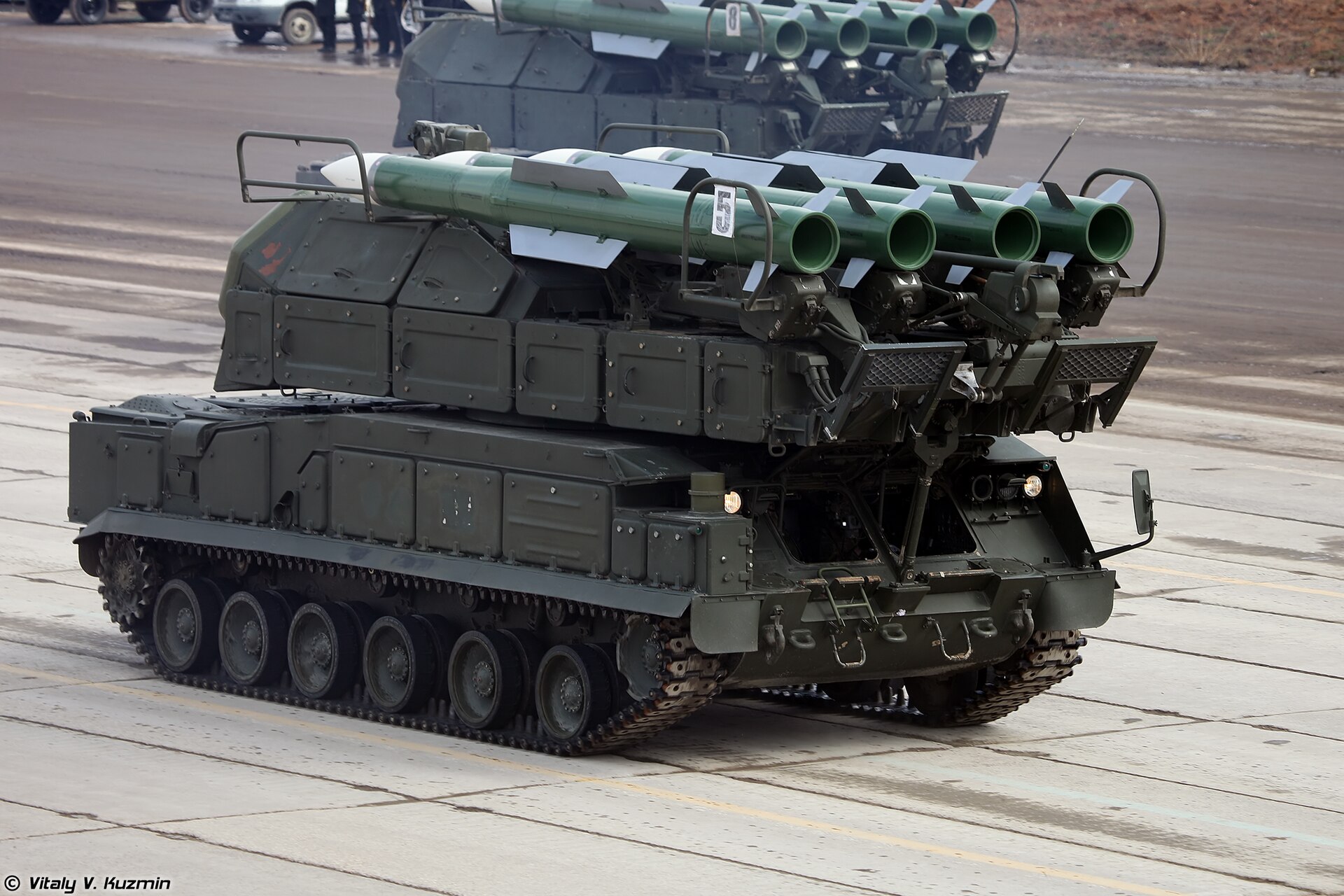
Buk is the medium-range workhorse of the Russian air defense way of war, the radar-topped tracked launcher that has fought in every post-Soviet conflict, shot down airliner MH17 in the world’s most infamous SAM engagement, and now duels drones and jets over Ukraine on both sides of the line. The latest Buk-M3 remains one of the most capable mobile systems Russia fields.
What is the Buk system
Buk, Russian for beech, is the Soviet-designed medium-range, mobile SAM family developed by NIIP from 1972 as successor to the Kub, filling the layer between short-range systems like Pantsir and Tor and the long-range S-300/S-400. Its job is army air defense on the move: killing aircraft, helicopters, cruise missiles and, in later versions, tactical ballistic targets, while displacing before counterfire arrives.
The TELAR idea
Buk’s signature is the TELAR, transporter-erector-launcher and radar: each vehicle carries its own engagement radar atop four missiles, so a single vehicle can fight alone, and a battalion’s vehicles can spread across terrain yet engage simultaneously. The design multiplies survivability and saturation resistance compared with single-radar systems, and it is exactly why hunting Buks is hard: kill the search radar and the TELARs keep shooting on their own sensors.
Buk variants and specifications
| Variant | Service | Range / altitude | Note |
|---|---|---|---|
| Buk-M1 (SA-11) | 1983 | 3-35 km / to 22 km | Cold War baseline, wide export |
| Buk-M1-2 / M2 (SA-17) | 1998-2008 | Up to 45-50 km / 25 km | 9M317 missile, better ECM resistance |
| Buk-M3 ‘Viking’ (SA-27) | 2016+ | 2.5-70 km / to 35 km | 36 channels per battalion, canisterized 9M317M, targets to 3,000 m/s |
| Naval Shtil / Shtil-1 | Various | To ~50 km | Vertical-launch export variant on Indian, Chinese, Russian hulls |
Combat record, from MH17 to Ukraine
The family’s history is written in wars: Georgian Buks downed Russian aircraft in 2008, Syrian batteries engaged cruise missiles in 2018, and on July 17, 2014 a Buk TELAR fired from separatist-held eastern Ukraine destroyed Malaysia Airlines Flight 17, killing all 298 aboard, an atrocity traced by the JIT investigation to Russia’s 53rd brigade and the engagement that made the system globally notorious. Since 2022 Buks have been central for both combatants: Russia’s screening its front and claiming HIMARS intercepts, Ukraine’s soldiering on with depleted Soviet stocks against drones and cruise missiles while losses mount on each side under drone and HARM attack.
Hunting Buks, the other half of the story
Ukraine’s skies have also been a clinic in killing Buks. HARM anti-radiation seeding forced radar discipline; decoys baited emissions; and Lancet and FPV drones plus GMLRS strikes have burned TELARs on both sides, documented across open-source loss ledgers. The system’s dispersed-radar architecture mitigates but cannot repeal the rule every SAM now lives under: emit and move, or die. That churn, more than any single duel, is why both armies treat medium-range SAMs as consumables and why production of the M3 line continues at pace inside Russia’s war economy.
Operators and the FrankenSAM twist
A dozen-plus states operate Buk variants, from Belarus, Algeria and Egypt to India’s naval Shtil launchers, with Venezuela and Syria’s remnants among others. The most inventive operator is Ukraine: with 9M38-series missiles running out, US-Ukrainian FrankenSAM conversions rearmed Buk TELARs to fire RIM-7 Sea Sparrows, NATO missiles on Soviet launchers, keeping the fleet shooting and previewing the hybrid air defense economics the whole war has forced, the same pressure driving allies’ layered-network buildouts.
Frequently asked questions
What is the range of the Buk system?
From about 35 km for the M1 to 70 km for the Buk-M3, with altitude coverage to roughly 35 km.
What shot down MH17?
International investigators concluded a Buk-M1 missile fired from separatist-held Ukraine by a launcher from Russia’s 53rd brigade destroyed MH17 in July 2014.
What is a TELAR?
A vehicle combining transporter, erector, launcher and its own radar, letting each Buk vehicle engage independently.
Is the Buk still effective?
The M3 remains a serious modern system; both sides’ losses in Ukraine also show every radar SAM’s vulnerability to drones and anti-radiation fire.
What is FrankenSAM?
The US-Ukrainian program adapting Buk launchers to fire Sea Sparrow missiles, offsetting exhausted Soviet-era stock.
- Wikipedia – Buk missile system (accessed October 2026)
- JIT/Dutch Safety Board findings on MH17
- Public reporting on Buk-M3 and FrankenSAM in Ukraine