
Towed Array Sonar, the Kilometer-Long Ear of the Fleet
The towed array is the long ear of naval warfare: a cable of hydrophones streamed kilometers behind a ship or submarine, far from its own noise, listening for the faint low frequencies that betray even quiet submarines across great distances. A century after the first ‘Electric Eel,’ it remains the single most important passive sensor in anti-submarine warfare.
What a towed array is
A towed array is hundreds to thousands of meters of neutrally buoyant hose packed with hydrophones, streamed astern on a tow cable and processed into acoustic pictures by the ship’s combat system. Because the sensors ride far from the towing vessel’s machinery, and because the line’s sheer length forms a giant acoustic antenna, the array hears what no hull-mounted set can: the deep, quiet rumble of distant propulsion that shorter sensors lose in their own ship’s hiss.
Why length and distance win
Two physics facts rule. Low frequencies travel farthest underwater, and resolving low frequencies demands a long baseline, so detection reach scales with array length; spacing hydrophones along kilometers lets processors beam-form narrow listening lobes and estimate bearings precisely. And signal-to-noise rules everything: towing the sensors hundreds of meters behind and often below the ship, away from engines and wake and beneath the surface layer, buys the quiet that makes faint contacts visible at all. The array is, in effect, the phased-array principle inverted for listening.
Ship arrays vs submarine tails
| Platform | Arrangement | Role |
|---|---|---|
| Surface combatants | Winch and drum astern; active-passive sets pair a towed source with the line | Task-group ASW screen, multistatic pinger-listener play |
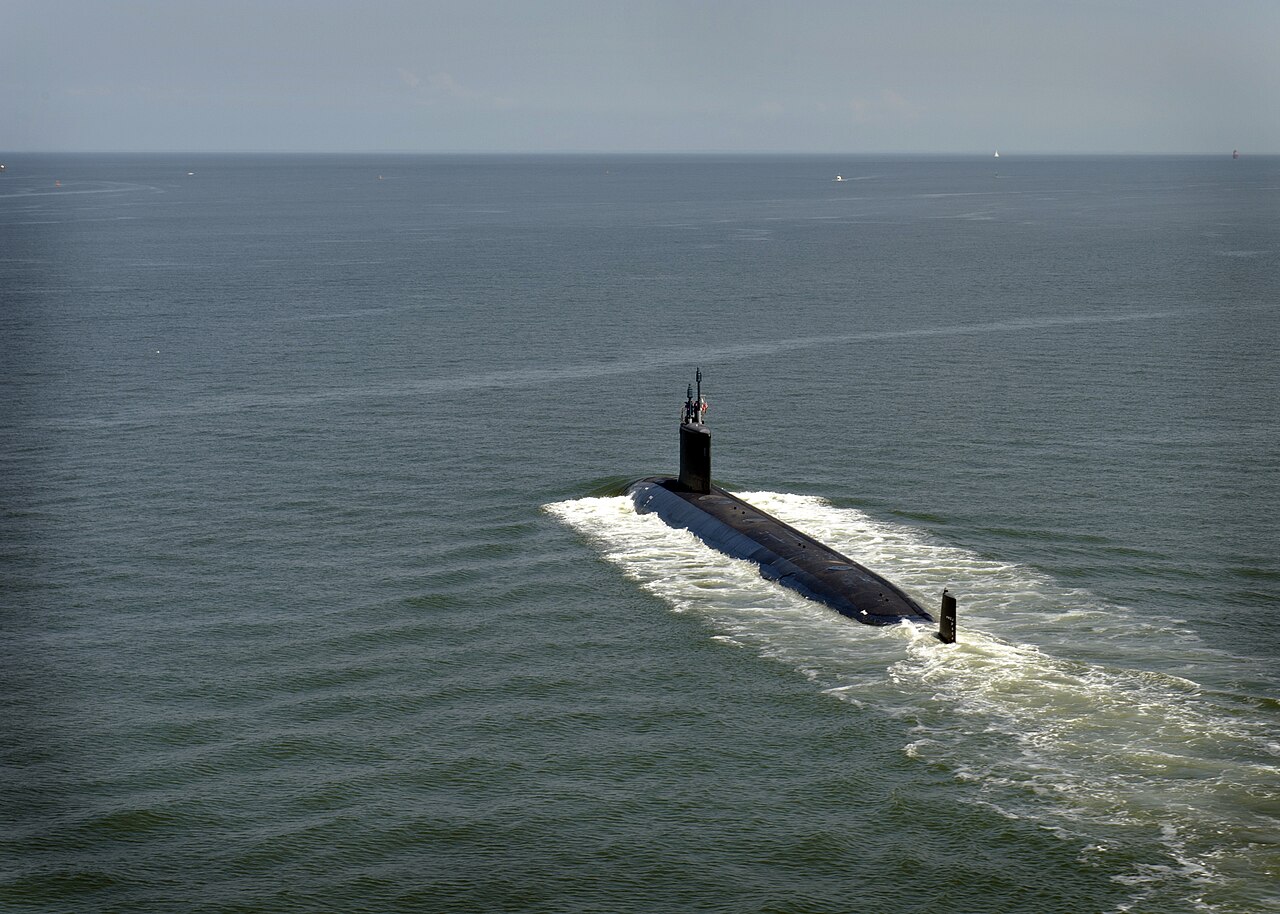
| Submarines | Line stowed in a hull tube, streamed from the tail; fat-line and thin-line types | Covert wide-area search while the boat stays silent and deep |
| Surveillance ships | Very long arrays on dedicated slow hulls | Ocean-basin listening, the SURTASS tradition |
The operational trade-offs
The price of the long ear is seamanship. A turning ship drags its array through a curve that scrambles bearings until the line straightens, so ASW maneuvering is a discipline of gentle, planned legs; speed is capped lest drag damage the line or flow noise drown the take; shallow water risks grounding the tail; and recovering kilometers of cable is slow work a warship under threat must budget for. Every towed-array navy trains around the same sentence: the sensor shapes the ship’s behavior, not the reverse.
Multistatics, the towed array’s new job
The contemporary play pairs the passive tail with a towed active source: one ship pings from a variable-depth projector while its own and consorts’ arrays catch echoes from angles the target’s stealth never faced. Low-frequency active multistatics turns a frigate line or a manned-unmanned group into a distributed sensor web, and it is the architecture behind current NATO ASW frigates’ sonar suites and the unmanned tow-ships entering trials. The array, century-old in concept, thus anchors the newest chapter of the hunt.
From Electric Eel to thin-line tails
Harvey Hayes’s WWI ‘Electric Eel’ proved the concept; the Soviet nuclear fleet’s rise revived it in the 1960s, and Cold War hunters like the TB-16 and thin-line TB-29 families made the tail standard submarine equipment while surface groups streamed their own. Today’s frontier is processing, machine-learned classification pulling contacts from biologic and shipping clutter, and proliferation: modern tails now trail European AIP boats, unmanned surface vessels and even containerized systems, spreading capability the superpowers once monopolized.
Frequently asked questions
What is a towed array sonar?
A long cable of hydrophones towed behind a ship or submarine, forming a large passive antenna away from the platform’s own noise.
Why are towed arrays so long?
Long baselines resolve the low frequencies that travel farthest underwater, extending detection range and bearing accuracy.
What are a towed array’s weaknesses?
Turns disrupt it, speed and shallow water threaten it, and streaming or recovering it takes time.
Do submarines use them too?
Yes; tails stowed along the hull are standard on modern submarines for covert long-range listening.
What was the first towed array?
Harvey Hayes’s ‘Electric Eel’ of World War I, revived and industrialized during the Cold War.
- Wikipedia – Towed array sonar (accessed October 2026)
- Open naval literature on ASW sensors
- Defence & Tech submarine coverage