Does China Have Hypersonic Missiles? DF-17, DF-27 and YJ-21
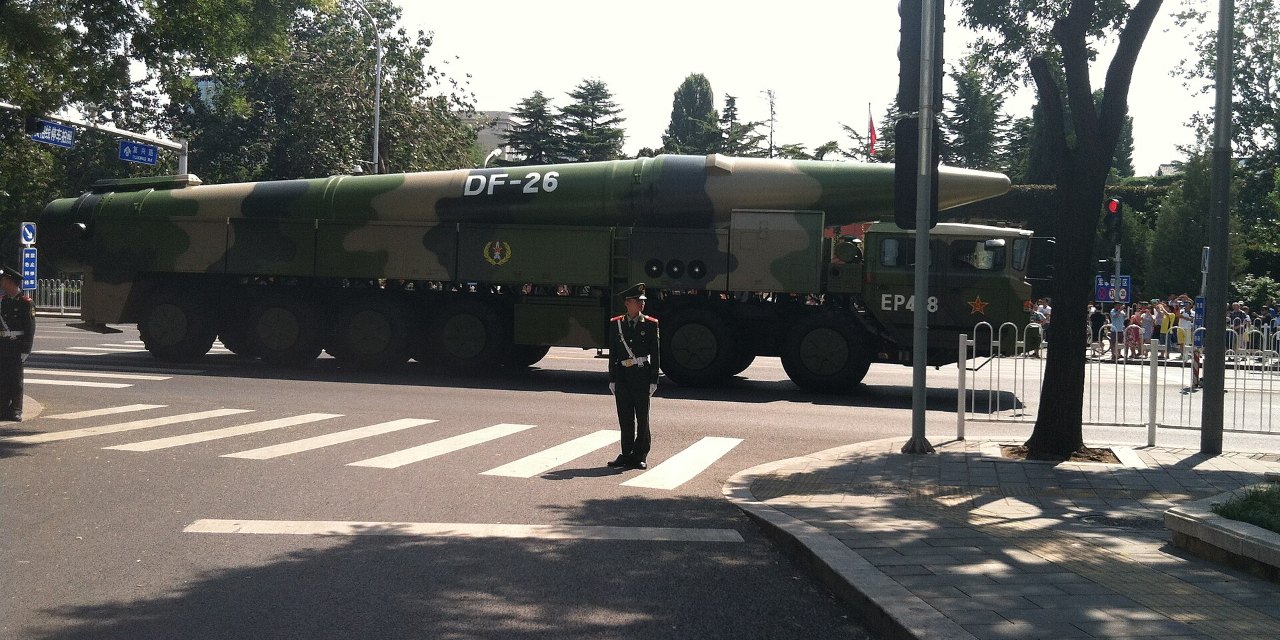
Yes. China has more hypersonic weapons in service than any other country. It fielded the DF-17, the world’s first operational hypersonic glide missile, around 2020, and has since added the YJ-21 anti-ship missile and, according to leaked US intelligence documents, the longer-range DF-27. At the September 2025 parade it showed a new wave: the YJ-17, YJ-19 and YJ-20 hypersonic anti-ship missiles and the CJ-1000, described as a long-range hypersonic cruise missile.
This guide explains what makes these missiles different, which ones China has and what they are designed to hit.
Which hypersonic missiles does China have?
Hypersonic weapons fly at more than five times the speed of sound, but so do most ballistic missiles. What makes the new generation different is that they can manoeuvre at those speeds, either by gliding through the upper atmosphere after a rocket boost or by using air-breathing scramjet engines. That makes their path hard to predict and their targets hard to defend.
| Missile | Type | Range (est.) | Status |
|---|---|---|---|
| DF-17 | Ballistic missile with hypersonic glide vehicle | About 1,800-2,500 km | In service since about 2020 |
| DF-27 | Longer-range glide missile | About 5,000-8,000 km | Reported in leaked US documents |
| DF-26D | Intermediate-range missile variant | About 4,000 km | Shown in 2025 |
| YJ-21 | Anti-ship ballistic / hypersonic missile | About 1,000-1,500 km | Ship- and air-launched; in service |
| YJ-17 / YJ-19 / YJ-20 | Hypersonic anti-ship missiles | YJ-19 reportedly up to about 1,400 km | Shown at the 2025 parade |
| CJ-1000 | Hypersonic cruise missile | Long range (claimed) | Shown at the 2025 parade |
DF-17: the first operational glide missile
The DF-17 was first shown at the 1 October 2019 parade. It mounts a hypersonic glide vehicle, known in the West as the DF-ZF, on a solid-fuel rocket. After the rocket burns out, the glide vehicle skims through the upper atmosphere at hypersonic speed and can change direction, making it much harder for defences such as Patriot or THAAD to intercept. It is aimed mainly at bases and defences in Japan, Taiwan and the Philippines. Our DF-17 guide covers it in detail.
YJ-21 and the anti-ship hypersonics
China’s most worrying hypersonic weapons for the US Navy are those built to hit ships. The YJ-21 is launched from the vertical cells of the Type 055 destroyer and from H-6 bombers, and is believed to dive on its target at very high speed. It joins the land-based DF-21D and DF-26 in China’s arsenal of “carrier killers”. The 2025 parade added the YJ-17, YJ-19 and YJ-20; the YJ-19 is reportedly powered by a scramjet. Few of these claims can be independently checked, but the variety alone shows how heavily China has invested in this field. China’s carrier fleet, which these missiles complement, is covered in our guide to Chinese aircraft carriers.
The 2021 orbital test
In July and August 2021 China tested a hypersonic glide vehicle launched into orbit, which circled the Earth before descending towards its target. The test, first reported by the Financial Times, surprised US officials, and the chairman of the Joint Chiefs of Staff compared it to a “Sputnik moment”. A weapon of this kind, known as a fractional orbital bombardment system, could approach the United States from the south, avoiding the radars and interceptors that face north. China said it was testing a reusable spacecraft.
How does China compare with the United States?
China is ahead in fielded hypersonic weapons. The United States only began fielding its first ground-based hypersonic missile, the Army’s Dark Eagle, in 2025, and several other programmes have been delayed or cancelled, as our guide to American hypersonic missiles explains. Russia also has hypersonic weapons in service, including the Kinzhal and Zircon. The wider picture of China’s missile force is in our guide to Chinese missiles.
Frequently asked questions
Does China have hypersonic missiles?
Yes. China fielded the DF-17 around 2020 and has since added the YJ-21 and other hypersonic missiles.
What is China’s hypersonic missile called?
The best known is the DF-17. Others include the DF-27, the YJ-21 anti-ship missile, the YJ-17, YJ-19 and YJ-20, and the CJ-1000 cruise missile.
Is China ahead of the US in hypersonic weapons?
In fielded weapons, yes. The US only began fielding its first ground-based hypersonic missile, Dark Eagle, in 2025.
Can hypersonic missiles be intercepted?
It is difficult but not impossible. Their manoeuvring makes them hard to track, and the US is developing new space sensors and interceptors to counter them.
What can the DF-17 hit?
It is designed to strike military bases, air defences and possibly ships within about 1,800 to 2,500 kilometres.
What was China’s 2021 hypersonic test?
China launched a hypersonic glide vehicle into orbit that circled the Earth before descending, a test that surprised US officials.
- Defense One – China’s new missiles: parade showpieces or showstoppers? (September 2025): defenseone.com
- Breaking Defense – China’s parade shows off nuclear triad (September 2025): breakingdefense.com
- US Department of Defense – Military and Security Developments Involving the People’s Republic of China 2025: media.defense.gov