How Many Submarines Does Russia Have? Borei, Yasen, Kilo
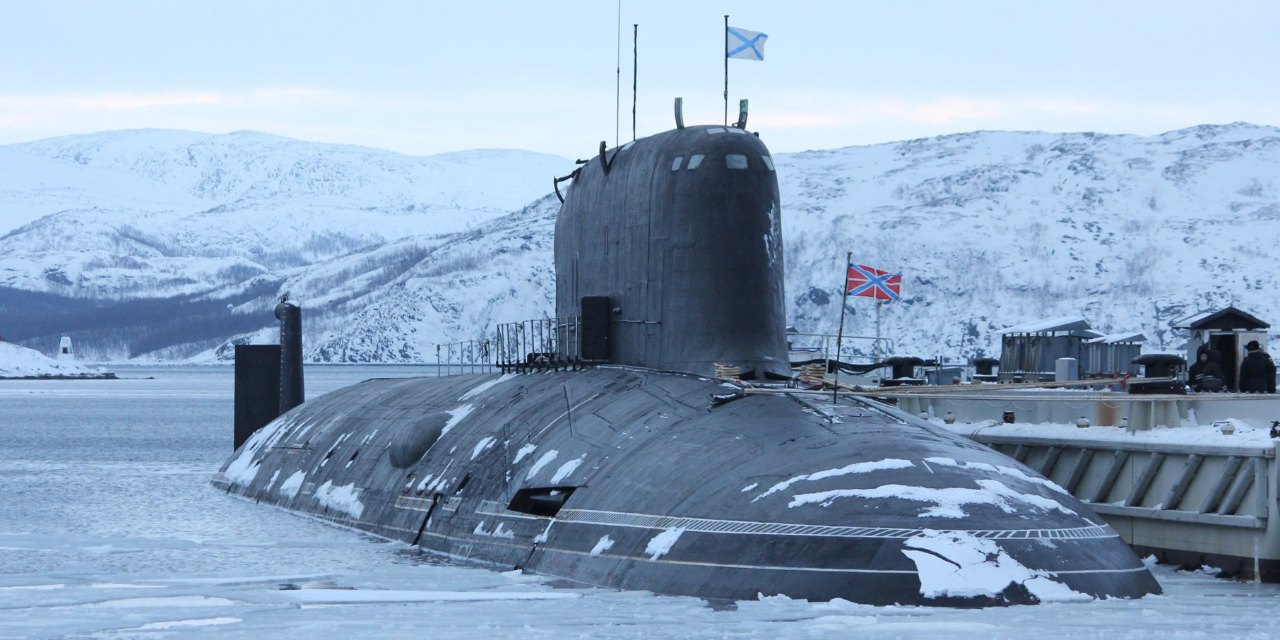
Russia has about 67 submarines in 2026, roughly 40 of them nuclear-powered, according to open-source fleet lists. Thirteen are ballistic missile submarines that carry about 700 deployed nuclear warheads, and the rest range from large cruise missile boats to small diesel-electric patrol submarines.
Submarines are the best-funded and most capable part of the Russian Navy. This guide explains each class, what it carries, where it is based and what Russia has lost and is building.
How many submarines does Russia have?
The total depends on what is counted. The figure of about 67 includes boats in long refits and about ten special-purpose submarines. The number ready for sea at any time is considerably lower.
| Class | Type | Number | Main weapons |
|---|---|---|---|
| Borei / Borei-A | Nuclear ballistic missile | 8 | 16 Bulava missiles |
| Delta IV | Nuclear ballistic missile | 5 | 16 Sineva missiles |
| Yasen / Yasen-M | Nuclear cruise missile and attack | 5 | Up to 40 Kalibr, or Oniks and Zircon |
| Oscar II | Nuclear cruise missile | About 6 | 24 Granit anti-ship missiles |
| Akula | Nuclear attack | About 8 | Torpedoes and cruise missiles |
| Sierra II and Victor III | Nuclear attack | About 4 | Torpedoes |
| Kilo and Improved Kilo | Diesel-electric attack | About 18 | Torpedoes, Kalibr on newer boats |
| Lada | Diesel-electric attack | 2 | Torpedoes, Kalibr |
| Special purpose | Deep-sea research and Poseidon carriers | About 10 | Belgorod, Khabarovsk and small deep-diving craft |
The wider fleet is covered in how big Russia’s navy is.
Borei and Delta IV, the nuclear deterrent at sea
Ballistic missile submarines exist to hide and survive so that Russia could retaliate after a nuclear attack. The Borei class is the modern standard: about 24,000 tonnes submerged, 170 m long and armed with 16 Bulava missiles, each able to carry several warheads. Eight are in service, split between the Northern Fleet at Gadzhiyevo and the Pacific Fleet at Vilyuchinsk, and more are being built toward a planned total of 12.
Five older Delta IV boats with liquid-fuel Sineva missiles remain in the Northern Fleet and will retire as new Boreis arrive. The Federation of American Scientists estimates about 704 warheads are deployed on submarine missiles. Their place in the nuclear forces is covered in how many nuclear weapons Russia has.
Yasen-M and the nuclear attack submarines
The Yasen-M is the submarine Western navies watch most closely. It is quieter than any earlier Russian design and has eight vertical launch tubes holding up to 40 Kalibr cruise missiles or a smaller number of Oniks and Zircon missiles, in addition to torpedoes. Five Yasen-type boats are in service and four more are under construction. Our Virginia class vs Yasen-M comparison sets it against its American counterpart.
The rest of the nuclear attack force is Soviet-built. Oscar II boats were designed to attack aircraft carriers with heavy Granit missiles, and one is being rebuilt to carry Kalibr and Oniks. Akula-class submarines, quiet for their time, spend long periods in overhaul. How nuclear boats work is explained in nuclear submarine propulsion, and the global ranking is in our top 10 attack submarines.
Kilo class, the diesel-electric workhorse
The Improved Kilo, known in Russia as Varshavyanka, is a 4,000-tonne diesel-electric submarine that is very quiet on battery power in coastal waters. It fires torpedoes and, through its torpedo tubes, Kalibr cruise missiles. Russia built six for the Black Sea Fleet and six for the Pacific Fleet, and has ordered more.
The newer Lada class was meant to replace it but has had a difficult development, and only two are in service. Neither class has air-independent propulsion, so both must come up to recharge their batteries more often than the newest Western and Asian diesel submarines.
Belgorod, Poseidon and the special-purpose boats
Belgorod, delivered in 2022, is a stretched Oscar II hull 184 m long. It was built to carry the Poseidon, a nuclear-powered underwater drone the size of a small submarine that Russia says is designed to destroy coastal targets. A second carrier, Khabarovsk, was launched in November 2025. Russia says it tested Poseidon’s nuclear power unit in October 2025, and outside analysts do not consider the weapon operational.
These boats belong to a secretive organization, the Main Directorate of Deep-Sea Research. It also operates small deep-diving submarines able to work on the seabed, which NATO governments regard as a threat to undersea cables and pipelines.
What has Russia lost, and what is it building?
Ukraine has put two Kilo-class submarines out of action without having a navy. Rostov-on-Don was hit by cruise missiles in dry dock at Sevastopol in September 2023 and, according to Ukraine, sunk in a second strike in August 2024. In December 2025 Ukraine’s security service said an underwater drone had hit another Kilo in the port of Novorossiysk.
New construction is concentrated at Sevmash in Severodvinsk, which delivers roughly one Borei-A and one Yasen-M a year, and at Admiralty Shipyards in Saint Petersburg, which builds the diesel boats. This is the one area of naval shipbuilding where Russia has kept to something like its plans.
Frequently asked questions
How many submarines does Russia have?
About 67 of all types in 2026, according to open-source fleet lists, including boats in refit.
How many nuclear submarines does Russia have?
Roughly 40 are nuclear-powered: 13 ballistic missile submarines, about 23 cruise missile and attack submarines and several special-purpose boats.
What is Russia’s most advanced submarine?
The Yasen-M attack submarine and the Borei-A ballistic missile submarine.
What is the largest Russian submarine?
Belgorod, at 184 m, is the longest submarine in service anywhere. The larger Typhoon class has been retired.
Does Russia have more submarines than the United States?
The totals are similar, at roughly 65 to 70 each. All American submarines are nuclear-powered, while about a third of Russia’s are diesel-electric.
- Wikipedia – List of active Russian Navy ships: en.wikipedia.org
- Bulletin of the Atomic Scientists – Russian nuclear weapons, 2026: thebulletin.org
- Ministry of Defence of Ukraine – Russia’s largest losses in the Black Sea and the Sea of Azov (April 2026): mod.gov.ua
- Wikipedia – Yasen-class submarine: en.wikipedia.org
- Wikipedia – Russian submarine Belgorod: en.wikipedia.org