Inside TKMS, the Submarine Builder With a Record Order Book
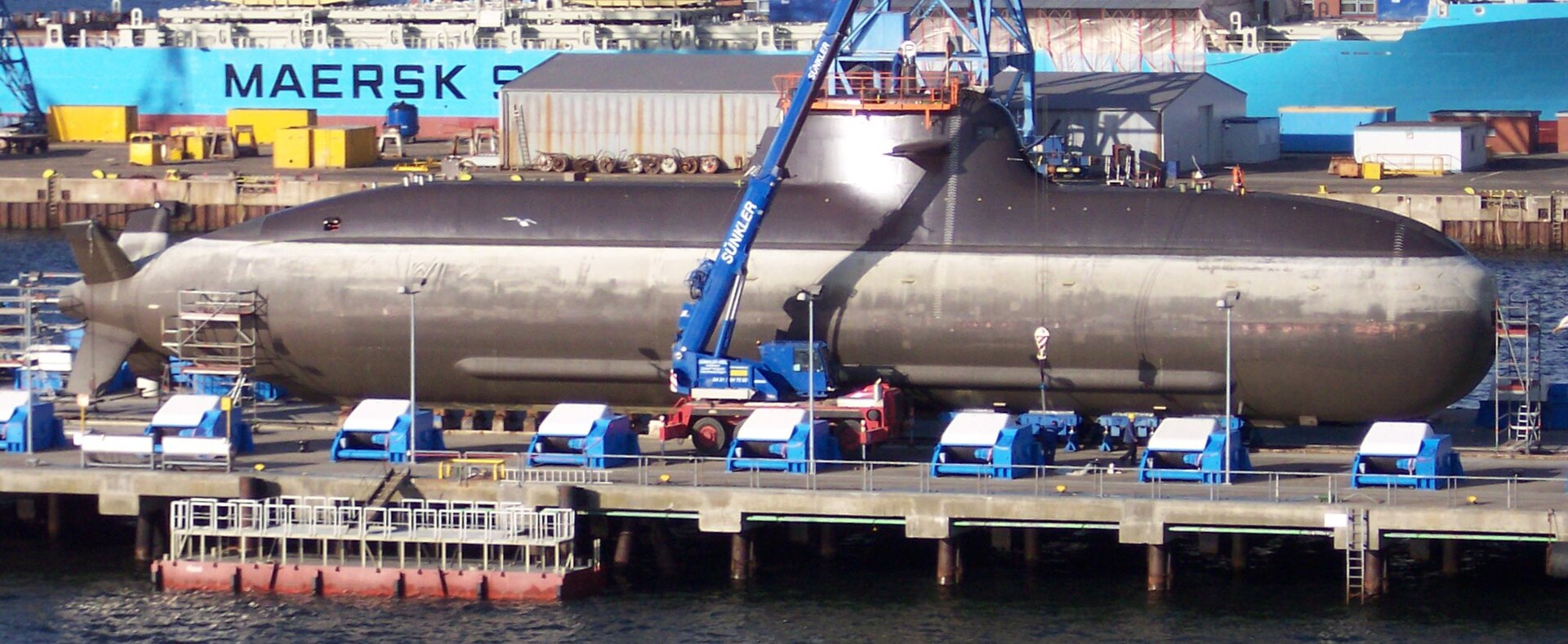
TKMS is the world’s leading exporter of conventional submarines, the Kiel-based builder whose Type 212 and Type 214 boats serve a dozen navies and whose order book has swollen to record size on the back of Europe’s rearmament. Spun into sharper focus as ThyssenKrupp restructures around it, the company sits on confirmed orders for 22 submarines, a growing frigate line and a strategic debate in Berlin about who should control Germany’s naval crown jewel.
TKMS at a glance
| Item | Detail |
|---|---|
| Name | TKMS (ThyssenKrupp Marine Systems) |
| Headquarters | Kiel, Germany |
| Formed | 2005, when ThyssenKrupp combined its yards around Howaldtswerke-Deutsche Werft (HDW) |
| Employees | About 9,100 (2025) |
| Ownership | ThyssenKrupp 51 percent after the 2025 restructuring; Alfried Krupp von Bohlen und Halbach Foundation 10 percent; remainder floated |
| Sites | Kiel (HDW), Wismar, Atlas Elektronik in Bremen, Estaleiro Brasil Sul in Brazil |
| Core products | Type 212A/212CD, Type 214 and Type 218SG submarines; MEKO frigates; F127 program; naval electronics |
From HDW to TKMS, a shipbuilding lineage
The Kiel yard at the heart of TKMS has been building submarines since the imperial era, and its post-war U-boat exports, the Type 209 family, armed navies from South America to Asia in numbers no Western competitor matched. The modern company dates to 2005, when ThyssenKrupp acquired HDW and folded its naval yards together. Two decades later the group added the former Meyer yard in Wismar to expand capacity, and in 2025 ThyssenKrupp listed TKMS as a standalone company, keeping 51 percent.
The submarines that built the brand
TKMS’s signature technology is air-independent propulsion: fuel-cell systems that let a diesel-electric boat stay submerged for weeks, quietly, at a fraction of a nuclear submarine’s cost. The Type 212A introduced it for Germany and Italy; the Type 214 carried it to Greece, South Korea, Portugal and Turkey; and the Type 218SG was built for Singapore. The current flagship is the Type 212CD, a larger, stealth-shaped evolution ordered in 2021 as six identical boats for Germany and Norway in a contract worth 5.5 billion euros, the largest order in the company’s history.
| Class | Customers | Note |
|---|---|---|
| Type 209 (legacy) | 14+ navies since the 1970s | The best-selling export submarine of the Cold War era |
| Type 212A | Germany, Italy | First operational fuel-cell AIP boats |
| Type 214 | Greece, South Korea, Portugal, Turkey (licensed) | Export workhorse of the 2000s-2010s |
| Type 218SG | Singapore | Customized large AIP design |
| Type 212CD | Germany, Norway (6 boats, with expansion under discussion) | Current production; deliveries into the 2030s |
Surface ships and sensors
Submarines are the headline, but the MEKO modular frigate line has been just as influential, with variants serving or under construction for more than a dozen navies, and TKMS leads Germany’s F127 air defense frigate program. Through Atlas Elektronik in Bremen, the group also builds the sonars, torpedoes and unmanned underwater systems that go inside its hulls, a vertical integration few naval builders can match. German naval expansion, from frigates to the new Type 424 intelligence ships, keeps the domestic pipeline full.
How fuel-cell AIP changed the diesel submarine
A conventional submarine’s weakness was always the snorkel: every few days it had to run diesels near the surface to recharge batteries, exactly when it was easiest to find. TKMS’s polymer fuel cells convert stored hydrogen and oxygen directly into electricity with no combustion, no moving parts and little heat, letting a Type 212 stay deep and silent for a couple of weeks at patrol speeds. The trade-offs are cost, hydrogen logistics and modest sustained speed, and rivals now push lithium-ion batteries or Stirling engines as alternatives, but for two decades the fuel cell has been the benchmark the others chase.
The competition, Naval Group, Saab and the Koreans
TKMS’s export throne has real challengers. France’s Naval Group sells the Scorpene widely and won Australia before losing it to AUKUS; Sweden’s Saab is rebuilding its export line around the A26; and South Korea’s Hanwha Ocean and HHI, having learned on licensed Type 209s and 214s, now bid aggressively with the KSS-III, including in Poland and Canada where TKMS also competes. The German advantage remains reference customers and the 212CD’s NATO-standard pedigree; the Korean advantage is price and delivery speed. The next two or three national decisions, Canada and Poland above all, will show whether the crown moves.
A record backlog and a stretched yard
The company’s confirmed backlog stands at 22 submarines plus surface combatants, with public reporting pointing to well over a dozen further boats in advanced negotiations, from additional 212CDs to bids in Poland, India, Canada and the Philippines. That is a decade of visible work, and also the company’s central management problem: submarine halls, skilled welders and suppliers of specialized steel do not scale quickly, which is why the Wismar acquisition and hiring drive matter as much as any new order.
The ownership question in Berlin
TKMS frequently asked questions
What does TKMS build?
Conventional submarines (Type 212A, 212CD, 214, 218SG), MEKO frigates, the German F127 frigate program and naval electronics through Atlas Elektronik.
Who owns TKMS?
ThyssenKrupp holds 51 percent after the 2025 listing, the Krupp Foundation about 10 percent, with the rest publicly traded and the German state holding negotiated oversight rights.
How many submarines does TKMS have on order?
A confirmed backlog of 22 boats, led by the six-submarine, 5.5 billion euro Type 212CD program for Germany and Norway.
What is special about TKMS submarines?
Fuel-cell air-independent propulsion, allowing diesel-electric boats to remain submerged for weeks with very low noise.
Where are TKMS shipyards?
Kiel and Wismar in Germany, Atlas Elektronik in Bremen, and Estaleiro Brasil Sul in Brazil.
- Wikipedia – ThyssenKrupp Marine Systems (accessed October 2026)
- Public reporting on the 2025 restructuring and Type 212CD program
- Company materials on MEKO and Atlas Elektronik