North Korea Tests Cluster-Bomb Warhead for Tactical Ballistic Missiles
North Korea has tested a cluster-bomb warhead designed for its tactical ballistic missiles, state news agency KCNA reported on Sunday, 1 November 2026. The test was carried out on Saturday, 31 October, by the country’s Missile Administration to assess the warhead’s “adaptation to combat and power”, KCNA said (KCNA). South Korea’s military said it had tracked the launch (Yonhap).
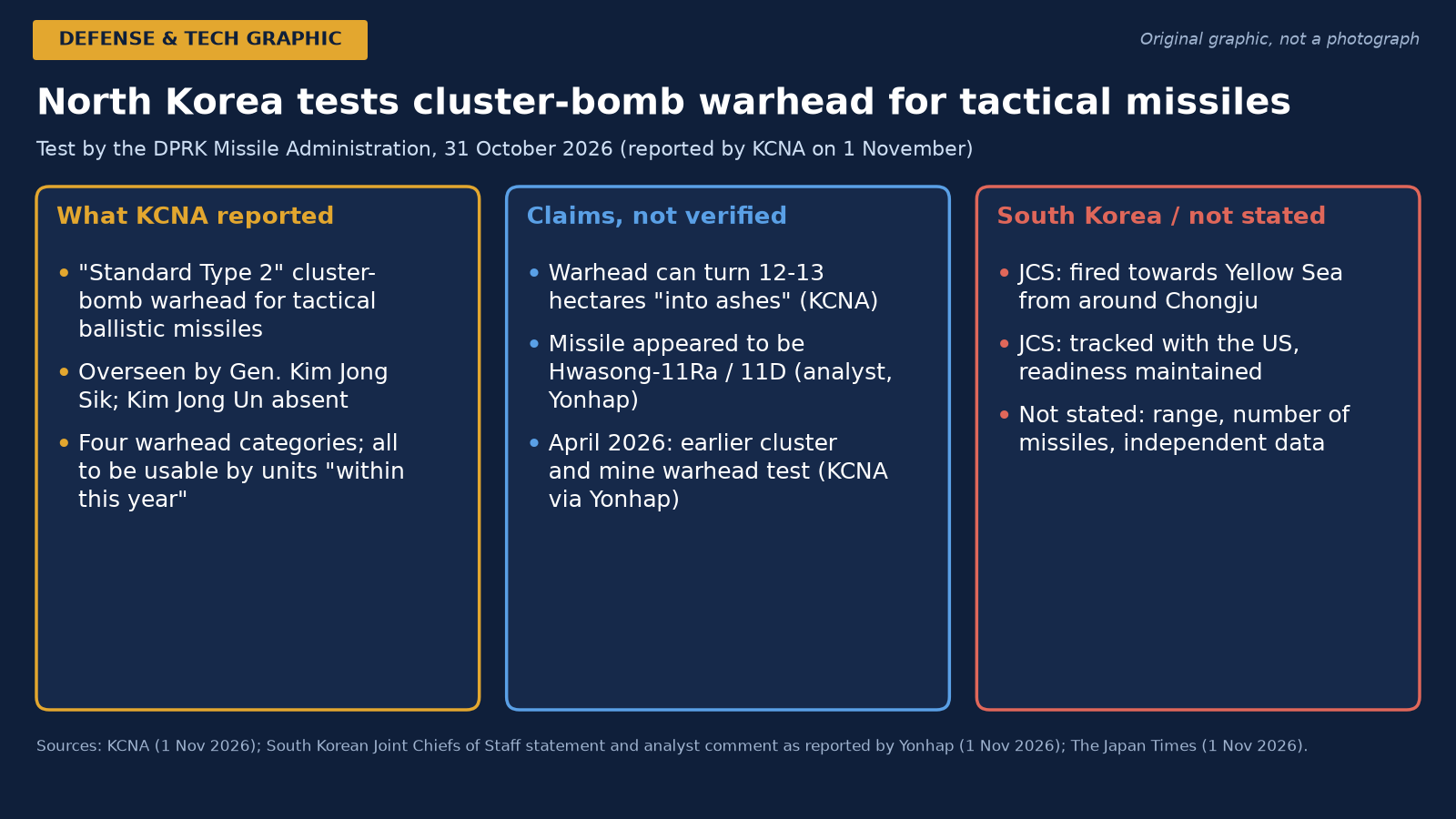
- North Korea’s Missile Administration tested a cluster-bomb warhead for tactical ballistic missiles on 31 October, state media KCNA said
- KCNA claimed the “Standard Type 2” warhead can turn a 12-13 hectare target area “into ashes”; the figure has not been independently verified
- North Korea says it has four categories of cluster warhead and wants units able to use all of them by the end of 2026
- South Korea’s Joint Chiefs of Staff said the missile was fired towards the Yellow Sea from around Chongju and that it tracked the launch with the US
What Pyongyang claims
According to KCNA, the Missile Administration’s Ballistic Missile System Institute and Warhead Institute “confirmed that the Standard Type 2 cluster-bomb warhead is capable of turning into ashes a target area of 12 to 13 hectares with its highest-density power”. That is North Korea’s own assessment; no independent data on the test has been published. The test was overseen by General Kim Jong Sik, a member of the ruling party’s Central Military Commission. Leader Kim Jong Un did not attend (KCNA, The Japan Times).
The Missile Administration’s general director, who was not named, said the warheads are divided into four categories “according to special and standard purposes”, adding: “Within this year we will enable units to select and use all those types according to operational aims and specific features of targets.” KCNA described the launch as “part of regular scientific research activities” (KCNA).
What Seoul says
South Korea’s Joint Chiefs of Staff (JCS) said on Sunday that the missile was fired towards the Yellow Sea from an area around Chongju, a county in the north-west of the country. “Under close information sharing between South Korea and the United States, (we) tracked relevant activities before North Korea’s missile launch and maintained a readiness posture,” the JCS said, according to Yonhap. Unusually, the South Korean military did not announce the launch until the day after it took place (Yonhap). Neither side has given the missile’s flight distance or the number of rounds fired.
Which missile was used
KCNA did not name the missile. Shin Jong-woo, secretary-general of the Seoul-based Korea Defense and Security Forum, told Yonhap it appeared to be the Hwasong-11Ra, written as Hwasong-11D in some English-language reports (Yonhap). The Japan Times said the state-media images showed Hwasong-11D short-range ballistic missiles being fired and the warheads hitting an island target (The Japan Times). The Hwasong-11 name covers a family of North Korean short-range ballistic missiles; for an earlier variant, see our report on the Hwasong-11Ma test.
What a cluster warhead does
A cluster warhead opens in flight and scatters dozens to hundreds of smaller submunitions over an area, rather than delivering a single explosive charge to one aim point. That makes it suited to targets spread across open ground, such as airfields, troop concentrations or air-defence sites. Submunitions that fail to explode can remain a hazard long after an attack. The 2008 Convention on Cluster Munitions bans these weapons for its member states, but North Korea, South Korea and the United States are not parties to it (Convention on Cluster Munitions). For the wider debate, see our cluster munitions explainer.
Previous developments
This is not the first such test. In April 2026, North Korea said it had tested cluster-bomb and fragmentation-mine warheads fitted to the Hwasong-11Ra, a launch attended by Kim Jong Un and his daughter, according to Yonhap (Yonhap). The latest test came as the top diplomats of South Korea, the United States and Japan renewed calls for North Korea’s complete denuclearisation at talks in Atlanta (Yonhap). It follows a run of North Korean weapons announcements this autumn, including submarine-launched Hwasal-2 cruise missiles.
Why it matters
Pairing submunition warheads with short-range ballistic missiles is aimed at area targets rather than precise points. For air and missile defence in South Korea, that raises the cost of a missed intercept, because a warhead that is not destroyed before it opens can affect a much wider area than a unitary charge. How layered defences deal with this kind of threat is explained in our guide to missile defence layers. North Korea’s stated goal of fielding all four warhead categories with units by the end of the year is a claim that outside observers will only be able to judge over time.
Sources: KCNA (1 November 2026); South Korean Joint Chiefs of Staff statement and analyst comment as reported by Yonhap (1 November 2026); The Japan Times (1 November 2026); Convention on Cluster Munitions implementation support unit.