
Iskander, the Russian Missile That Learned to Dodge
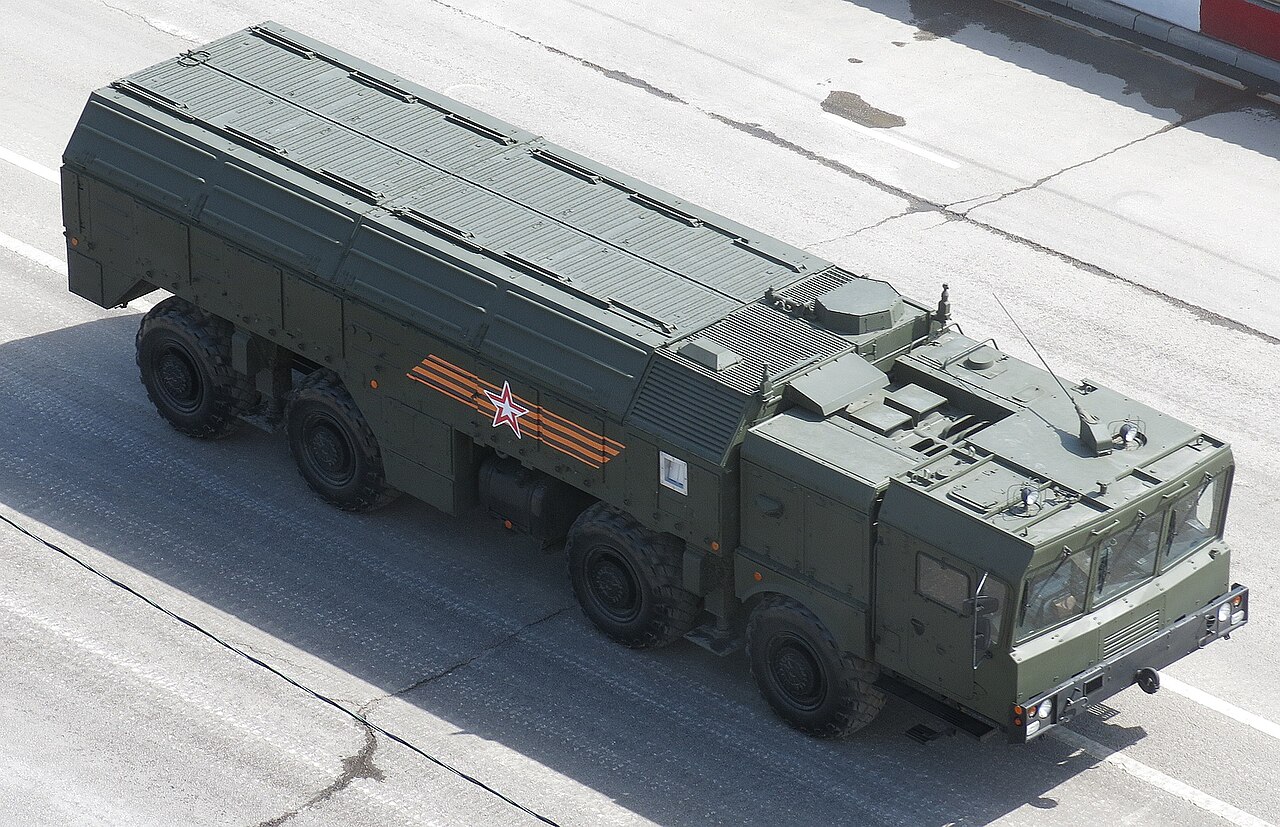
No Russian weapon has shaped the Ukraine war’s deep battle more than the 9K720 Iskander, a short-range ballistic missile that flies low for its class, maneuvers on the way down and has been upgraded mid-war specifically to beat Patriot. Understanding it is understanding why no rear-area city in range ever feels safe.
What the Iskander is
Iskander-M is Russia’s standard operational-tactical ballistic missile, a 3.8-tonne, 7.3-meter weapon fired from a wheeled transporter-erector-launcher that carries two rounds. It replaced the Soviet-era Tochka series with something in a different class entirely, combining inertial and GLONASS satellite guidance with, on some rounds, a terminal optical correlation seeker that Russian sources credit with accuracy of five to seven meters.
An export version, Iskander-E, is capped at 280 kilometers to fit missile technology control limits, while the domestic Iskander-M reaches an estimated 400 to 500 kilometers. The system entered service in 2006 and has been produced at an accelerating rate since 2022, with Russian claims of more than 1,400 combat launches against Ukraine, figures that cannot be independently verified.
Quasi-ballistic, the trajectory trick
A classic ballistic missile follows a predictable arc, which is precisely what interceptor fire-control computers exploit. Iskander does not cooperate. It flies a flattened, depressed trajectory, staying inside the atmosphere where aerodynamic surfaces work, and can maneuver during boost and in its terminal dive. Defenders therefore face a target whose future position is genuinely uncertain rather than computable.
This is why the system is often labeled quasi-ballistic, and why it sits closer to the hypersonic maneuvering problem than its short range suggests. Every Iskander intercept requires the defending battery to solve a harder geometry than the Scud-era threats many air defense systems were originally designed around.
Warheads and the K variant
| Variant | Type | Range | Notes |
|---|---|---|---|
| Iskander-M | Quasi-ballistic missile | 400-500 km | Russian service standard |
| Iskander-E | Export ballistic | 280 km | MTCR-compliant, Armenia, Algeria |
| Iskander-K (9M728) | Cruise missile | ~500 km | Same launcher, TERCOM guidance |
| 9M729 | Cruise missile | Disputed | Missile behind the INF Treaty collapse |
The missile carries conventional loads from unitary high explosive to cluster and penetrating warheads, and is certified for nuclear delivery with yields reported between five and fifty kilotons, which is why every Iskander deployment to Kaliningrad or Belarus carries political weight beyond the hardware. The same launcher also fires the 9M728 cruise missile as Iskander-K, and its longer-ranged sibling 9M729 triggered the American withdrawal from the INF Treaty in 2019.
The Patriot duel over Ukraine
Ukraine’s Patriot batteries initially achieved operator-reported intercept rates against Iskander that surprised even optimists. The response came as software and hardware upgrades on the Russian side, with missiles observed performing sharper terminal maneuvers and dispensing decoys in their final seconds. Ukrainian officials acknowledged through 2025 that intercept rates against upgraded Iskanders had fallen significantly, a rare public admission of an adaptation cycle running in the attacker’s favor.
The duel matters far beyond Ukraine. Every army watching has absorbed the lesson that ballistic missile defense is not a solved problem but a contest of update cycles, and that a missile cheap enough to fire in salvos can impose defensive costs wildly out of proportion to its own price.
Who operates it
Russia fields Iskander brigades across its military districts, Belarus received the system in 2022 and has since claimed a nuclear-capable role for it, Armenia purchased the export version, and Algeria operates it as well. For most other interested buyers the system remains off the table, both for political reasons and because the missile technology control regime caps what Russia can legally export.
Production in Wartime
Prewar Western estimates assumed Russia could build perhaps fifty Iskander missiles a year. Sanctions were supposed to strangle even that, since the guidance sections depend on imported microelectronics. Instead, Ukrainian intelligence and Western trade-flow investigations documented components rerouted through third countries, and by 2025 Kyiv assessed Russian ballistic missile production at several dozen rounds per month across the Iskander family, alongside growing deliveries of North Korean KN-23 missiles that copy the Iskander’s flight profile.
The production story may be the most consequential part of the whole system. A missile that can be replaced faster than the defender replaces interceptors wins the exchange war over time regardless of individual intercept outcomes, and it is the reason Western planners now talk about defending against salvos per week rather than missiles per war.
Frequently asked questions
What is the range of the Iskander missile?
The domestic Iskander-M is estimated at 400-500 km; the export Iskander-E is limited to 280 km.
Can Patriot intercept Iskander?
Yes, Ukrainian operators have reported many successful intercepts since 2023, but Russian mid-war upgrades adding terminal maneuvering and decoys have reportedly reduced success rates.
Is Iskander nuclear-capable?
Yes, it is certified for nuclear warheads with reported yields of 5-50 kilotons, alongside a full range of conventional options.
What is the difference between Iskander-M and Iskander-K?
Iskander-M is the quasi-ballistic missile; Iskander-K uses the same launcher to fire 9M728 cruise missiles.
- Wikipedia – 9K720 Iskander (accessed October 2026)
- Ukrainian Air Force statements on intercept rates (operator-reported)
- Arms control reporting on the 9M729 and INF Treaty