

Ballistic Missile
9K720 Iskander
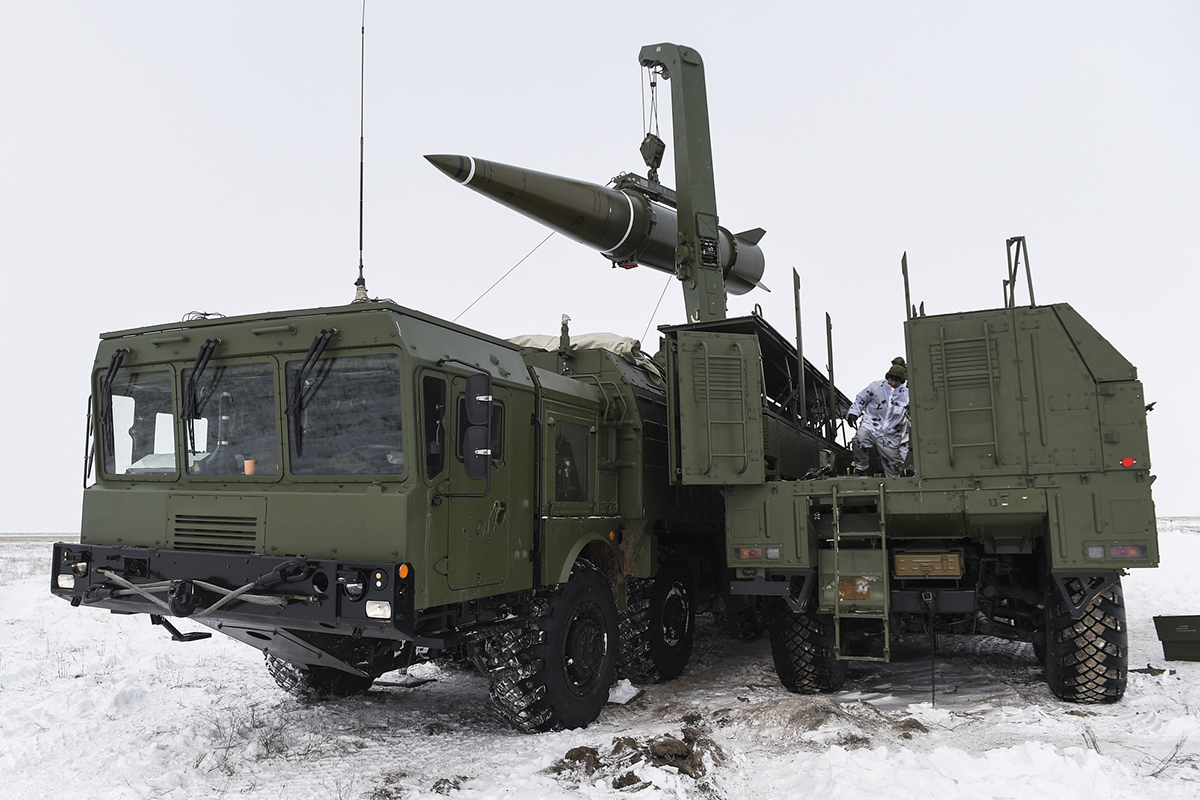
The 9K720 Iskander (NATO: SS-26 Stone) is a Russian road-mobile short-range ballistic missile system designed by KBM in Kolomna. Replacing the Tochka, it fires quasi-ballistic and cruise missiles and has become one of Russia’s main precision strike weapons in Ukraine.
 Russia|KBM (Kolomna)
Overview
After a first test launch in 1996, the Iskander was adopted by the Russian Army in 2006. The 9M723 missile is about 7.3 m long, weighs roughly 3,800 kg and reaches up to 500 km, manoeuvring in flight to complicate interception at estimated speeds of Mach 6–7. Its 480–700 kg warhead can be conventional or nuclear. The 9P78-1 launcher on an MZKT 8×8 chassis carries two missiles, while the Iskander-K fires the 9M728 and 9M729 ground-launched cruise missiles.
Russia fields around a dozen Iskander brigades, Belarus received the system from 2022 and Armenia operates the export Iskander-E; Algeria is reported to have it as well. The 9M729 led the US to leave the INF Treaty in 2019, and deployments in Kaliningrad have long worried NATO. Russia has used Iskanders extensively against Ukraine since 2022, where Ukraine reports interceptions by Patriot and SAMP/T. Their reported use in Georgia in 2008 and Nagorno-Karabakh in 2020 remains disputed.
Key Specifications
Variants
Main Russian version firing the 9M723 quasi-ballistic missile out to about 500 km.
Cruise missile version firing the 9M728 (R-500) and the 9M729, the missile at the centre of the INF Treaty dispute.
Export version limited to about 280 km under MTCR rules, operated by Armenia.
Operators
Russia Belarus
 Armenia
Frequently Asked Questions
What is the range of the Iskander?
The Iskander-M’s 9M723 missile has a range of up to 500 km, while the export Iskander-E is limited to about 280 km. The US assessed that the Iskander-K’s 9M729 cruise missile exceeds the INF Treaty’s 500 km limit.
How much does an Iskander missile cost?
The Iskander’s price is not public. Press estimates put a single missile at about $3 million, but that figure is unverified, and a full system with launchers, reload vehicles and support costs far more.
Can Patriot intercept Iskander?
Ukraine reports regular interceptions of Iskander-M missiles by Patriot PAC-3 and SAMP/T systems, while Russia reports high hit rates. Neither side’s totals can be independently verified, and the Iskander’s in-flight manoeuvres are designed to make interception harder.
Iskander vs ATACMS: which is better?
The Iskander-M has the longer range, about 500 km against roughly 300 km for ATACMS, and a heavier warhead. ATACMS is lighter and fired from HIMARS or M270 launchers, and the US is replacing it with the longer-range PrSM.
Which countries have the Iskander?
The Iskander is operated by Russia, Belarus and Armenia, which has the export Iskander-E. Algeria is reported to operate the Iskander-E as well, but this has not been officially confirmed.
Why is Iskander in Kaliningrad?
Russia has deployed Iskander-M units in its Kaliningrad exclave since about 2016–2018, putting much of Poland and the Baltic states within range. That makes the system a recurring issue in NATO-Russia tensions.
