The 2024 NGAD Pause: Why the Air Force Nearly Dropped the F-47

Eight months before Boeing won the F-47 contract, the Air Force stopped the competition and asked whether it needed the aircraft at all. The pause was ordered in July 2024 by Frank Kendall, then Air Force secretary and one of the programme’s original backers. He cited cost and a changing threat. A review followed, and in December he left the decision to the incoming Trump administration.
The episode matters because the questions raised in 2024 have not gone away. The answers the Air Force gave then are the case for the F-47 now.
What happened in 2024
In May 2023 the Air Force asked industry for proposals and said it would pick a winner in 2024. By mid-2024 that plan was in doubt. In June the chief of staff, Gen. David Allvin, declined to commit to the programme when asked. In July Kendall confirmed that the source selection was on hold.
Work did not stop entirely. Boeing and Lockheed Martin kept their technology-maturation contracts, which were later extended, and were asked to update their schedules. But no winner was chosen, and for several months the Air Force openly discussed alternatives to its own flagship programme. Our NGAD timeline places the pause in the longer history.
Why Kendall stopped the contest
Kendall gave two reasons. The first was price. He said the aircraft would cost “multiple hundreds of millions” of dollars each, and estimates at the time were around $300 million, roughly three times an F-35A. An air force could afford only a small fleet at that price.
The second was the threat. Chinese air defences and long-range missiles had advanced since the requirement was written. Kendall was no longer sure the design was the right answer, particularly when bases and tankers near China looked increasingly exposed.
Behind both lay the budget. The Sentinel intercontinental missile had breached its cost limits, with its estimate rising to about $141 billion, and the B-21 bomber was moving into production. There was also a new factor in the form of Collaborative Combat Aircraft. If cheap uncrewed jets could carry much of the load, the crewed fighter might not need to do everything itself.
The alternatives on the table
The Air Force looked at several different ways to achieve the same end.
| Option | The idea | Outcome |
|---|---|---|
| Proceed with NGAD | Large, long-range crewed stealth fighter | Chosen; became the F-47 |
| Cheaper crewed fighter | A smaller aircraft at about F-35 cost, mainly to direct drones | Not pursued |
| Stand-off strike | Rely more on the B-21 and long-range weapons | Judged insufficient on its own |
| Stealth tanker (NGAS) | A survivable tanker to extend existing fighters | Reported to have been scaled back |
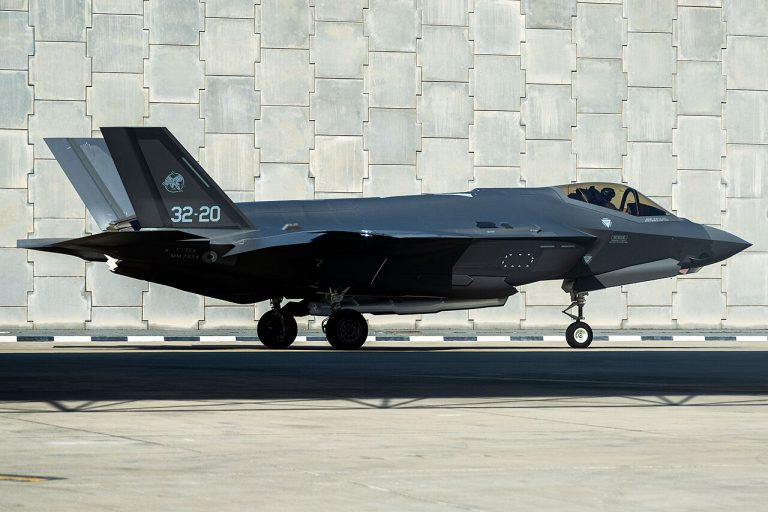
Kendall floated the cheaper option in public. In September 2024 he suggested a crewed aircraft priced close to an F-35, at about $80 million, which would act mainly as a controller for uncrewed aircraft. It would have had less range and payload than the original design.
The stand-off option would have shifted the weight of an air campaign to bombers and long-range missiles, giving up the attempt to put fighters over the most heavily defended areas.
What the review concluded
Kendall set up a panel of former senior officials with experience of stealth programmes, and the Air Force ran its own analysis alongside it. The result was made public at the Air & Space Forces Association symposium on 4 March 2025.
Maj. Gen. Joseph Kunkel, the service’s director of force design, said the study had tested a range of options and that “there was no more viable option than NGAD to achieve air superiority”. Gen. Kenneth Wilsbach, then head of Air Combat Command, made the wider argument: “The entire joint force counts on air superiority.”
In other words, the review found that drones and bombers could add to a crewed penetrating fighter but could not replace it. Kendall, who left office in January 2025, said the review had found value in going ahead. He still doubted the money was there, and put the cost of finishing development at about $20 billion.
What changed, and what did not
The decision passed to the new administration, which made it quickly. The contract went to Boeing on 21 March 2025, less than three weeks after the study was described in public. Our article on why Boeing won covers the selection itself.
The requirement appears to have survived largely intact. The F-47 is a large, long-range crewed fighter, with a combat radius above 1,000 nautical miles on the Air Force’s own graphic. The cheaper drone-controller concept was dropped.
The cost problem was deferred, not solved. There is still no official unit price, and estimates run from $180 million to $300 million, as our cost guide sets out. Funding has risen to about $3.5 billion in fiscal 2026 and a request of about $5 billion for 2027. The pressure from Sentinel and the B-21 that prompted the pause is still in the budget.
Frequently asked questions
Was NGAD cancelled in 2024?
No. The source selection was paused in July 2024 while the Air Force reviewed the requirement. The programme resumed with a contract award in March 2025.
Who paused NGAD?
Frank Kendall, then secretary of the Air Force.
Why was NGAD paused?
Kendall cited a unit cost of several hundred million dollars and doubts about whether the design matched a changing threat. Other large programmes were also squeezing the budget.
What alternatives were considered?
A cheaper crewed aircraft to direct drones, greater reliance on bombers and long-range weapons, and a stealthy tanker to extend existing fighters.
What did the review find?
That no other option was as viable as NGAD for achieving air superiority in heavily defended airspace.
Did the pause delay the F-47?
It delayed the contract award from 2024 to March 2025. The Air Force still plans a first flight in 2028.
- The War Zone – Next Generation Fighter Critical To Future Air Superiority, Key USAF Study Concluded: twz.com
- Defense One – ‘No more viable option than NGAD,’ Air Force says as decision rests in new hands: defenseone.com
- Air & Space Forces Magazine – Air Force Defers Decision on NGAD to New Trump Administration: airandspaceforces.com
- Breaking Defense – A year of next-gen fighter doubts for the Air Force: 2024 in review: breakingdefense.com
- Air Force Times – Air Force defers NGAD decision to Trump administration: airforcetimes.com