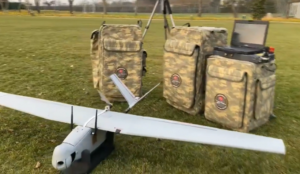

Bayraktar TB2 vs Shahed-136, Two Drones, Two Doctrines

The Bayraktar TB2 and the Shahed-136 are the two drones that defined the 2020s, yet they could hardly be more different, a reusable $5 million surveillance-strike aircraft against a one-way attack munition reportedly costing under $50,000. Comparing them is really a comparison of two doctrines, precision airpower for the mid-tier military versus saturation bombardment on an industrial budget.
Why compare a UCAV with a kamikaze drone
Because budget offices do. Nations shopping for unmanned strike capability face exactly this fork, a reusable armed drone that surveils, designates and strikes with guided munitions, or expendable deep-strike munitions bought by the thousand. The TB2, built by Turkey’s Baykar, is the flagship of the first path; the Iranian-designed Shahed-136, mass-produced in Russia as the Geran-2, defines the second, part of the family covered in our loitering munitions explainer.
Bayraktar TB2 vs Shahed-136 specs
| Item | Bayraktar TB2 | Shahed-136 / Geran-2 |
|---|---|---|
| Type | Reusable armed ISR drone (MALE UCAV) | One-way attack munition |
| Wingspan | 12 m | About 2.5 m |
| Takeoff weight | Around 700 kg | Roughly 200 kg |
| Payload | 150 kg, four MAM guided munitions | Warhead around 40–50 kg, integral |
| Endurance / range | Up to 27 h on station, datalink-limited radius | 1,000–2,000+ km claimed one-way |
| Speed | About 130 km/h cruise | Around 185 km/h |
| Guidance | Remote crew, EO/IR sensor, laser designation | Preprogrammed GNSS/INS; newer versions add updates |
| Reported cost | Around $5 million per aircraft | Reported tens of thousands of dollars in Russian production |
| Reuse | Returns and re-arms | Destroyed on use |
What the Bayraktar TB2 does best
The TB2 is an airpower starter kit. It loiters for a day, finds targets with a stabilized EO/IR ball, designates for its own MAM-L micro-munitions or for artillery, and comes home. In Karabakh in 2020 and Ukraine’s opening weeks it destroyed air defenses, armor and logistics on camera, and its export list, more than 30 countries by Baykar’s account, made it a diplomatic instrument. Its heavier sibling, the Akinci, extends the same model upward.
Its weakness is survivability against a functioning integrated air defense. A 130 km/h aircraft with a large radar signature lives only where enemy SAMs are suppressed, absent or jammed, which is why TB2 losses mounted in mid-2022 Ukraine and its role there shifted to maritime patrol and stand-off spotting.
What the Shahed-136 does best
The Shahed-136 weaponizes cheapness. A mopped-propeller airframe, commercial-grade electronics and a preset course produce a munition accurate enough for fixed targets, power plants, depots, factories, at a cost that makes intercepting it with missiles economically painful. Fired in volleys mixed with decoys, it forces defenders to reveal and drain their air defenses; every interceptor spent on a Shahed is unavailable for a cruise missile. Russian production at Yelabuga has pushed volumes into the tens of thousands, with newer jet-powered and datalinked variants reported.
Combat record in Ukraine
Ukraine’s experience wrote both verdicts. Ukrainian operator-reported figures typically credit defenses with intercepting a large majority of Shaheds in most raids, yet the minority that leak through, multiplied by nightly volleys, have systematically damaged the power grid and defense industry. Against them, cheap gun systems like the Gepard, electronic warfare and now interceptor drones carry the load. The TB2’s Ukrainian moment came early, Bayraktar songs and sunk landing craft, before dense Russian air defense pushed it back from the front line; it remains in service for reconnaissance and coastal strike.
Which drone wins by mission
| Mission | Better fit | Why |
|---|---|---|
| Persistent surveillance | Bayraktar TB2 | A munition cannot loiter and report for hours |
| Precision strike on moving targets | Bayraktar TB2 | Live sensor and laser-guided munitions |
| Deep strike on fixed infrastructure | Shahed-136 | Range and cost allow mass and attrition |
| Defense saturation and cost imposition | Shahed-136 | Forces expensive interceptors against cheap airframes |
| Contested airspace | Neither alone | TB2 needs suppressed defenses; Shaheds need volume to leak through |
| Small military on a budget | TB2 first | Reusable capability, training and prestige per dollar |
TB2 vs Shahed frequently asked questions
Is the Shahed-136 a drone or a missile?
Functionally it sits between, a propeller-driven one-way attack munition, often called a kamikaze drone, destroyed in every strike.
How much does a Shahed-136 cost compared to a TB2?
Reported figures put Russian-built Shaheds in the tens of thousands of dollars, versus around $5 million for a TB2 aircraft, roughly a hundredfold gap.
Why did TB2s stop dominating in Ukraine?
Dense Russian surface-to-air coverage made the slow, non-stealthy aircraft too vulnerable near the front, shifting it to safer reconnaissance roles.
What share of Shaheds does Ukraine shoot down?
Ukrainian operator-reported rates are often above 80% per raid, but nightly volume means meaningful numbers still get through.
Can the TB2 shoot down Shaheds?
Intercepting drones is not its role; counter-Shahed work falls to guns, electronic warfare, SAMs and interceptor drones.
- Baykar product literature for TB2 figures
- Analyst estimates and reporting on Shahed-136/Geran-2 production and cost
- Ukrainian operator-reported interception figures as noted
- Wikipedia – Bayraktar TB2 and HESA Shahed 136 (accessed October 2026)
- Defence & Tech reporting on drone warfare