Top 10 Infantry Fighting Vehicles (IFVs) in the World in 2026
Infantry fighting vehicles (IFVs) carry soldiers into battle and then fight alongside them with cannons and anti-tank missiles. The war in Ukraine has shown how vital they are, and how vulnerable to drones, mines and artillery. This ranking weighs protection, firepower, mobility, technology and real-world combat record.
- Best-protected: Puma (Germany)
- Most successful European family: CV90
- Most combat-proven in Ukraine: M2 Bradley
- Key trend: active protection and anti-drone defenses
1. Puma (Germany)
Arguably the best-protected IFV in service, with modular armor up to around 43 tonnes, an unmanned turret with a 30 mm airburst cannon and Spike missiles. Reliability problems hurt its reputation, but the upgraded S1 version is closing the gap.
2. CV90 Mk IV (Sweden)
Operated by Sweden, Norway, Finland, Denmark, the Netherlands, Switzerland and others, the CV90 is Europe’s most successful IFV family. The latest Mk IV adds more power, active protection and digital systems, and Ukrainian crews have praised its performance.
3. Lynx KF41 (Germany/Hungary)
Rheinmetall’s modular IFV is in service with Hungary and was chosen by Italy, which plans a large fleet based on it. It can carry a 30 or 35 mm cannon, missiles and drones.
4. AS21 Redback (South Korea/Australia)
Built by Hanwha for Australia’s Land 400 program, the Redback combines Israeli Iron Fist active protection, rubber tracks for a quieter ride and a 30 mm turret with Spike missiles.
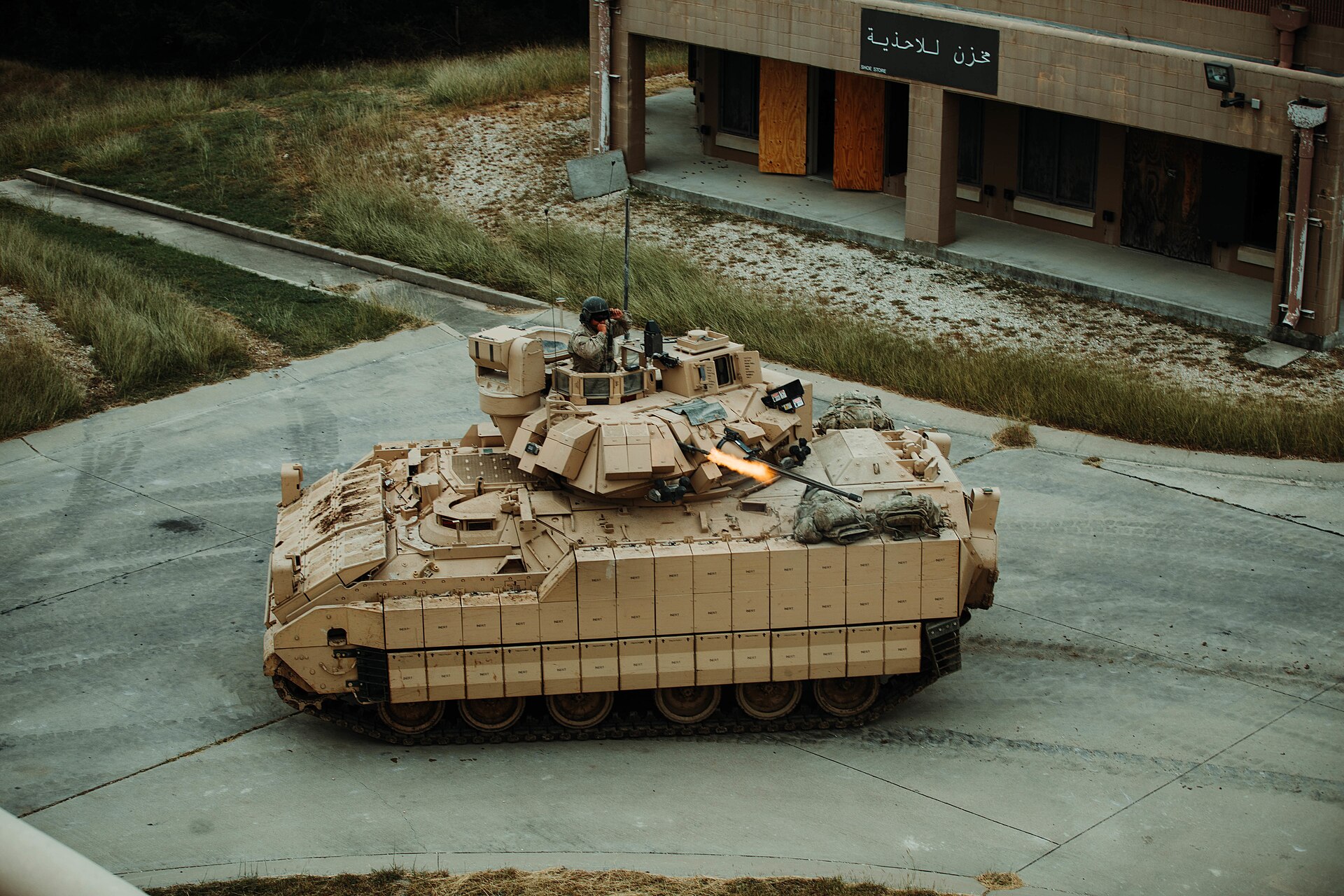
5. M2A4 Bradley (United States)
The Bradley has fought from Iraq to Ukraine, where it gained fame for surviving hits and destroying Russian tanks with its 25 mm cannon and TOW missiles. The A4 version adds a more powerful engine and better electronics. Its replacement, the XM30, is in development.
6. K21 (South Korea)
A lightweight, amphibious IFV with a 40 mm cannon, built for Korean terrain and the basis for the Redback.
7. BMP-3 (Russia)
Heavily armed with a 100 mm gun-launcher and a 30 mm cannon, the BMP-3 packs more firepower than most rivals, but its thin armor has led to heavy losses in Ukraine.
8. ZBD-04A (China)
China’s main tracked IFV, with a 100 mm gun and 30 mm cannon, improved armor and modern fire control.
9. Tulpar (Türkiye)
Otokar’s modular tracked vehicle can be configured as an IFV or light tank and has been tested by several export customers.
10. Kurganets-25 (Russia)
A modern design with an unmanned turret, unveiled in 2015 but produced only in small numbers so far, reflecting Russia’s struggles to field new-generation armor.
The trend
Next-generation IFVs are heavier, carry active protection systems, use unmanned turrets and increasingly launch their own drones. Ukraine has shown that no amount of armor is enough without protection against top-attack drones.
Featured image: U.S. Army / Public domain, via Wikimedia Commons