Russia’s Artillery: Howitzers, Rocket Launchers and Shells
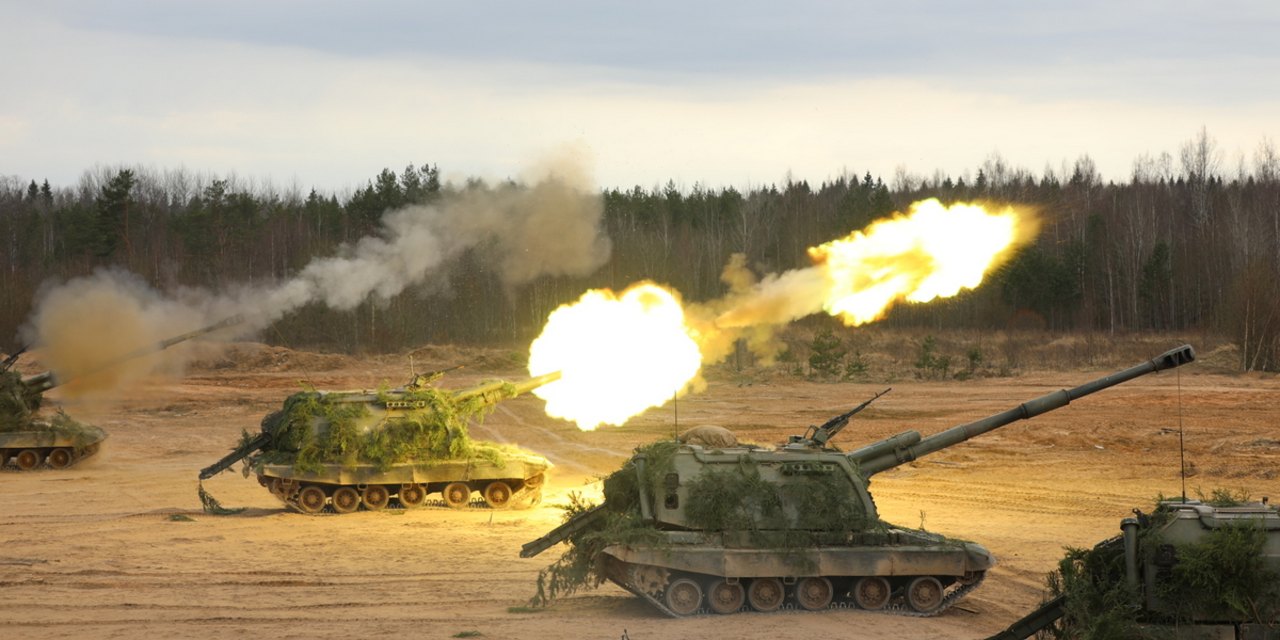
Russia has the largest artillery force in Europe and built about 7 million artillery rounds of all kinds in 2025, according to Estonia’s foreign intelligence service. Guns and rocket launchers remain the backbone of how the Russian army fights, firing more than 10,000 rounds a day along the front in Ukraine.
This guide covers the main Russian guns and rocket launchers, how much ammunition Russia makes and imports, how drones have changed the artillery war and what has been lost.
What artillery does Russia have?
Russian doctrine has treated artillery as the main killing arm since the Second World War. A Russian brigade has far more guns and rocket launchers than a NATO formation of the same size, and commanders use them to destroy positions before infantry move forward.
The inventory is almost entirely Soviet in origin. Standard calibers are 122 mm and 152 mm for guns, against NATO’s 155 mm, and 122, 220 and 300 mm for rockets. Before 2022 the army also held thousands of older guns in storage, many of which have since been pulled out and sent to the front. The wider army is described in how big Russia’s army is.
Russia’s guns and howitzers
| System | Type | Caliber | Maximum range |
|---|---|---|---|
| 2S19 Msta-S | Tracked self-propelled howitzer | 152 mm | 25 to 29 km |
| 2S3 Akatsiya | Tracked self-propelled howitzer | 152 mm | About 18 km |
| 2S1 Gvozdika | Tracked self-propelled howitzer | 122 mm | About 15 km |
| 2S5 Giatsint-S | Tracked self-propelled gun | 152 mm | 28 to 33 km |
| 2S7M Malka | Tracked self-propelled gun | 203 mm | 37 to 47 km |
| 2S35 Koalitsiya-SV | Tracked self-propelled howitzer | 152 mm | More than 40 km |
| 2S43 Malva | Wheeled self-propelled howitzer | 152 mm | About 25 km |
| 2A65 Msta-B | Towed howitzer | 152 mm | About 25 km |
| D-30 | Towed howitzer | 122 mm | About 15 km |
The 2S19 Msta-S is the standard modern gun, comparable to older versions of the American M109. The Koalitsiya-SV, with an automated turret and a longer barrel, was meant to replace it but has reached units only in small numbers. The wheeled Malva, in service since 2023, reflects a lesson of the war: trucks are cheaper and quicker to move after firing than tracked vehicles. The 152 mm Krasnopol laser-guided shell gives these guns a precision option when a drone can mark the target.
Grad, Uragan and Tornado-S rocket launchers
| System | Caliber | Rockets | Range |
|---|---|---|---|
| BM-21 Grad / Tornado-G | 122 mm | 40 | 20 to 40 km |
| BM-27 Uragan | 220 mm | 16 | About 35 km |
| BM-30 Smerch / Tornado-S | 300 mm | 12 | 90 to 120 km |
| TOS-1A Solntsepyok | 220 mm thermobaric | 24 | 6 to 10 km |
The Grad has been in production since the 1960s and saturates an area the size of several football fields in seconds. The Tornado-S is the modern end of the family, firing guided 300 mm rockets to 120 km, and is Russia’s nearest equivalent to the American HIMARS. The two are compared in HIMARS vs Tornado-S. The thermobaric launcher is covered in our TOS-1A guide.
How many shells does Russia produce?
Estonia’s foreign intelligence service estimated in its 2026 annual report that Russia produced about 7 million artillery rounds in 2025, against roughly 400,000 in 2021. The total included about 3.4 million howitzer shells, 2.3 million mortar bombs and 500,000 rockets, at a cost of around 1 trillion rubles.
| Measure | Figure | Source |
|---|---|---|
| Production in 2021 | About 400,000 rounds | Estonian foreign intelligence |
| Production in 2025 | About 7 million rounds | Estonian foreign intelligence |
| Imports from North Korea and Iran since 2023 | 5 to 7 million shells | Estonian foreign intelligence |
| Peak firing rate, spring 2022 | About 60,000 rounds a day | Estonian foreign intelligence |
| Later firing rate | 10,000 to 15,000 rounds a day | Estonian foreign intelligence |
North Korea has been the decisive outside supplier. South Korean military intelligence estimated in 2025 that Pyongyang had shipped the equivalent of more than 12 million 152 mm shells, along with rocket launchers and long-range guns.
How drones changed Russian artillery
In 2022 artillery caused most casualties on both sides. By 2025 small drones had taken that place, and they changed how guns are used. Reconnaissance drones find targets and correct fire within minutes, which makes artillery more accurate. Attack drones also hunt the guns themselves, so batteries now disperse, dig in under nets and fire a few rounds before moving.
Russia uses its own Lancet drones to destroy Ukrainian guns. The effect on both sides has been to push artillery further back and to favor range and mobility over weight of fire.
How much artillery has Russia lost?
Oryx has visually confirmed well over 1,500 Russian towed guns, self-propelled guns and rocket launchers destroyed or damaged. Ukraine’s General Staff claims a figure many times higher, which cannot be verified. Barrel wear is a quieter problem: guns firing thousands of rounds need new barrels, and Russia has stripped stored weapons to supply them.
To fill gaps Russia has returned Soviet-era D-20 and M-46 guns to service and fielded North Korean artillery. Armored losses are covered in how many tanks Russia has.
Frequently asked questions
How many artillery shells does Russia produce a year?
About 7 million rounds of all types in 2025, including roughly 3.4 million howitzer shells, according to Estonian intelligence.
What caliber is Russian artillery?
Mostly 152 mm and 122 mm for guns, and 122, 220 and 300 mm for rocket launchers. NATO’s standard is 155 mm.
What is Russia’s best artillery gun?
The 2S35 Koalitsiya-SV is the most advanced but is scarce. The 2S19 Msta-S is the main modern gun in service.
What is the Russian equivalent of HIMARS?
The Tornado-S, which fires guided 300 mm rockets to about 120 km.
Does North Korea supply Russia with shells?
Yes. South Korean intelligence estimates deliveries equivalent to more than 12 million 152 mm shells.
- Estonian Foreign Intelligence Service – International Security and Estonia 2026: valisluureamet.ee
- Militaer Aktuell – Estonian secret service: Russia multiplies production of artillery shells: militaeraktuell.at
- Oryx – Documenting Russian equipment losses during the invasion of Ukraine: oryxspioenkop.com
- RUSI – Assessing North Korea’s contribution to Russia’s war in Ukraine: rusi.org
- IISS – The Military Balance 2026: iiss.org