JF-17 Block III Specs, Radar, Missiles and Operators
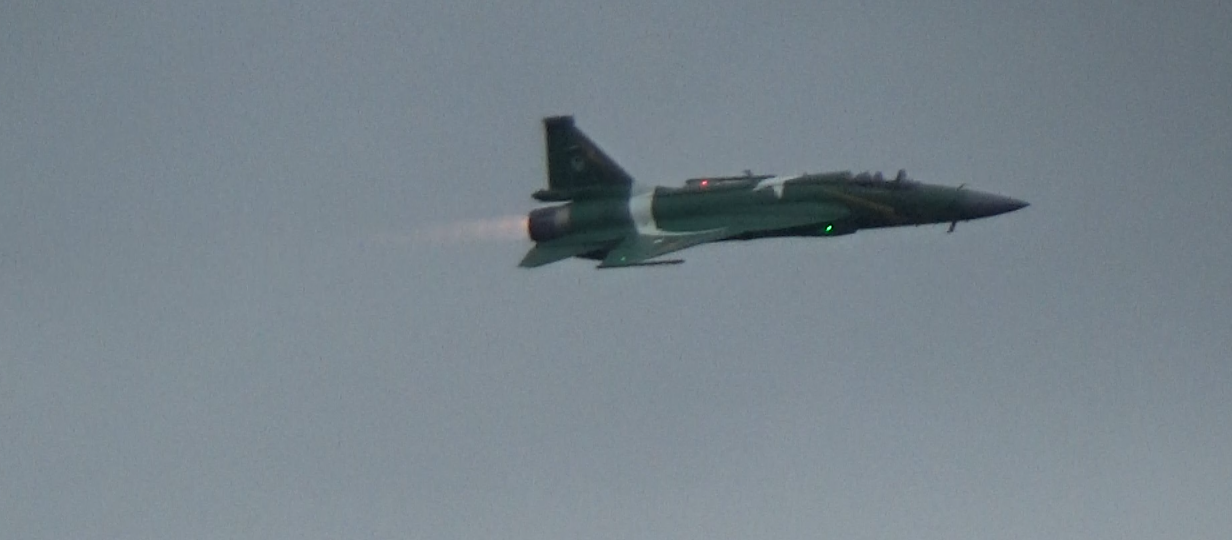
The JF-17 Block III is the most capable version of the Pakistan-China lightweight fighter, adding an AESA radar, a helmet-mounted sight and compatibility with the PL-15 missile to a jet that costs a fraction of a Western fourth-generation fighter. Built by Pakistan Aeronautical Complex Kamra with China’s Chengdu Aircraft, the JF-17 family has become a rare example of a low-cost export fighter that actually sells.
What is the JF-17 Block III
The JF-17 Thunder, known in China as the FC-1 Xiaolong, began as a joint effort in the 1990s and first flew in 2003. Pakistan wanted a modern replacement for aging Mirage III, Mirage 5 and A-5 aircraft without paying for a US or European fighter. The Block III, which Pakistan has been receiving since the early 2020s, is the first version to bring the jet close to current-generation sensors.
The aircraft is a single-engine, single-seat multirole fighter built around a conventional airframe with a pair of fixed intakes. Most figures below are manufacturer and operator claims, because independent testing data on Chinese-origin systems is scarce. Treat them as indicative rather than verified.
JF-17 Block III specifications
| Parameter | Value |
|---|---|
| Crew | 1 (a two-seat JF-17B trainer also exists) |
| Length | About 14.9 m |
| Wingspan | About 9.5 m with wingtip rails |
| Maximum takeoff weight | About 12,700 kg |
| Engine | One Klimov RD-93 turbofan (Russian design), roughly 8,300 kgf with afterburner |
| Maximum speed | About Mach 1.6, manufacturer claim |
| Combat radius | Roughly 1,200 km in a hi-lo-hi profile, claimed |
| External hardpoints | 7, carrying roughly 3,700 kg |
| Radar | KLJ-7A AESA, detection range claimed in the 100 km class for fighter targets |
| Cannon | One 23 mm GSh-23-2 twin-barrel gun |
JF-17 Block III radar and weapons
The headline upgrade is the KLJ-7A AESA radar, a Chinese set that replaces the older mechanically scanned radar on earlier blocks. An AESA set usually improves detection range, tracking of multiple targets and resistance to jamming, a topic we explain in how AESA radar works. The radar is paired with a helmet-mounted display, a new cockpit display layout and improved electronic warfare gear.
The Block III is compatible with the Chinese PL-15 beyond-visual-range missile, which China claims reaches roughly 200 to 300 km in export form. That claim is a manufacturer figure. The jet also carries PL-5 and SD-10 missiles, laser-guided bombs, anti-ship weapons such as the C-802, and Pakistani-developed cruise missiles, including the Ra’ad air-launched weapon.
JF-17 Block I, II and III compared
| Block | Entered service | Main features |
|---|---|---|
| Block I | 2010 | Basic multirole fighter, mechanically scanned radar, limited weapons |
| Block II | About 2016 | Air-to-air refueling probe, improved datalink, more weapon options |
| Block III | About 2020 onward | KLJ-7A AESA radar, helmet-mounted display, PL-15 capability, upgraded avionics |
| JF-17B | First flew 2017 | Two-seat trainer and light attack variant |
Block III airframes are also reported to carry a larger share of Pakistani-built systems, including some electronic warfare and mission computer components. Industry reports have discussed a Chinese WS-13 engine as a way to reduce reliance on the Russian RD-93, but no confirmed fleet-wide change has been announced.
Who operates the JF-17
Pakistan is by far the main operator, with well over 100 aircraft across Blocks I to III. Myanmar and Nigeria were the first export buyers, and Azerbaijan signed a reported deal for around 40 jets in 2024, which was the largest JF-17 export to date. Other nations, including Iraq and Libya-based forces, have been reported as buyers or evaluators, although details are less certain. Indonesia and other countries have also been linked to talks.
Price is the selling point. Reported unit costs fall in the tens of millions of dollars, well below the newest Western fighters. The trade-off is lower performance and a supply chain that runs through both Beijing and Moscow. For how the JF-17 sits among export rivals, see our guide to the J-10C and our top 10 fighter jets of 2026.
JF-17 combat record
The JF-17 saw action against militants in Pakistan’s tribal areas and was involved in the February 2019 clash with India. During the India-Pakistan fighting in May 2025, Pakistan said its J-10C and JF-17 aircraft shot down several Indian aircraft, a claim India disputed. Independent confirmation of the exact losses and of which aircraft fired which missile remains limited. Claims from both governments should be read as claims rather than established facts.
JF-17 frequently asked questions
Who makes the JF-17 Block III?
Pakistan Aeronautical Complex Kamra builds it with China’s Chengdu Aircraft Corporation as co-developer.
Is the JF-17 Block III a fifth-generation fighter?
No. It is a fourth-generation-plus multirole fighter with an AESA radar but no stealth shaping.
How fast is the JF-17 Block III?
About Mach 1.6 according to manufacturer figures, which is typical for a light single-engine fighter.
Which countries fly the JF-17?
Pakistan, Myanmar, Nigeria and Azerbaijan have been reported as operators, with other buyers reported or under discussion.
Can the JF-17 fire the PL-15?
Yes, the Block III is reported as compatible with the PL-15, though the missile’s export range figures are claims.
- Pakistan Air Force and PAC Kamra public materials (manufacturer claims)
- SIPRI Arms Transfers Database
- Wikipedia – CAC/PAC JF-17 Thunder (accessed October 2026)
- Defence & Tech reporting