Rudram Missile Explained: India’s Anti-Radiation Missile Family, Range and Su-30MKI Role

Before an air force can strike deep inside enemy territory, it must deal with enemy radars and surface-to-air missiles. That job, known as suppression of enemy air defences (SEAD), needs specialised weapons. India’s answer is the Rudram family, a series of home-grown air-launched missiles designed to find and destroy radars and other high-value ground targets.
- Developed by India’s DRDO for the Indian Air Force
- Rudram-1 is a new-generation anti-radiation missile, first tested in October 2020
- Rudram-2, tested in May 2024, has a range of around 300 km
- Rudram-3 is planned with an even longer range
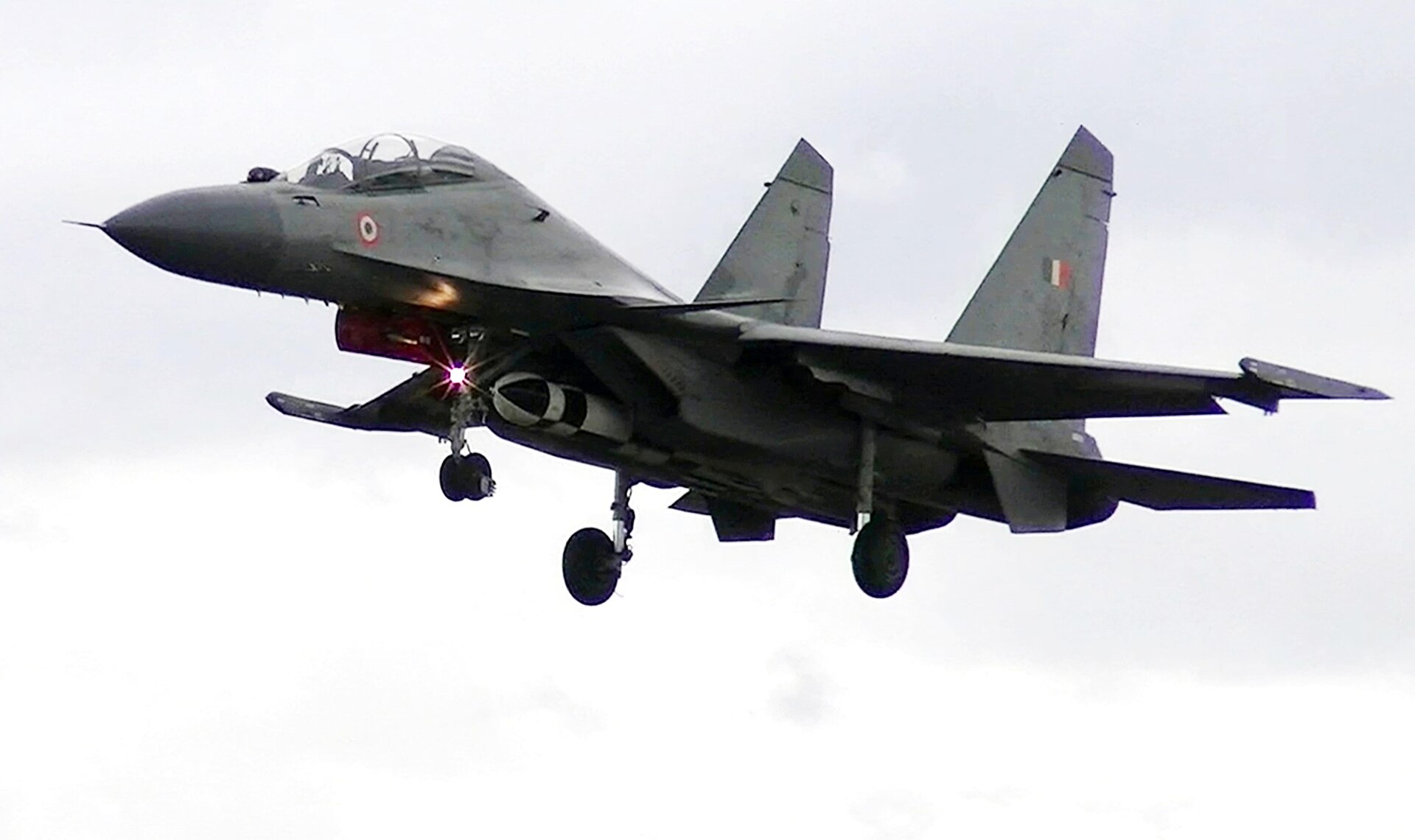
- Launched from the Su-30MKI, with integration on other fighters expected
What is the Rudram?
Rudram, named after a Sanskrit word linked to the god Rudra, is a family of air-to-surface missiles developed by the Defence Research and Development Organisation. The first member, Rudram-1, is India’s first indigenous anti-radiation missile, built to home in on radar emissions. Later versions expand the family into longer-range strike weapons against a wider range of ground targets.
How an anti-radiation missile works
An anti-radiation missile carries a passive seeker that detects the radio signals emitted by enemy radars. After launch, it navigates using inertial guidance supported by satellite navigation, including India’s NavIC system, and then uses its seeker to home in on the radar. Rudram-1 can also remember a radar’s location if it is switched off, a common tactic to defeat such missiles.
Rudram-1
Rudram-1 was first test-fired from a Su-30MKI over the Bay of Bengal on 9 October 2020. It flies at around Mach 2 and its range depends on launch altitude and speed, with figures of roughly 100 to 250 km reported. It is designed to destroy surveillance, tracking and fire-control radars, opening a path for following strike aircraft.
Rudram-2 and Rudram-3
Rudram-2 is a larger, solid-fuelled air-to-surface missile with a range of around 300 km. DRDO carried out a successful flight test from a Su-30MKI off Odisha on 29 May 2024. It is meant to hit radars, command posts, bunkers and other fixed targets from stand-off range. Rudram-3, still in development, is expected to reach well beyond that, giving the Indian Air Force a long-range strike option without relying on imported missiles.
Why it matters for India
China and Pakistan have both built dense air defence networks, including long-range systems such as the HQ-9. Without effective SEAD weapons, Indian strike aircraft would face high risks. The Rudram family gives the IAF a home-built way to target those defences and reduces dependence on foreign suppliers whose weapons may come with restrictions.
Verdict
The Rudram programme marks India’s entry into a small group of countries that design their own anti-radiation missiles. Once the full family is in service, it will strengthen the Su-30MKI as a deep-strike platform and form a key part of India’s growing arsenal of indigenous air-launched weapons.
Featured image: Ministry of Defence / GODL-India, via Wikimedia Commons