
V-22 Osprey Explained: Speed, Range, Variants and the Tiltrotor’s Safety Record
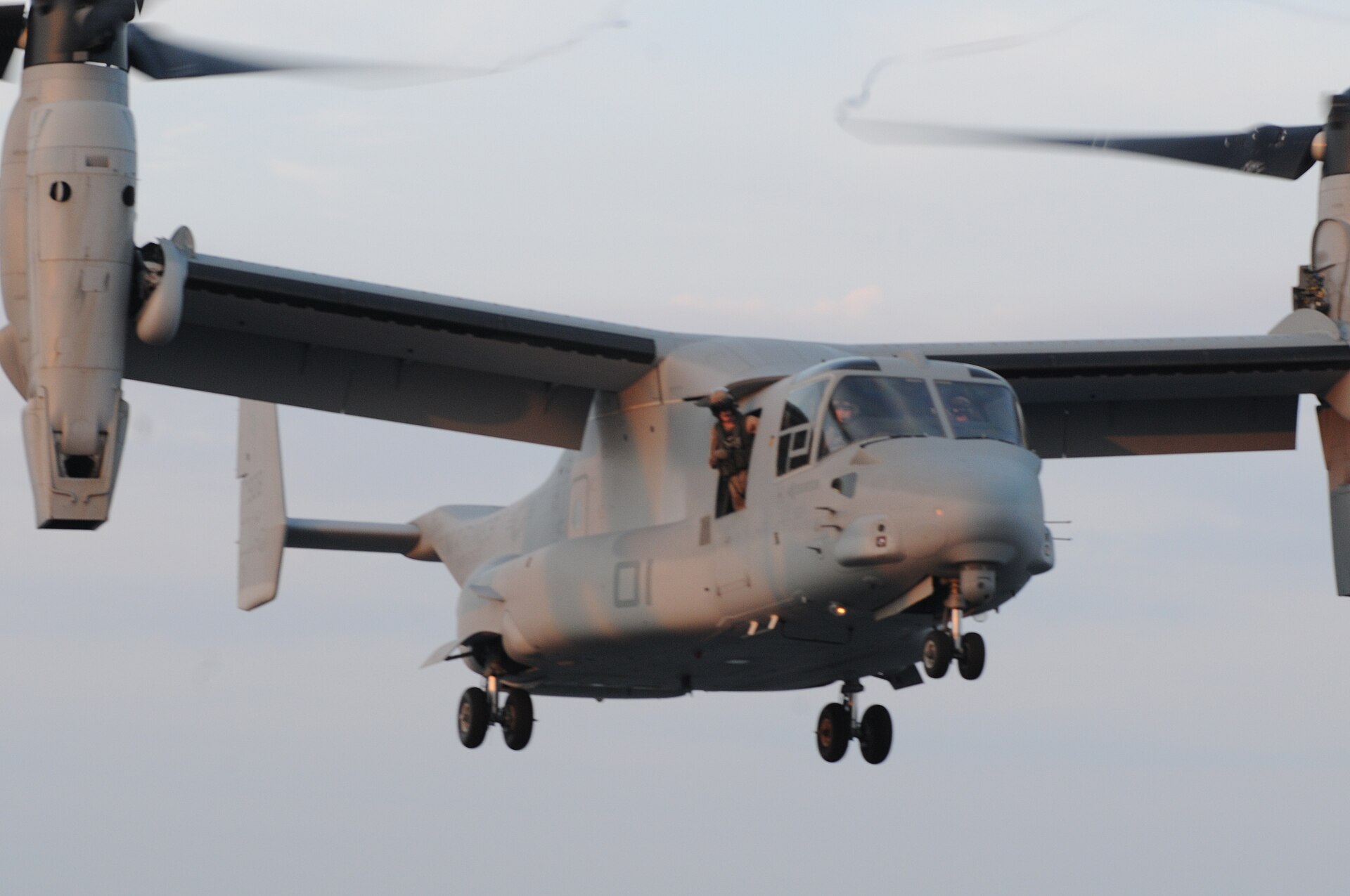

The V-22 Osprey takes off like a helicopter and flies like an aeroplane. That unique combination has made it indispensable to the US Marine Corps, Air Force special operations and Navy, but it has also brought controversy because of high-profile crashes. Here is what the Osprey does and why it remains in demand.
- Tiltrotor aircraft built by Bell and Boeing
- First flight in 1989; entered US Marine Corps service in 2007
- Cruise speed of about 450-500 km/h, around twice that of a typical helicopter
- Carries about 24 combat-equipped troops
- Variants: MV-22B (Marines), CV-22B (Air Force), CMV-22B (Navy)
How the Osprey works
The V-22 has two large proprotors mounted on engine nacelles at the tips of its wings. For take-off and landing, the nacelles point upwards and the aircraft behaves like a helicopter. In flight, they rotate forward and the Osprey flies on its wings like a turboprop aeroplane. Two Rolls-Royce AE1107C engines are linked by a cross-shaft so that one engine can drive both rotors in an emergency.
Speed and range
The Osprey cruises at around 450-500 km/h and has a combat radius of several hundred kilometres, extendable with air-to-air refuelling. That lets Marines launch raids or evacuations from ships far offshore, and lets special forces reach targets much faster than with conventional helicopters.
Variants
The MV-22B is the Marine Corps assault transport and makes up most of the fleet. The CV-22B, flown by Air Force Special Operations Command, adds terrain-following radar and extra fuel for long-range special missions. The CMV-22B is the Navy’s carrier onboard delivery aircraft, carrying people, mail and F-35 engines to aircraft carriers. Japan’s Ground Self-Defense Force is the only foreign operator.
Safety record
The Osprey’s development was marked by fatal accidents, and crashes in recent years have renewed concern. In November 2023 an Air Force CV-22 crashed off Yakushima, Japan, killing all eight crew members. The entire fleet was grounded for about three months. Investigators linked several incidents to problems with the proprotor gearbox, and flight restrictions and inspections were introduced while fixes were developed. Supporters note that its overall accident rate is comparable with other military rotorcraft.
The future
More than 400 Ospreys have been built, and production is winding down. The US military plans to keep the fleet flying into the 2050s through upgrades and reliability programmes. Meanwhile the US Army has chosen a newer tiltrotor, Bell’s MV-75 (based on the V-280 Valor), to replace many of its Black Hawks, showing that the tiltrotor concept the Osprey pioneered has a long future.
Verdict
The V-22 Osprey transformed how the US military moves troops: faster, farther and from ships at sea. Its safety problems are real and must be solved, but no other aircraft currently in service offers the same mix of vertical lift and speed.
Featured image: Marines from Arlington, VA, United States / Public domain, via Wikimedia Commons