
Bayraktar Akinci, the Heavy Drone Carrying Turkey’s Ambitions
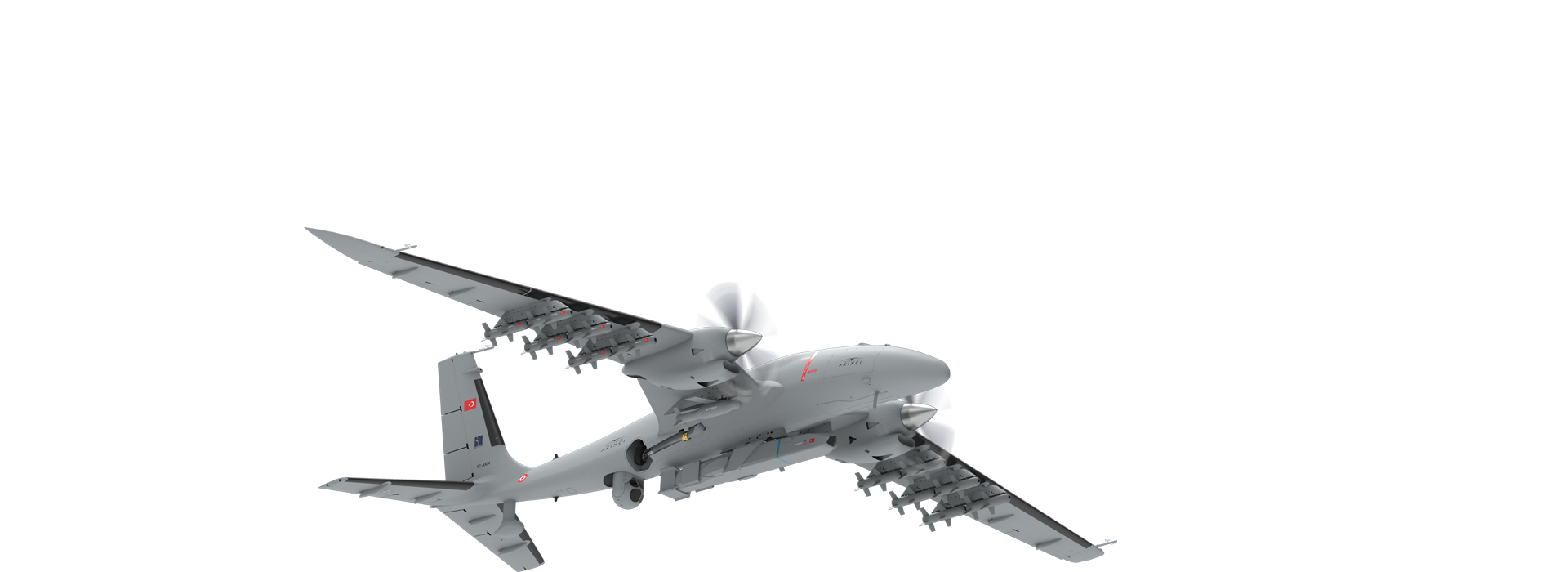
The Bayraktar Akinci is Baykar’s heavyweight, the drone that took the Turkish company from tactical TB2s into the class of aircraft that carry a ton and a half of weapons, fire air-to-air missiles and stay aloft for a day. In service since 2021 and exported to a dozen countries, the Akinci is the platform on which Turkey is testing how far a drone can go toward doing a fighter-bomber’s job.
What is the Bayraktar Akinci
Akinci, Turkish for raider, is a high-altitude long-endurance armed drone developed by Baykar. It first flew on December 6, 2019 and entered Turkish service on August 29, 2021. Where the TB2 is a light tactical aircraft, the Akinci is a twin-turboprop platform with a 20-meter wingspan and a six-tonne takeoff weight, built to carry heavy standoff weapons, cruise missiles and a radar of its own. It anchors the top end of a Turkish drone family whose broader market we ranked in our top combat drones list.
Akinci specifications
| Parameter | Figure |
|---|---|
| Manufacturer | Baykar, Turkey |
| First flight / service entry | December 6, 2019 / August 29, 2021 |
| Wingspan | 20 m |
| Maximum takeoff weight | 6,000 kg |
| Payload | 1,500 kg external and internal stations |
| Engines | Two turboprops; 450 hp, 750 hp or 850 hp options |
| Service ceiling | 13,716 m (45,000 ft) |
| Endurance | 24+ hours |
| Communications | Dual satellite links plus line-of-sight |
Sensors and the flying-radar role
The Akinci’s sensor fit is what moves it beyond strike work. Alongside the usual electro-optical turret it can carry ASELSAN’s MURAD 100-A AESA radar in the nose plus a synthetic-aperture radar with moving-target indication, giving it stand-off ground surveillance and a real air picture of its own, the technology background is in our AESA explainer, and much of the electronics comes from ASELSAN. Dual SATCOM links let it operate far beyond line of sight, which is what made its export runs to Africa and the Gulf practical.
Weapons the Akinci carries
The integration list is unusually broad for a drone: the full MAM family of smart micro-munitions, laser and GPS-guided bombs including penetrators, the SOM-A cruise missile for standoff strike, supersonic missiles in test, anti-ship weapons, and, most distinctively, the Gokdogan and Bozdogan air-to-air missiles, making the Akinci one of the few drones anywhere cleared to shoot at aircraft. In practice its heavy stations let one aircraft mix surveillance pods and weapons on the same sortie.
Where Akinci sits in Baykar’s lineup
| Aircraft | Class | Payload | Role |
|---|---|---|---|
| Bayraktar TB2 | Tactical MALE | 150 kg | Armed surveillance, the export bestseller |
| Bayraktar TB3 | Ship-capable MALE | 280 kg | Short-deck operations from TCG Anadolu |
| Bayraktar Akinci | Heavy HALE | 1,500 kg | Standoff strike, flying radar, heavy weapons |
| Bayraktar Kizilelma | Jet UCAV | 1,500 kg class | Low-observable jet, loyal-wingman trajectory |
The ladder matters commercially: TB2 customers are upsell candidates, and several, Pakistan, Azerbaijan, Morocco among them, have already climbed to the Akinci. Above it, the jet-powered Kizilelma points where the family goes next, toward the collaborative combat aircraft category the US and China are also chasing.
Development story and production
Akinci went from program launch to first flight in roughly three years, flying on December 6, 2019, with the PT-1 prototype, and Baykar iterated through test aircraft at a pace that had the type certified and delivered by August 2021. Production runs at Baykar’s Istanbul-area plants alongside the TB2 line; the company has said its combined output makes it the world’s highest-volume drone exporter by aircraft count, and the Saudi localization deal extends assembly abroad for the first time. Engines remain the visible dependency: Ukrainian and Turkish turboprops power current aircraft, and engine-supply politics, not airframes, set the program’s tempo risk.
Who operates the Akinci
| Region | Countries |
|---|---|
| Home | Turkey (Armed Forces, Gendarmerie and intelligence service) |
| Caucasus and South Asia | Azerbaijan; Pakistan (deliveries reported from 2023) |
| Gulf | Saudi Arabia (with local production agreement), United Arab Emirates |
| Africa | Morocco, Libya, Ethiopia, Somalia, Burkina Faso, Mali, Sudan |
The Saudi deal, announced in 2023 as Baykar’s largest export contract and including local production, is the standout, tying Akinci output into Gulf industrial plans. Exact unit costs are not published; reporting around export packages suggests tens of millions of dollars per aircraft with ground systems, far below Western heavyweight drones.
Combat and notable operations
Turkish Akincis flew their first combat mission on February 13, 2022 and have since worked over Iraq and Syria in strike and surveillance roles. The aircraft drew global attention in May 2024 when a Turkish Akinci located the crash site of the Iranian president’s helicopter in mountainous fog, a search task that showcased exactly the sensor reach the platform sells on. In 2023 earthquake relief, Akincis served as communications relays over the disaster zone.
Akinci frequently asked questions
How much can the Bayraktar Akinci carry?
1,500 kilograms of payload across internal and external stations, against about 150 kg for the TB2.
How long can the Akinci fly?
More than 24 hours, at altitudes up to 45,000 feet.
Can the Akinci shoot down aircraft?
It is integrated with Turkey’s Bozdogan and Gokdogan air-to-air missiles, one of the few drones with that capability, though no air-to-air kill has been reported.
Which countries have bought the Akinci?
Reported operators include Azerbaijan, Pakistan, Saudi Arabia, the UAE, Morocco, Libya, Ethiopia, Somalia, Burkina Faso, Mali and Sudan, alongside Turkey.
What engines does the Akinci use?
Twin turboprops in 450, 750 or 850 horsepower configurations, giving operators a cost-performance choice.
- Wikipedia – Baykar Bayraktar Akinci (accessed October 2026)
- Baykar published specifications (manufacturer figures)
- Public reporting on export customers and the May 2024 Iran search operation