Tandem Warheads Explained, How They Beat Reactive Armor
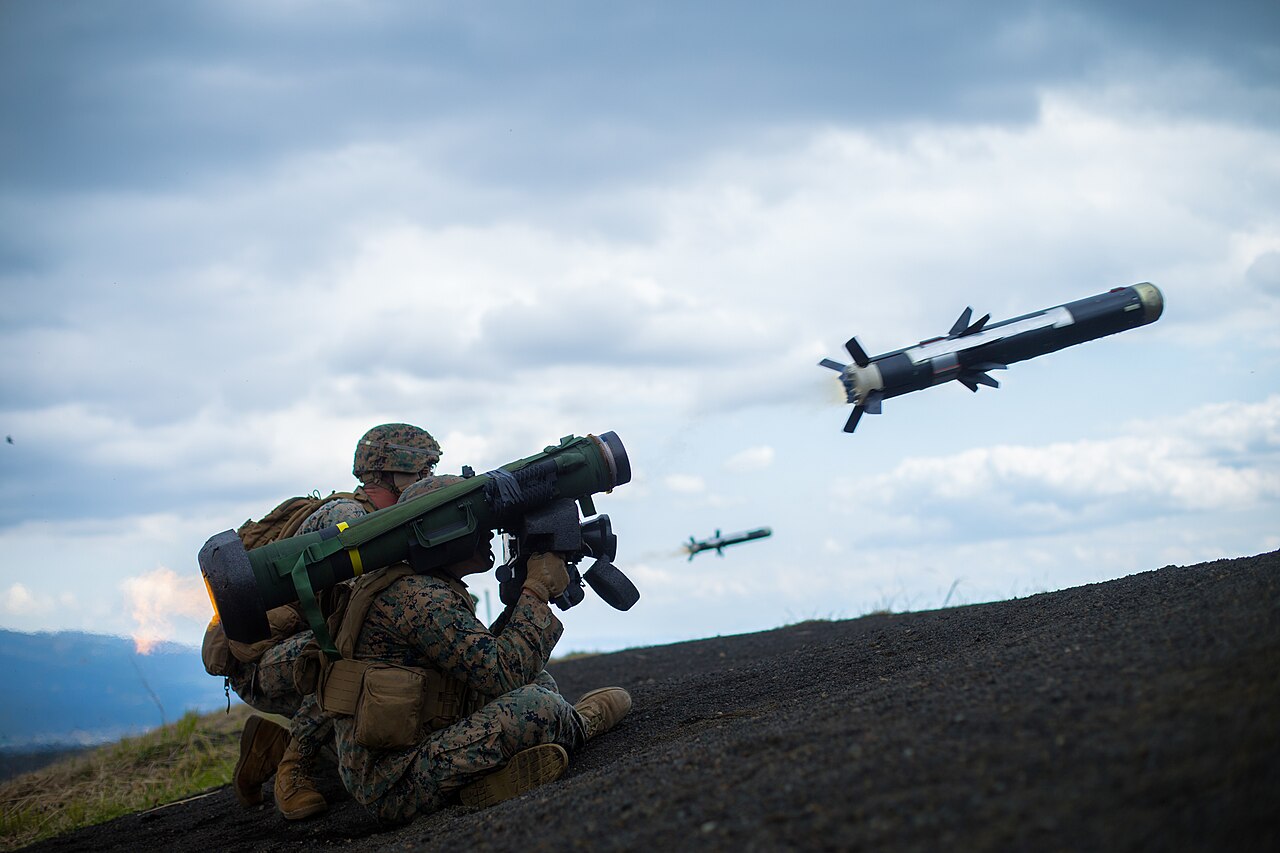
A tandem warhead defeats explosive reactive armor by firing two shaped charges microseconds apart, the first to trigger the armor’s explosive tiles, the second to punch through the hull they no longer protect. The design is why missiles like the Javelin still kill tanks wrapped in reactive bricks, and it has shaped every serious anti-armor weapon built since the 1980s.
How does a tandem warhead work
A shaped charge focuses its explosive energy into a thin, hypervelocity jet of metal, usually copper, that drills through armor. A tandem warhead stacks two of them on one missile. The small precursor charge in the nose detonates first against whatever it meets, reactive armor, a cage, a roof screen, and sacrifices itself to strip that layer away. A fraction of a millisecond later the much larger main charge, set further back in the body, fires its jet down the cleared path into the base armor.
The engineering challenge is keeping the second jet intact. The precursor’s blast, debris and the detonating reactive tile all threaten to disrupt the main charge, so designers tune the delay between detonations, shield the main liner, and set the charges at a standoff distance that lets each jet form properly. Those microseconds of timing are the difference between a kill and a scorch mark.
Why reactive armor forced the tandem design
Explosive reactive armor, fielded widely on Soviet tanks from the mid-1980s as Kontakt-1 and later Kontakt-5, sandwiches explosive between steel plates. When a shaped-charge jet strikes, the sandwich detonates and drives the plates across the jet’s path, shredding it before it reaches the hull. Against single-charge weapons of the era it was devastatingly effective, and it threatened to make an entire generation of NATO missiles obsolete overnight.
The tandem warhead was the direct answer, spend a small charge to make the armor explode on your terms, then attack the now-bare tank. Nearly every anti-tank missile designed or upgraded since, from the TOW-2A onward, carries one, and the measure-countermeasure race has continued through newer Russian armor generations like Relikt, whose claimed effectiveness against modern tandems comes from Russian sources and should be read that way.
| Armor generation | Era | How it works | Tandem counter |
|---|---|---|---|
| Kontakt-1 | Mid-1980s | Single explosive sandwich disrupts shaped-charge jets | Defeated by first-generation tandem precursors |
| Kontakt-5 | Late 1980s | Heavier plates add protection against some kinetic rounds | Modern tandem ATGMs designed specifically against it |
| Relikt | 2000s | Dual-layer reaction, claimed effective against tandems | Effectiveness claims come from Russian sources |
| Cage / slat armor | 2000s-today | Stands off the precursor before it can function properly | Partially effective; top attack bypasses most coverage |
Which weapons use tandem warheads
| Weapon | Origin | Class | Note |
|---|---|---|---|
| FGM-148 Javelin | USA | Fire-and-forget ATGM | Tandem charge plus top attack against thin roof armor |
| TOW-2A | USA | Wire/RF-guided ATGM | Early tandem answer to reactive armor |
| Akeron MP | France | 5th-generation ATGM | Tandem shaped charge with selectable modes |
| AGM-114 Hellfire (anti-armor variants) | USA | Helicopter/drone-launched missile | Tandem charge on anti-tank versions |
| HJ-12 | China | Fire-and-forget ATGM | Tandem warhead, per Chinese state media |
| 9M133 Kornet | Russia | Laser-guided ATGM | Tandem charge, penetration figures are manufacturer claims |
| RPG-29 / PG-7VR | Russia | Rocket-propelled grenades | Tandem rounds that brought the concept to infantry |
The Javelin is the best-known case because it combines a tandem charge with top attack, diving onto the turret roof where armor is thinnest and reactive coverage is patchiest. Ukraine’s early-war ambush successes against Russian columns, widely documented on video, made it the poster weapon for the combination, and the same logic drives loitering munitions that dive on tanks from above with shaped-charge payloads.
Tandem warheads beyond anti-tank
The two-stage idea also scales up. Bunker-busting and anti-runway weapons use a tandem sequence in which a shaped precursor blows a channel through concrete or earth and a follow-through bomb flies into the cavity before exploding, the approach used by the BROACH warhead on the Storm Shadow cruise missile. The physics differ in detail, penetration by jet versus penetration by momentum, but the grammar is the same, first charge opens the door, second charge walks through it.
What defeats a tandem warhead
Passive answers include spaced and slat armor that triggers the precursor too early, thicker composite arrays behind the reactive layer, and dual-layer reactive bricks designed to present a second explosive element to the main jet. The more decisive answer is the active protection system, which intercepts the incoming missile before any warhead functions at all, a capability race covered in our guide to modern tank protection ecosystems. None of it is absolute; Ukraine has shown that saturation, top attack and drone-corrected fire eventually find every armor scheme’s bad angle.
Tandem warheads frequently asked questions
What is a tandem warhead?
A warhead with two shaped charges fired in rapid sequence. The small precursor detonates reactive armor or other add-on protection, and the main charge then penetrates the exposed base armor.
Why are tandem warheads needed against reactive armor?
Reactive armor destroys a single shaped-charge jet by exploding across its path. A tandem design spends its first charge triggering that explosion so the second, larger jet meets only the base armor.
Does the Javelin have a tandem warhead?
Yes. The FGM-148 combines a tandem shaped charge with a top-attack profile, striking the thin roof armor of tanks.
Can reactive armor stop a tandem warhead?
Standard single-layer reactive armor generally cannot. Newer dual-layer designs claim improved performance against tandems, though such figures are largely manufacturer claims.
Are tandem warheads used against bunkers?
Yes, in adapted form. Weapons like Storm Shadow’s BROACH use a precursor charge to breach concrete and a follow-through charge that detonates inside.
- Reference works on shaped-charge physics and reactive armor
- Wikipedia – Tandem-charge (accessed October 2026)
- Manufacturer product literature for Javelin, Akeron MP and Kornet (claims noted)
- Defence & Tech reporting on the Ukraine anti-armor fight