ShinMaywa, the Japanese Firm Keeping the Flying Boat Alive
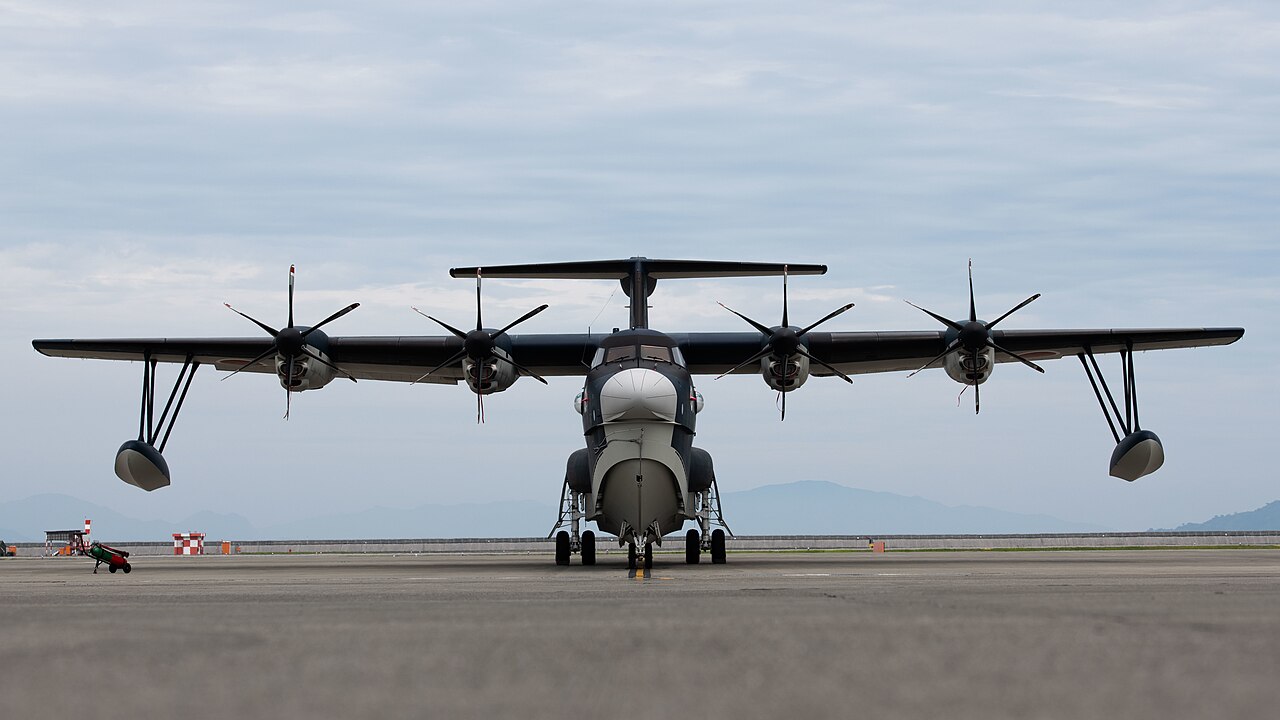
ShinMaywa Industries is the only company in the world still building a large open-ocean amphibious aircraft, the US-2, a four-engine flying boat that can put down in 3-meter swells roughly 4,700 kilometers from its base. The Japanese firm behind it traces its lineage to the Kawanishi Aircraft Company of the 1930s, yet today earns most of its money far from defense, in aircraft components, industrial machinery and even automated parking systems.
ShinMaywa at a glance
| Item | Detail |
|---|---|
| Full name | ShinMaywa Industries, Ltd. |
| Headquarters | Takarazuka, Hyogo Prefecture, Japan |
| Founded | 1949 as Shin Meiwa Industry, successor to Kawanishi Aircraft; renamed ShinMaywa in 1992 |
| Listing | Tokyo Stock Exchange |
| Revenue | Roughly 250 billion yen a year across all segments; defense is a minority share |
| Defense flagship | US-2 STOL search-and-rescue amphibian for the Japan Maritime Self-Defense Force |
| Other businesses | Aircraft structures, dump truck bodies, vacuum pumps, parking systems, environmental equipment |
Who is ShinMaywa, from Kawanishi flying boats to today
The company began as Kawanishi Aircraft, the wartime manufacturer whose H8K “Emily” flying boat was widely regarded as the best aircraft of its type in the Second World War. Reborn in 1949 as Shin Meiwa Industry, it kept the flying-boat specialty alive when nearly every other nation abandoned the class, delivering the PS-1 anti-submarine flying boat and the US-1A rescue amphibian to Japanese forces in the 1960s and 1970s.
The current US-2 flew in 2003 and entered Japan Maritime Self-Defense Force service in 2007. Production is artisanal by modern standards, the fleet numbers fewer than ten aircraft, and each one is priced in the neighborhood of 15 billion yen, which is a consequence of building a highly specialized aircraft in single units.
ShinMaywa US-2 specifications
| Specification | Value |
|---|---|
| Role | Short takeoff and landing (STOL) open-sea search-and-rescue amphibian |
| Powerplant | 4 x Rolls-Royce AE 2100J turboprops plus a separate engine driving the boundary layer control system |
| Crew | 11 typical (pilots, observers, medics) |
| Range | About 4,700 km reported |
| Sea state | Landings in wave heights up to about 3 m |
| Takeoff run on water | Roughly 280 m; landing run shorter still |
| Approach speed | As low as about 90 km/h thanks to blown flaps |
| Fleet | Fewer than ten US-2s delivered to the JMSDF |
Why the US-2 is so hard to replace
The US-2’s party trick is a boundary layer control system, a dedicated gas turbine that blows compressed air over the flaps and control surfaces so the 43-ton aircraft stays controllable at speeds where most transports would stall. That is what lets it alight on rough open ocean hundreds of kilometers from land, pick up a downed pilot or a sick sailor, and fly home. Helicopters lack the range, and ships lack the speed.
For a country whose territory is an archipelago stretched over thousands of kilometers of Pacific, that mission profile is not a luxury. US-2 crews based at Iwakuni and Atsugi have flown over a thousand rescues across the type’s family history, and the aircraft doubles as a long-range eye during disaster relief, a role Japan calls on more often than combat.
US-2 exports and the India talks
When Japan relaxed its arms-export rules in 2014, the US-2 became the test case. India was the obvious customer, its navy wanted roughly a dozen aircraft for the Andaman and Nicobar islands, and negotiations ran for the better part of a decade. They never closed, stumbling on price, offsets and local assembly demands, and the deal remains the great missed opportunity of Japanese defense exports. The episode previewed the difficulties Japan faced until its more recent wins, and it explains why Tokyo now leans on government-to-government frameworks of the kind visible in programs such as the Aegis-equipped vessel effort.
What else ShinMaywa builds
Defense is the company’s calling card, not its cash cow. ShinMaywa supplies structural components for commercial airliners, including work shared across Japan’s aerospace sector with heavyweights like Mitsubishi Heavy Industries, and its industrial arm sells dump truck bodies, garbage trucks, wire processing machines, vacuum pumps and mechanical parking systems across Asia. That civilian base keeps the firm profitable while the amphibian line ticks over at a rate of well under one aircraft a year.
The risk in that structure is obvious. If the JMSDF ever walks away from the flying boat, the skills die with the program, a concern Japanese planners weigh as they debate follow-on orders and periodic upgrades to the small fleet.
ShinMaywa frequently asked questions
What does ShinMaywa make?
The US-2 rescue amphibian for Japan’s navy, plus commercial aircraft components, special-purpose trucks, vacuum pumps, wire processors and automated parking systems.
What is the ShinMaywa US-2?
A four-engine STOL flying boat that can land on open ocean in roughly 3-meter waves and reach areas about 4,700 km from base, used for long-range search and rescue.
How many US-2 aircraft exist?
Fewer than ten have been delivered to the Japan Maritime Self-Defense Force, and production continues at a very low rate.
Did India buy the US-2?
No. India and Japan negotiated for roughly a decade over about a dozen aircraft, but price and local-production demands kept the deal from closing.
Where did ShinMaywa come from?
It is the postwar successor of Kawanishi Aircraft, the WWII maker of the H8K flying boat, reborn as Shin Meiwa in 1949 and renamed ShinMaywa in 1992.
- ShinMaywa corporate disclosures and product literature
- Japan Ministry of Defense and JMSDF public information
- Wikipedia – ShinMaywa US-2 (accessed October 2026)
- Defence & Tech reporting on Japanese defense programs