Russia vs United States: Military Comparison 2026
The United States and Russia are ranked first and second in most league tables of military power, but they are very different kinds of force. America spends five times as much and dominates the air and the oceans; Russia matches it only in nuclear weapons, yet leads in artillery, ground-based air defense and the experience of fighting a large land war.
This comparison sets the two side by side using figures available in October 2026, and explains what the numbers do and do not show.
United States vs Russia at a glance
The Global Firepower index for 2026 places the United States first, with a score of 0.0741, and Russia second on 0.0791; lower is better. The table shows what lies behind that narrow gap. For the alliance-wide picture, see our Russia vs NATO comparison.
| Indicator | United States | Russia | Source |
|---|---|---|---|
| Global Firepower rank, 2026 | 1st | 2nd | Global Firepower |
| Military spending, 2025 | $954 billion | $190 billion | SIPRI |
| Active personnel | About 1.3 million | About 1.1 million (1.5 million authorized) | IISS; Russian decree |
| Combat aircraft | 2,444 | About 1,200 | IISS Military Balance 2026 |
| Aircraft carriers | 11 | 1, inactive since 2017 | Navy data |
| Submarines | About 70, all nuclear-powered | About 67, nuclear and diesel | Open sources |
| Total nuclear warheads | 5,042 | 5,420 | Federation of American Scientists |
| Deployed strategic warheads | About 1,770 | About 1,796 | Federation of American Scientists |
Budgets and industry
The Stockholm International Peace Research Institute puts US military spending at $954 billion in 2025, a third of the world total, against $190 billion for Russia. The burden is reversed: about 3% of GDP for the United States and 7.5% for Russia, as detailed in our guide to Russia’s military budget.
Money does not translate directly into output. Russian labor and materials are cheap, and its factories run on a war footing: Estonian intelligence estimated that Russia made about 7 million artillery rounds in 2025, several times US production. American industry builds fewer, far more capable systems, including stealth aircraft, nuclear submarines and precision munitions, that Russia cannot produce in comparable numbers at any price.
Air power
The gap is widest in the air. The IISS counts 2,444 US combat aircraft against about 1,200 Russian, and the difference in quality is larger still. US forces fly roughly 900 fifth-generation F-22 and F-35 fighters; Russia has about 30 Su-57s, compared in F-35 vs Su-57. The United States also operates several hundred tankers and dozens of airborne early warning aircraft, while Russia has a handful of each.
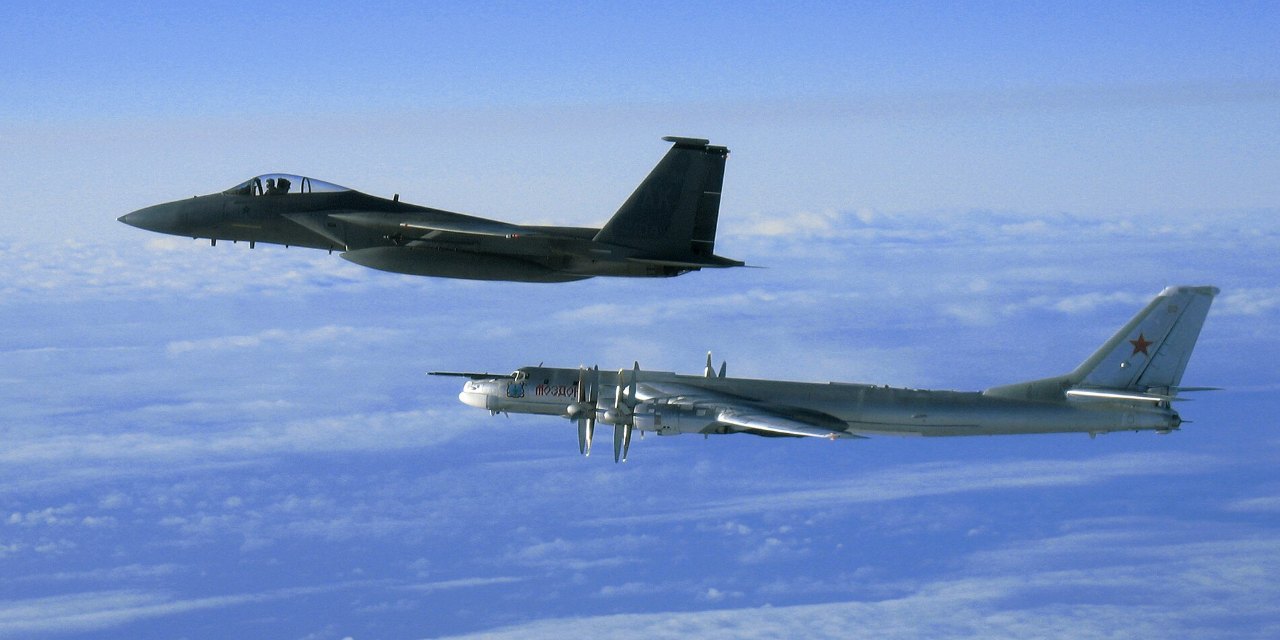
In bombers the two are closer. Russia keeps about 60 nuclear-capable Tu-95MS and Tu-160 aircraft, described in our guide to Russia’s strategic bombers; the United States fields 19 B-2As and 46 nuclear-capable B-52Hs, with the B-21 Raider in flight testing. The wider picture is in our guide to the Russian air force.
Navies
The US Navy is built to project power across oceans: 11 nuclear-powered aircraft carriers, nine large amphibious assault ships and more than 70 cruisers and destroyers with the Aegis combat system. Russia’s only carrier has not sailed since 2017, as explained in our article on Russia’s aircraft carrier, and its surface fleet is mostly made up of small missile ships.
Submarines are the exception. Both navies have just under 70 boats, but all American ones are nuclear-powered, while Russia’s fleet mixes nuclear and diesel-electric types. Russia’s newest attack submarines are a serious threat, compared in Virginia class vs Yasen-M; see also how many submarines Russia has.
Land forces and missiles
On land the comparison is more even. Russia has more tanks in units, about 3,460 against roughly 2,600 active US Abrams, far more artillery, and the densest ground-based air defense network in the world, covered in our guide to Russian air defense systems. It fields nuclear-capable Iskander missiles and has used Kinzhal and Zircon hypersonic missiles in combat, while the first US hypersonic weapon, the Army’s Dark Eagle, only began reaching its first unit at the end of 2025.
The United States counters with precision, logistics and integration: HIMARS and ATACMS, compared in ATACMS vs Iskander-M, satellite reconnaissance, and the ability to move and supply forces worldwide through some 750 overseas sites. Russia’s army is larger at the front, but has taken an estimated 1.4 million casualties in Ukraine and lost most of its pre-war professional core.
Nuclear forces
Nuclear weapons are where the two are equals. The Federation of American Scientists counts 5,420 Russian and 5,042 US warheads in total, with about 1,796 and 1,770 deployed on strategic missiles and at bomber bases. The United States has 400 Minuteman III missiles and 14 Ohio-class submarines; Russia has about 324 intercontinental missiles and 13 ballistic missile submarines, described in our guide to Russia’s nuclear arsenal.
Since New START expired on 5 February 2026, no treaty limits either arsenal for the first time in half a century. Russia holds a large lead in short-range non-strategic weapons, about 1,800 against some 200 US B61 bombs. Both countries are replacing nearly every delivery system, at a cost that weighs far more heavily on the Russian economy.
Frequently asked questions
Who has the stronger military, Russia or the United States?
The United States, by most measures. It spends five times as much, has about twice as many combat aircraft and a far larger navy. Russia is close to parity only in nuclear weapons and leads in artillery and ground-based air defense.
Who has more nuclear weapons, Russia or the US?
Russia, narrowly. The Federation of American Scientists estimates 5,420 Russian warheads against 5,042 American. Deployed strategic warheads are almost equal, at about 1,796 and 1,770.
Does Russia have more tanks than the United States?
Russia has more tanks in active units, about 3,460 against roughly 2,600, according to the IISS. Both hold thousands more in storage, although Russia’s reserve has been heavily depleted by losses in Ukraine.
How many aircraft carriers do Russia and the US have?
The United States has 11 nuclear-powered aircraft carriers. Russia has one conventionally powered carrier, the Admiral Kuznetsov, which has not been operational since 2017 and may be scrapped.
How do US and Russian troop numbers compare?
The United States has about 1.3 million active-duty personnel. Russia has around 1.1 million according to the IISS, with an authorized strength of 1.5 million, and some 720,000 troops committed to the war in Ukraine in mid-2026.
- SIPRI – Trends in World Military Expenditure, 2025: sipri.org
- Bulletin of the Atomic Scientists – United States nuclear weapons, 2026: thebulletin.org
- Federation of American Scientists – Status of World Nuclear Forces: fas.org
- Global Firepower – 2026 Military Strength Ranking: globalfirepower.com
- IISS – The Military Balance 2026: iiss.org