Russia’s Air Defense Systems: S-300, S-400, S-500 and More
Russia operates the densest ground-based air defense network in the world, built in layers from the 400 km S-400 down to shoulder-fired missiles. The systems are designed to work together: long-range batteries engage aircraft and missiles at distance while shorter-range weapons protect the batteries themselves.
More than four years of war have tested that design against Western missiles and thousands of drones. This guide explains each system, what it is for and how the network has performed.
What air defense systems does Russia have?
Russian air defense is split between two organizations. The Aerospace Forces run the strategic systems that protect cities, bases and industry. The Ground Forces have their own mobile systems that travel with the army. Both rely almost entirely on missiles designed by one state company, Almaz-Antey.
| System | NATO name | Role | Maximum range |
|---|---|---|---|
| S-500 Prometey | None assigned | Long-range air and missile defense | Up to 600 km, claimed |
| S-400 Triumf | SA-21 Growler | Long-range air defense | Up to 400 km |
| S-300PM2 / S-300V4 | SA-20 / SA-23 | Long-range air defense | 200 to 400 km |
| S-350 Vityaz | None assigned | Medium-range air defense | Up to 120 km |
| Buk-M2 / Buk-M3 | SA-17 / SA-27 | Medium-range, army | 45 to 70 km |
| Tor-M2 | SA-15 Gauntlet | Short-range, army | About 16 km |
| Pantsir-S1 | SA-22 Greyhound | Point defense, guns and missiles | About 20 km |
| Verba / Igla-S | SA-29 / SA-24 | Shoulder-fired | About 6 km |
For how these compare with Western equivalents, see our top 10 air defense systems.
S-400 and S-300, the long-range backbone
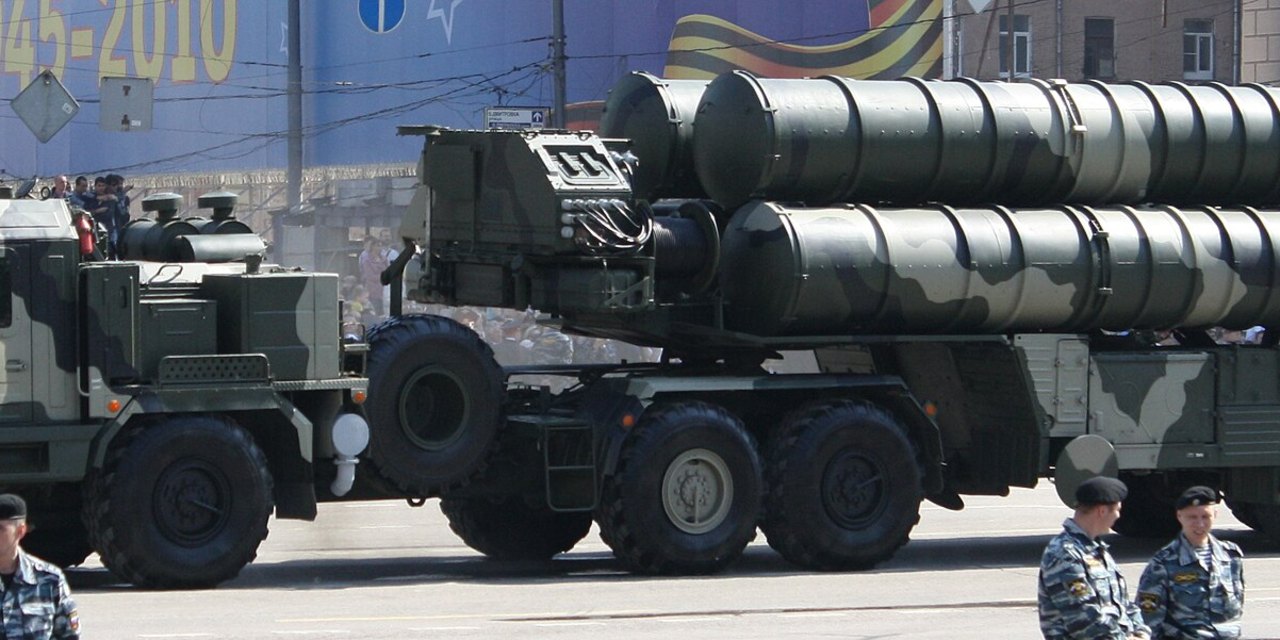
The S-400 Triumf entered service in 2007. A battalion has up to eight launchers with four missiles each, plus search and engagement radars. It can fire several missile types, from the 40N6 with a stated reach of 400 km to shorter-range missiles for self-defense. Russian officials reported more than 50 battalions in service by 2020.
Older S-300 variants are still numerous. The S-300PM2 defends fixed sites, while the tracked S-300V4 moves with the army and was designed to stop ballistic missiles. Russia has also fired S-300 and S-400 interceptors at ground targets in Ukraine, especially at Kharkiv. The S-400 is measured against its main rival in Patriot vs S-400.
S-500 and S-350, the newest systems
The S-500 Prometey is meant to sit above the S-400 and to engage ballistic missiles, hypersonic weapons and targets at the edge of space. Russia claims a range of 600 km. Production has been slow, and only a small number exist. Russia’s chief of the general staff said in late 2024 that the first regiment was being formed. A comparison with the American system is in THAAD vs S-500.
The S-350 Vityaz is less famous and arguably more useful. It carries 12 medium-range missiles on each launcher, three times the load of the old S-300PS it replaces, which suits a war of mass drone and cruise missile attacks.
Buk, Tor and Pantsir, protecting the army
The Buk is the army’s medium-range system, mounted on tracked vehicles that each carry their own radar. The Tor-M2 is a short-range system that can fire on the move and is used heavily against drones and guided bombs.
The Pantsir-S1 combines 12 small missiles with two 30 mm cannon on a truck. Its job is to guard larger systems and key buildings. Since 2023 Pantsirs have been placed on rooftops in Moscow and on purpose-built towers around oil refineries and airfields.
How well has Russian air defense worked in Ukraine?
Against aircraft, well. Long-range Russian missiles pushed Ukrainian jets down to treetop height in 2022 and have kept them there. Ukraine cannot fly freely over the front, and that remains one of the main facts of the air war.
Against missiles and drones the record is mixed. Storm Shadow and ATACMS missiles have struck defended targets in Crimea, including S-400 batteries. Long-range Ukrainian drones regularly reach refineries and factories more than 1,000 km inside Russia, because the country is too large to cover at low altitude. Ukraine’s intelligence services have run a sustained campaign against radars and launchers, and Oryx has confirmed well over 300 Russian air defense systems destroyed or damaged.
Who else uses Russian air defense systems?
The S-400 has been exported to China, Turkey, India and Belarus. Turkey’s purchase led the United States to remove it from the F-35 program in 2019. India ordered five regiments and used the system in its brief conflict with Pakistan in May 2025. Deliveries of the remaining Indian units have slipped as Russia gives priority to its own forces.
That priority shows in production. Ukrainian intelligence says Russia plans to build more than 480 long-range S-400 interceptors in 2026, over twice the 2025 target. The missiles used to attack, as opposed to defend, are covered in what missiles Russia has.
Frequently asked questions
What is Russia’s best air defense system?
The S-500 is the most advanced but exists in very small numbers. The S-400 is the most capable system deployed widely.
What is the range of the S-400?
Up to 400 km with the 40N6 missile against large aircraft at altitude, and less against small or low-flying targets.
Can the S-400 shoot down stealth aircraft?
It is designed to, but stealth sharply reduces the range at which it can detect and track a target. It has not been tested in combat against the F-35 or F-22.
How many S-400 systems does Russia have?
Russia reported more than 50 battalions by 2020. Current numbers are not published, and some have been destroyed in Ukraine.
Which countries have bought the S-400?
China, Turkey, India and Belarus.
- CSIS Missile Threat – S-400 Triumf: missilethreat.csis.org
- IISS – The Military Balance 2026: iiss.org
- Oryx – Documenting Russian equipment losses during the invasion of Ukraine: oryxspioenkop.com
- Ukrainska Pravda – Ukraine’s Defence Intelligence on Russia’s missile stockpiles and production rates (August 2026): pravda.com.ua
- Wikipedia – S-500 missile system: en.wikipedia.org