Russia’s Electronic Warfare Systems: Krasukha, Murmansk-BN, Zhitel and More
Electronic warfare is the field in which Russia’s armed forces were strongest before 2022, and it remains one of the few where they still set the pace. Truck-mounted jammers such as the Krasukha-4, Murmansk-BN and Zhitel blind radars, cut radio links and distort satellite navigation, and their effects are now felt well beyond Ukraine, in the cockpits of airliners over the Baltic.
This guide explains how Russian electronic warfare is organized, what the main systems do, how they have affected Western weapons and drones in Ukraine, and where jamming has stopped working.
How Russian electronic warfare is organized
Russia treats electronic warfare, or REB in its Russian abbreviation, as a combat arm in its own right. Each military district has a dedicated electronic warfare brigade for long-range jamming, and every motor rifle or tank brigade has its own company for the local fight. The ground forces they support are described in our guide to the size of Russia’s army.
The work falls into four tasks: jamming radio and satellite communications, denying satellite navigation, blinding radars, and breaking the control links of drones. The difference between jamming and the measures used to resist it is covered in our explainer on ECM and ECCM, and Russian systems are ranked against their foreign counterparts in our list of the top electronic warfare systems.
Krasukha and Murmansk-BN: the long-range jammers
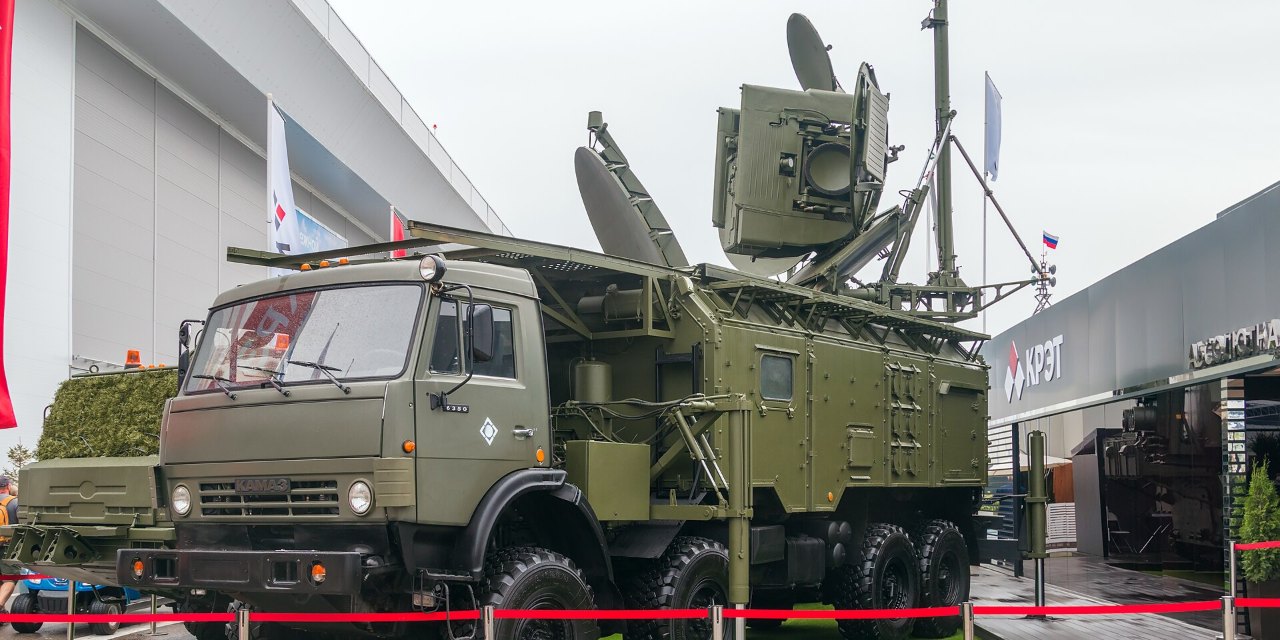
The Krasukha-4, built by the KRET concern, is the best-known Russian jammer. Carried on two KamAZ 8×8 trucks, it targets the X- and Ku-band radars used by strike aircraft, drones and radar-imaging satellites, with a claimed reach of 150–300 km. Its partner, the Krasukha-2, works in the S-band against airborne early warning aircraft such as the E-3. Both are meant to shield command posts, air defenses and Iskander brigades from being seen and targeted.
The Murmansk-BN is larger still: a set of trucks with 32-metre telescopic masts that jams high-frequency radio, the band used for long-distance military communication with ships and aircraft. Russian sources claim a range of up to 5,000 km. It is deployed in Kaliningrad, Crimea and with the Northern Fleet.
| System | Carrier | Target | Claimed reach |
|---|---|---|---|
| Krasukha-4 | Two 8×8 trucks | Airborne and satellite radars | 150–300 km |
| Krasukha-2 | 8×8 truck | Early warning aircraft radars | About 250 km |
| Murmansk-BN | Truck convoy with 32 m masts | High-frequency radio | Up to 5,000 km |
| Borisoglebsk-2 | MT-LB tracked vehicles | Tactical radio and navigation | 20–30 km |
| R-330Zh Zhitel | Truck and trailer | GPS, satellite phones, mobile networks | 25–30 km |
| Leer-3 | Orlan-10 drones | Mobile phone networks | Several km around each drone |
| Pole-21 | Antennas on masts and cell towers | Satellite navigation | Tens of km per site |
| Shipovnik-Aero | Truck | Drone control links | About 10 km |
Zhitel, Borisoglebsk-2 and the anti-drone fight
Closer to the front, the R-330Zh Zhitel and Borisoglebsk-2 jam tactical radios and GPS receivers within about 30 km, while the Leer-3 uses Orlan-10 drones, described in our guide to Russia’s military drones, to shut down mobile phone networks and send text messages to soldiers’ phones. Pole-21 antennas mounted on masts create zones in which satellite navigation is unreliable, a defense against cruise missiles and long-range drones.
The largest growth has been in counter-drone jamming. A 2023 study by the Royal United Services Institute (RUSI) found that Russia fielded roughly one major electronic warfare system for every 10 km of front and that Ukraine was losing about 10,000 drones a month, most of them to jamming. Since then small jammers have spread to individual vehicles and trenches, including the Volnorez sets fitted to tanks.
What jamming did to Western precision weapons
Russian jamming has blunted several GPS-guided weapons supplied to Ukraine. According to Ukrainian assessments reported by The Washington Post in May 2024, the hit rate of the American Excalibur guided artillery shell fell from about 70% to 6% within months, and the ground-launched small diameter bomb performed poorly for the same reason. GMLRS rockets and JDAM-ER bombs were also affected, though less severely.
The response has been technical: jam-resistant antennas, better inertial systems and seekers that home on a laser spot or an image. Each fix has worked for a time. The lesson that Western armies have drawn is that satellite guidance alone is no longer enough against an opponent with dense electronic warfare.
Starlink jammers and GPS interference beyond Ukraine
In 2026 Russia moved against the satellite internet that Ukrainian drones increasingly rely on. Ukrainian defense ministry adviser Serhii Beskrestnov said in July that Russia had deployed ten systems designed to suppress Starlink signals over an area of about 20 square kilometres each, at a reported cost of $1.5 million apiece. Ukrainian forces destroyed the first on 14 June 2026 and a second soon after; the powerful emissions that make such jammers work also make them easy to find.
The effects reach NATO territory. Interference traced mainly to the Kaliningrad region disrupts satellite navigation across the Baltic. A March 2026 report by the Polish Institute of International Affairs (PISM) said 85% of civil flights in Estonia experienced signal interference in 2025 and that spoofing incidents in Lithuania rose 22-fold in a year. How the technique works is explained in our guide to GPS jamming and spoofing.
Where Russian electronic warfare falls short
Jamming has three built-in limits. First, it is indiscriminate: Russian units have repeatedly jammed their own drones and radios, and coordination between jammers and friendly users remains a weak point. Second, every jammer is a powerful transmitter and therefore a target; Ukraine captured parts of a Krasukha-4 near Kyiv in March 2022 and has since hunted such systems with drones and anti-radiation missiles.
Third, the targets are changing. Fiber-optic FPV drones have no radio link to jam, and drones with on-board image recognition can finish an attack after the signal is lost. Russia’s aircraft carry their own self-protection suites, such as the Khibiny pod on the Su-34 and the Himalayas system on the Su-57, but these have not prevented losses to Ukrainian air defenses.
Frequently asked questions
What is the Krasukha-4?
It is a Russian truck-mounted jammer built by KRET. It targets the radars of aircraft, drones and radar satellites in the X and Ku bands, with a claimed reach of 150–300 km, and is used to protect high-value sites from being detected and targeted.
Can Russia jam GPS?
Yes. Systems such as Zhitel, Pole-21 and Borisoglebsk-2 jam or spoof satellite navigation signals. The effects are routine over Ukraine and are regularly reported by civil aircraft over the Baltic Sea, where interference is traced mainly to Kaliningrad.
Can Russia jam Starlink?
Partly. Ukraine says Russia deployed ten dedicated Starlink jammers by mid-2026, each covering about 20 square kilometres. They work locally, but their strong emissions make them easy to locate, and at least two have been destroyed.
How effective is Russian jamming against Western weapons?
It has significantly reduced the accuracy of some GPS-guided munitions. Ukrainian assessments reported in 2024 said the Excalibur shell’s hit rate fell from about 70% to 6%. Weapons with laser or image guidance are far less affected.
Do jammers work against fiber-optic drones?
No. A fiber-optic drone is controlled through a cable, so there is no radio signal to disrupt. It has to be stopped physically, with nets, guns or other drones.
- RUSI – Meatgrinder: Russian Tactics in the Second Year of Its Invasion of Ukraine: rusi.org
- Euromaidan Press – Russia has found way to jam Starlink and take down Ukraine’s drones, July 2026: euromaidanpress.com
- Polish Institute of International Affairs (PISM) – Baltic Sea region security report, March 2026: pism.pl
- The Washington Post – Russian jamming leaves some high-tech U.S. weapons ineffective in Ukraine, May 2024: washingtonpost.com
- LRT – GPS jamming incidents reported by pilots continue in Lithuania, March 2026: lrt.lt