Royal Navy Type 31 Frigates to Get Mk 41 Cells and Strike Missiles
Britain will arm its five Type 31 frigates with Mk 41 vertical launch cells and Norwegian-built Naval Strike Missiles, giving a class originally conceived as a low-cost general-purpose ship a strike capability its early design work deliberately left out.
The decision, set out through the government’s Defence Investment Plan, allocates £1.6 billion over four financial years to the Type 31 programme, covering construction, commissioning and the weapons fit. It confirms a direction that has been signalled in stages since 2023, when the Royal Navy first said the class would receive Mk 41 launchers, and reinforced in June 2026 when the Naval Strike Missile was named for both the Type 26 and Type 31 fleets.
A Class That Kept Growing
The Type 31 — the Inspiration class, comprising HMS Venturer, Active, Formidable, Bulldog and Campbeltown — began life as an austerity programme. Its defining constraint was a per-ship cost target of around £250 million, and the design Babcock offered to meet it was Arrowhead 140, derived from the Danish Navy’s Iver Huitfeldt-class frigate. The ships are being built at Rosyth in Fife.
The original weapons fit was modest by frigate standards: a 57mm main gun, two 40mm secondary mounts, Sea Ceptor point defence and a flight deck sized for a Merlin. There was no anti-ship missile and no vertical launch system for anything larger than Sea Ceptor. The ships were intended for presence, maritime security and forward deployment rather than high-end combat, on the reasoning that the Type 26 would carry the Royal Navy’s serious warfighting load.
That reasoning has steadily eroded. The Iver Huitfeldt hull was designed from the outset with margin for a heavy weapons fit — the Danish ships carry Mk 41 cells and Harpoon — and the Royal Navy has spent several years walking back toward the capability the parent design always had room for.
What Mk 41 Buys
The Royal Navy intends to fit strike-length Mk 41 modules, and the ships are being built with structural foundations for up to four eight-cell blocks. The final number to be installed has not been announced, and the distinction matters: structural provision is not the same as fitted equipment, and British shipbuilding has a long record of ships going to sea with foundations and no launchers.
Strike-length is the significant word. The tactical and self-defence variants of Mk 41 are too short for large cruise missiles; the strike-length cell is what allows a ship to carry Tomahawk, and in due course the Future Cruise/Anti-Ship Weapon being developed jointly with France. Fitting the longer cell is a statement about what the Royal Navy expects these ships to carry in the 2030s rather than what they will carry on commissioning.
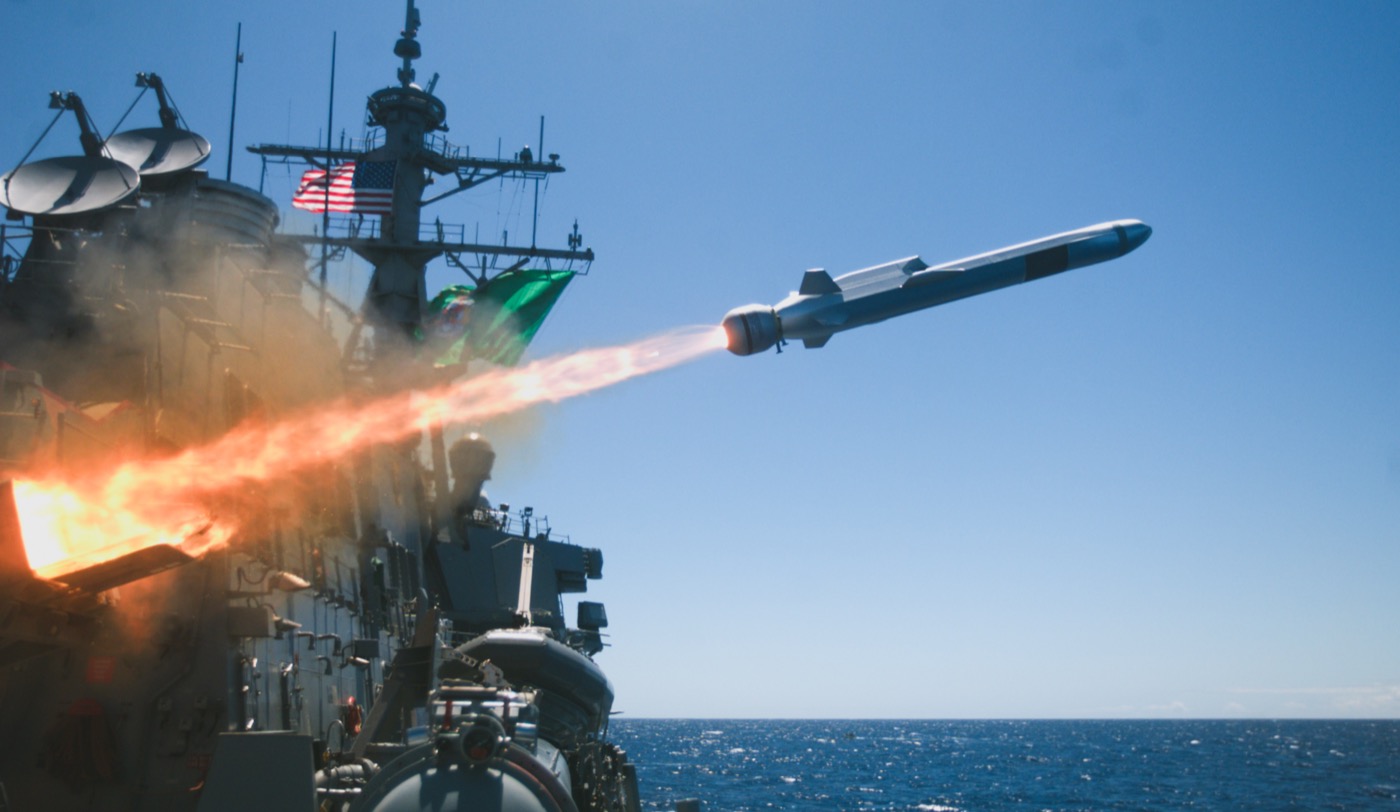
The Naval Strike Missile is a separate and nearer-term addition. Built by Kongsberg, it is carried in deck-mounted canisters rather than in the vertical launch system, and it is already entering service on Type 23 frigates and Type 45 destroyers as the replacement for the retired Harpoon. The missile is subsonic, sea-skimming and passive-seeking, with a range in excess of 100 nautical miles and a terminal profile designed to complicate shipboard defences.
Putting the same weapon on the Type 31 means the Royal Navy’s surface fleet will carry one anti-ship missile across three classes — a logistics and training simplification that the service, operating a small fleet, cannot easily do without.
Why the Change of Mind
The shift reflects a reassessment of what “general-purpose” means in European waters. A frigate deployed to the Baltic, the High North or the eastern Mediterranean is now operating in contested space, and the assumption that a lightly armed ship could handle presence work while heavier units stayed home has not survived contact with the past four years.
The Naval Strike Missile choice also carries an alliance dimension. Norway builds it, Poland, Germany and the United States operate it, and the Royal Navy’s adoption places British ships inside a growing northern European weapons pool at a time when the UK is deepening naval cooperation with Norway — including a joint approach to anti-submarine warfare in the North Atlantic and Norwegian interest in the Type 26.
Timing and Caveats
The government has not published a date for when either weapon will be operational aboard a Type 31, and the announcement says the timeline for the upgraded configuration remains open. The lead ship, Venturer, is well advanced at Rosyth, and the practical question is whether the Mk 41 modules are installed during build or deferred to a later refit — a decision that historically has driven a great deal of subsequent cost.
Nor has the government said how many missiles it is buying, for either the Type 31 or the Type 26. The Royal Navy’s recent experience with Sea Ceptor and Sea Viper stocks suggests that magazine depth, rather than launcher count, is the constraint that will determine what these ships can actually do.
What is settled is the design intent. The Type 31 is no longer a constabulary frigate with a gun. It is a ship the Royal Navy expects to shoot at other ships, and eventually at targets ashore.
Sources
- UK Ministry of Defence, Defence Investment Plan, June 2026
- Defence Industry Europe, “Britain to equip Royal Navy Type 31 frigates with Mk 41 launchers and Norwegian Naval Strike Missiles in major fleet firepower upgrade,” September 14, 2026
- Janes, “UK Royal Navy announces Mk 41 VLS fit for Type 31 frigates”
- Navy Lookout, “A guide to the Type 31 frigate” and “Royal Navy’s Type 31 frigates to be fitted with Mk41 vertical launch system”
- Naval News, “UK Announces Plans to Fit Strike Capability to Future Frigates”