Germany Orders MBDA Airborne Laser Demonstrator for Future Luftwaffe Pods
Germany has ordered a demonstrator for an aircraft-mounted laser weapon from MBDA Deutschland. The company said on 2 November 2026 that the Bundeswehr’s procurement office, BAAINBw, had contracted it to build an airborne laser demonstrator, with key parts of a laser pod designed from the start for later flight operations.
- Germany’s procurement office BAAINBw has ordered an airborne laser demonstrator from MBDA Deutschland (announced 2 November 2026)
- Key components of the ‘laser pod’ are to be designed for later flight operations
- Goal: test feasibility and lay the basis for a future Luftwaffe capability, mainly against drones and cruise missiles
- Not disclosed by MBDA: contract value, power output, host aircraft or timeline
- Reported but unconfirmed: up to 10 kW, a Taurus-sized pod and first flight trials in 2031 (Die Welt, via Aviacionline)
What MBDA and BAAINBw have agreed
According to MBDA Deutschland’s press release, the aim is to build the technological basis for future laser weapons on board aircraft. The order covers a demonstrator in which the main components of the so-called laser pod are designed for flight use. It is meant to test whether an airborne laser weapon is feasible and to lay the foundation for a future operational capability in the Luftwaffe.
MBDA calls an airborne laser the ‘supreme discipline’ of laser weapon technology because of the strict limits on size and weight and the need to withstand flight conditions. The company says such systems are mainly intended to defend against drones and cruise missiles. It also says it will give priority to German supply chains and national system know-how.
What has not been confirmed
MBDA did not publish the contract value, the laser’s power, the aircraft that would carry it or a schedule. German daily Die Welt reported, as cited by Aviacionline, that the concept foresees a laser source of up to 10 kW in an external pod roughly the size of a Taurus cruise missile, about three years of technology development and first flight trials in 2031. Aviation Week also reported a development period of around three years. These figures have not been confirmed by MBDA or the German defence ministry. MBDA’s artwork shows the pod on large, uncrewed, fighter-like aircraft (The War Zone); that is an illustration, not a stated platform choice.
Why an airborne laser is hard
On a ship or a truck, a laser weapon can draw on a large power supply and cooling system. On an aircraft, the beam must stay focused on a small spot on a moving target while the aircraft itself vibrates, manoeuvres and passes through turbulence, all within a tight weight and volume budget. Power output matters too; our guide to laser weapon power levels sets out what different power classes are designed to engage.
Previous developments: the naval laser
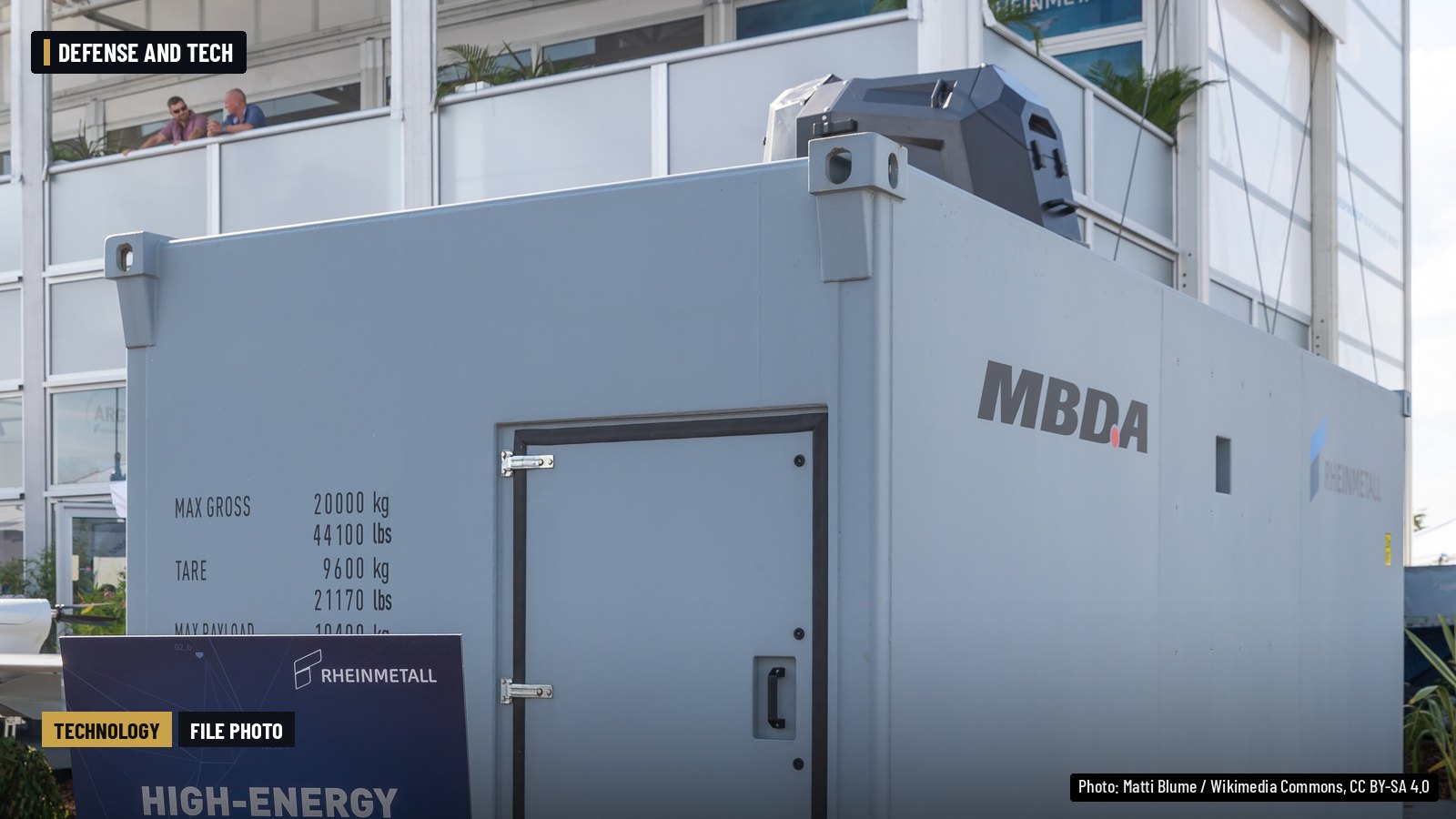
The airborne project follows Germany’s naval laser work. BAAINBw signed a contract with ARGE HEL, a working group of MBDA Deutschland and Rheinmetall Waffe Munition, to develop a high-energy laser weapon system for the German Navy. Rheinmetall dates the signing to 9 July 2026, puts the value in the ‘mid three-digit million-euro range’ and says the system is expected to be operational by 2029. The companies say their naval demonstrator covered 28,000 nautical miles aboard the frigate Sachsen and fired more than 1,000 shots at air, sea and land targets during more than a year of testing.
Industry context
Several countries are working on laser weapons as a cheaper way to deal with drones than interceptor missiles. The UK’s ship-based programme is covered in our DragonFire explainer, and the place of lasers among a warship’s defences in our guide to naval air defence layers. Germany’s new contract is a technology demonstrator, not a procurement of an operational weapon: it does not commit the Luftwaffe to buying a laser pod.
Sources: MBDA Deutschland press release, 2 November 2026; Rheinmetall press release, 9 July 2026; Aviation Week, 2 November 2026; Aviacionline (citing Die Welt), 3 November 2026; The War Zone, 3 November 2026.