EMP Weapons Explained, How Electromagnetic Pulses Disable Electronics

EMP weapons use a burst of electromagnetic energy to burn out electronics rather than to destroy structures, and the best-documented example is the 1962 Starfish Prime nuclear test, a 1.4-megaton blast about 400 km above the Pacific that disturbed systems in Hawaii roughly 1,400 km away. Today the idea has split into two families, the nuclear high-altitude pulse that worries planners, and non-nuclear high-power microwave weapons that are entering service against drones.
What is an EMP weapon
An electromagnetic pulse is a short, intense burst of energy across a broad range of frequencies. When it strikes wiring, antennas, circuit boards and power lines, it induces surges of current and voltage that can upset or permanently damage electronics. A weapon built for that purpose aims to disable computers, communications, radars and power systems without the blast damage of a conventional bomb.
The appeal for military planners is selective effect, in principle an EMP can defeat a target’s electronics and leave buildings and people intact. The reality is messier. Effects depend on power, distance, frequency and how well the targets are shielded, and modern systems built for military use are often hardened. That has led to two very different classes of device.
How does an EMP work
A nuclear detonation high above the atmosphere releases gamma rays that strip electrons from air molecules, which then spiral in the Earth’s magnetic field and generate a huge electromagnetic field across a wide area. Specialists describe three overlapping components, E1, a very fast pulse that damages microelectronics; E2, resembling lightning; and E3, a slow pulse that can induce currents in long power lines, similar in nature to a severe solar storm.
Non-nuclear devices work differently. Explosively pumped flux compression generators squeeze a magnetic field with a conventional explosive to produce a single intense pulse, often a one-shot weapon. High-power microwave systems instead use electronic sources and antennas to fire repeated bursts of energy in a narrower beam, so one system can engage many targets and be reused. The same logic drives concepts such as the Epirus Leonidas system.
Types of EMP and high-power microwave weapons
| Type | Power source | Reach | Reusable | Status |
|---|---|---|---|---|
| Nuclear high-altitude EMP | Nuclear warhead exploded at altitude | Hundreds to thousands of km | No | Tested in the 1960s, banned in practice by treaty |
| Flux compression generator | Explosive-driven magnetic compression | Tens of meters to km | No | Experimental and in limited use as warheads |
| High-power microwave, missile | Electronic source on a cruise missile | Buildings and compounds | No | Demonstrated by the US in 2012 |
| High-power microwave, ground | Vehicle-based pulsed emitter | Hundreds of meters | Yes | Entering service for counter-drone defense |
The practical trend is away from nuclear EMP and toward microwave emitters. Countries see a nuclear EMP as a strategic weapon that is essentially a nuclear attack, while microwave systems are attractive against drone swarms, where one pulse can disable many low-cost aircraft at once. The same trade-off is discussed in our explainer on drone swarms.
Key EMP tests and systems
| Name | Country | What it is | Notes |
|---|---|---|---|
| Starfish Prime | United States | 1.4 Mt test over Johnston Atoll in 1962 | Reported to have affected streetlights and telephones in Hawaii |
| Soviet Test 184 | Soviet Union | High-altitude test in 1962 over Kazakhstan | Reported damage to power and communication lines |
| CHAMP | United States | Missile-borne microwave payload | Boeing reported a successful 2012 test against electronic targets |
| Leonidas | United States | Ground-based microwave counter-drone system | Vendor-described; see our profile of Epirus |
| Ranets-E | Russia | Truck-mounted microwave system | Range and effect are manufacturer claims from Russian state media |
The Starfish Prime results shocked planners. The blast was 1,400 kilometers from Hawaii yet reported to have knocked out streetlights and some communication links, and it disabled several satellites, in part because of trapped radiation. Russia’s Ranets-E is described by its manufacturer and Russian state media as able to disable electronics at long distance, a claim that has not been independently verified, and Chinese state media have reported similar microwave research.
How do militaries protect against EMP
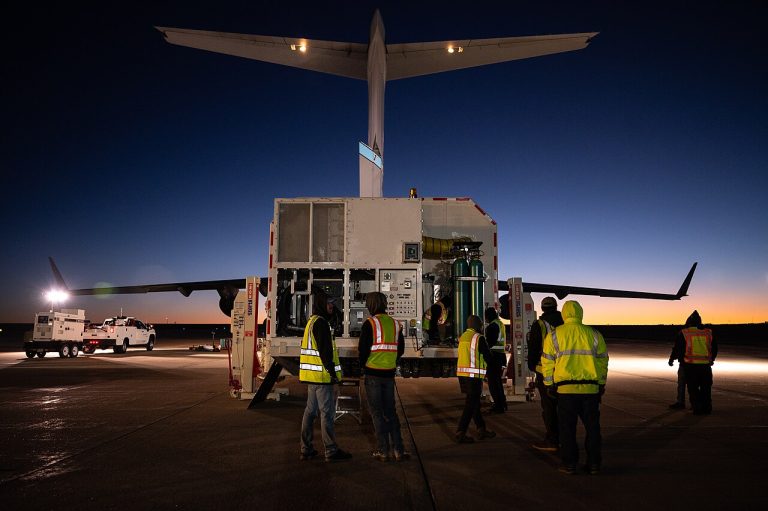
Protection is well understood, and expensive. Hardened equipment uses shielded enclosures, filters and surge arrestors, and communications gear is often built to survive an intense pulse. Command aircraft such as the E-4 and sites like the Cheyenne Mountain complex were tested for EMP survival decades ago, using giant simulators such as the TRESTLE facility at Kirtland Air Force Base in New Mexico.
Civilian infrastructure is far more exposed. Power transformers, telecom networks and payment systems are rarely shielded, which is why analysts worry about a high-altitude burst more than an isolated microwave attack. Commercial hardening remains a policy debate. Simple protections, from backup generators to Faraday enclosures for critical spares, reduce but do not eliminate risk. Electronic-warfare defenses in general are discussed in our guide to ECM and ECCM.
EMP weapons frequently asked questions
What does an EMP do to electronics?
It induces large surges of current that can scramble data or permanently burn out circuits, depending on strength and shielding.
Can an EMP kill people?
Not directly. The effects are on electronics and power systems, although the consequences for hospitals and infrastructure could be serious.
Does the US have EMP weapons?
The US has tested missile-borne microwave payloads and fielded ground-based microwave systems for counter-drone defense, though details are limited.
Do EMP weapons exist without nuclear weapons?
Yes. High-power microwave systems and explosive flux compression devices create pulses without a nuclear explosion, at much smaller ranges.
How do you protect electronics from EMP?
Shielded enclosures, Faraday cages, filters and surge protectors, plus spare equipment kept offline.
- US government and congressional studies on EMP threats
- Boeing and Air Force Research Laboratory CHAMP program information
- Wikipedia – Electromagnetic pulse (accessed October 2026)
- Defence & Tech reporting