Drone Swarms Explained, When a Hundred Drones Think as One
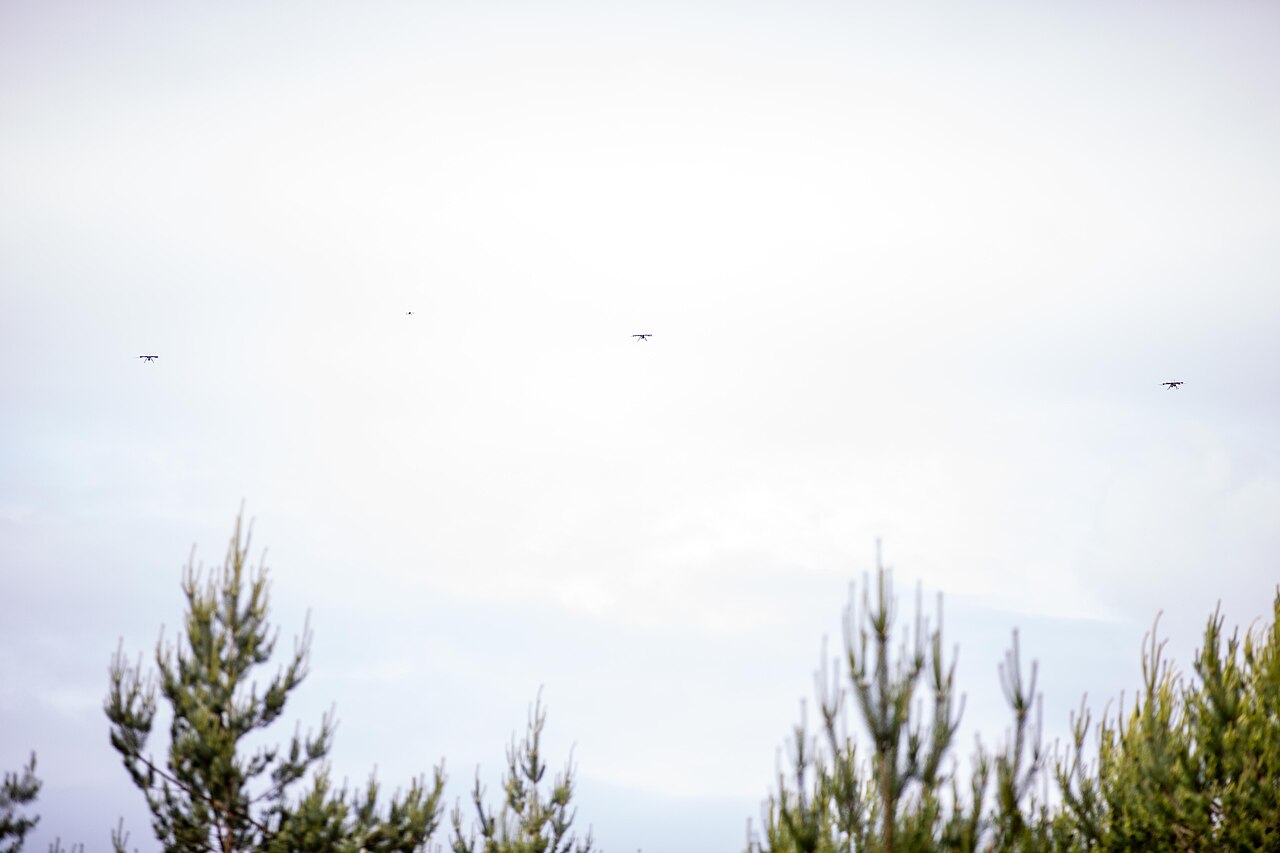
Drone swarms, groups of unmanned systems that coordinate with each other autonomously, are moving from laboratory demonstrations toward fielded weapons, and the US Replicator initiative alone aims to deliver thousands of autonomous systems. This explainer separates the engineering reality from the buzzword, shows how swarm coordination actually works, and surveys who is building swarms and what stops them.
What is a drone swarm
The term is used loosely for any large drone attack, but engineers reserve it for something specific: a group of unmanned vehicles that share information and make collective decisions with little or no human input per vehicle. One operator, or none, tasks the group; the group sorts out formation, search patterns and target assignment among itself. That distinction matters because the hard part is not flying a hundred drones, it is making a hundred drones behave as one organism when jamming cuts them off from their operators and each other.
The payoff is saturation economics. Air defenses fire interceptors costing hundreds of thousands of dollars; a swarm presents dozens of cheap targets simultaneously, overwhelming radars, magazines and human attention at once, the same logic that makes loitering munitions so cost-effective.
How do drone swarms communicate and coordinate
| Technology | What it does |
|---|---|
| Mesh networking | Each drone relays for its neighbors; the network survives losing nodes and needs no central mast |
| Swarm algorithms | Flocking rules and consensus logic, separation, cohesion, task auction, produce group behavior from simple local rules |
| Edge autonomy | Onboard processors run navigation and target recognition so the swarm functions under jamming, without datalinks home |
| Alternative navigation | Visual and terrain-matching navigation when GPS is denied |
| Human oversight | One operator sets intent and approves engagements; the swarm handles execution |
The intellectual roots go back to flocking simulations: three rules, stay close, do not collide, match your neighbors’ heading, generate bird-like group flight with no leader. Military swarms add task allocation on top, drones bidding among themselves for reconnaissance lanes or targets, so the group re-plans instantly when members are shot down. The 2016 Perdix test, 103 micro-drones released from three F/A-18s, demonstrated exactly this: no drone was leader, and the swarm healed its formation as units dropped out.
Are the drone attacks in Ukraine real swarms
Mostly not yet, and the distinction is instructive. Russia’s nightly Shahed waves, sometimes hundreds of drones plus missiles by operator-reported counts, are mass raids: individually routed, not mutually coordinating. Ukrainian long-range strikes on airfields and refineries likewise rely on pre-planned routes and, increasingly, terminal machine vision, with operator-reported accounts of drones that finish attacks autonomously under jamming. Both sides are edging toward swarm behavior, drones sharing targets or relaying for each other, and both treat full autonomy as the endgame, but today’s saturation attacks win through numbers and routing, not collective intelligence.
Which countries are developing drone swarms
The United States runs the broadest portfolio: DARPA’s OFFSET program swarmed hundreds of air and ground robots in urban trials, and the Pentagon’s Replicator initiative is fielding attritable autonomous systems in the thousands, alongside the crewed-uncrewed teaming of the collaborative combat aircraft programs. China has demonstrated large fixed-wing swarm launches through state-affiliated institutes such as CETC, tests presented through state media and therefore best read as manufacturer claims, while its commercial drone industrial base gives it unmatched manufacturing depth. European programs, South Korea, Turkey and India all run national swarm efforts; Turkey’s Kargu maker STM has marketed swarming loitering munitions for years. Every serious military has concluded the same thing: swarming is software, and software proliferates.
How do you stop a drone swarm
| Layer | Examples | Limit |
|---|---|---|
| Electronic warfare | Jamming links and GPS | Weakens as swarms go autonomous and mesh-networked |
| Guns and fragmentation | Skyranger 30, airburst 30-35mm | Magazine depth against dozens of targets |
| High-power microwave | Epirus Leonidas, frying electronics wholesale | Short range; power and beam management |
| Lasers | Point defense burning one drone at a time | Engagement rate against simultaneous attackers |
| Cheap interceptors | Interceptor drones, guided rockets | Cost-exchange still unfavorable at scale |
The mathematics favor whoever solves cost per kill. Microwave weapons like Epirus’s Leonidas are the most swarm-shaped answer, disabling whole groups per pulse, while gun turrets such as Skyranger 30 and laser and interceptor layers handle leakers. Defense, for once, is racing to become as cheap as offense.
Drone swarms frequently asked questions
What is a drone swarm?
A group of drones that coordinate among themselves autonomously, sharing information and dividing tasks with minimal human input per vehicle.
Are drone swarms being used in Ukraine?
Mass drone attacks are nightly reality, but they are mostly individually routed raids; true self-coordinating swarms remain emergent, per operator-reported accounts.
What is the Replicator program?
A US Department of Defense initiative to field thousands of attritable autonomous systems quickly, spanning aerial drones and uncrewed surface vessels.
How do you defend against a drone swarm?
Layered defenses, jamming, airburst guns, high-power microwaves, lasers and interceptor drones, cued by a single air picture.
Can drone swarms operate without GPS or radio links?
That is the design goal: mesh networks, visual navigation and onboard AI let advanced swarms keep functioning under jamming.
- DARPA and US Department of Defense public materials on OFFSET, Perdix and Replicator
- Chinese state media reports on CETC swarm demonstrations (manufacturer claims)
- Operator-reported drone attack counts from the war in Ukraine
- Wikipedia – Drone swarm (accessed October 2026)
- Defence & Tech reporting on counter-UAS systems