What Drones Does Turkey Have? TB2, Akıncı, Kızılelma and Anka
Turkey is, by most counts, the world’s largest exporter of armed drones: the Bayraktar TB2 alone has been sold to 36 countries. Two companies do nearly all of the work. Baykar makes the TB2, the ship-based TB3, the heavy Akıncı and the jet-powered Kızılelma. Turkish Aerospace makes Anka, Aksungur and the stealthy Anka-3.
This guide lists the main types with their size, payload and status, and explains what changes when the jets arrive.
What drones does Turkey have?
Seven types matter. Five are propeller-driven and in service, and two are jets still in test.
| Drone | Maker | Class | Take-off weight and payload | Status |
|---|---|---|---|---|
| Bayraktar TB2 | Baykar | Medium-altitude armed drone | 700 kg; 150 kg payload | In service since 2014 |
| Bayraktar TB3 | Baykar | Ship-based armed drone with folding wings | 1,450 kg; 280 kg payload | In service since 2025 |
| Bayraktar Akıncı | Baykar | Heavy high-altitude armed drone | 6,000 kg; up to 1,500 kg payload | In service since 2021 |
| Anka | Turkish Aerospace | Medium-altitude armed drone | 1,700 kg; 350 kg payload | In service |
| Aksungur | Turkish Aerospace | Twin-engine long-endurance drone | 3,300 kg; 750 kg payload | In service since 2021 |
| Kızılelma | Baykar | Jet-powered unmanned fighter | 8,500 kg; 1,500 kg payload | First delivery due in 2026 |
| Anka-3 | Turkish Aerospace | Stealth flying-wing strike drone | 7,250 kg; 1,600 kg payload | In flight test |
Bayraktar TB2 and TB3: the drones that made the name
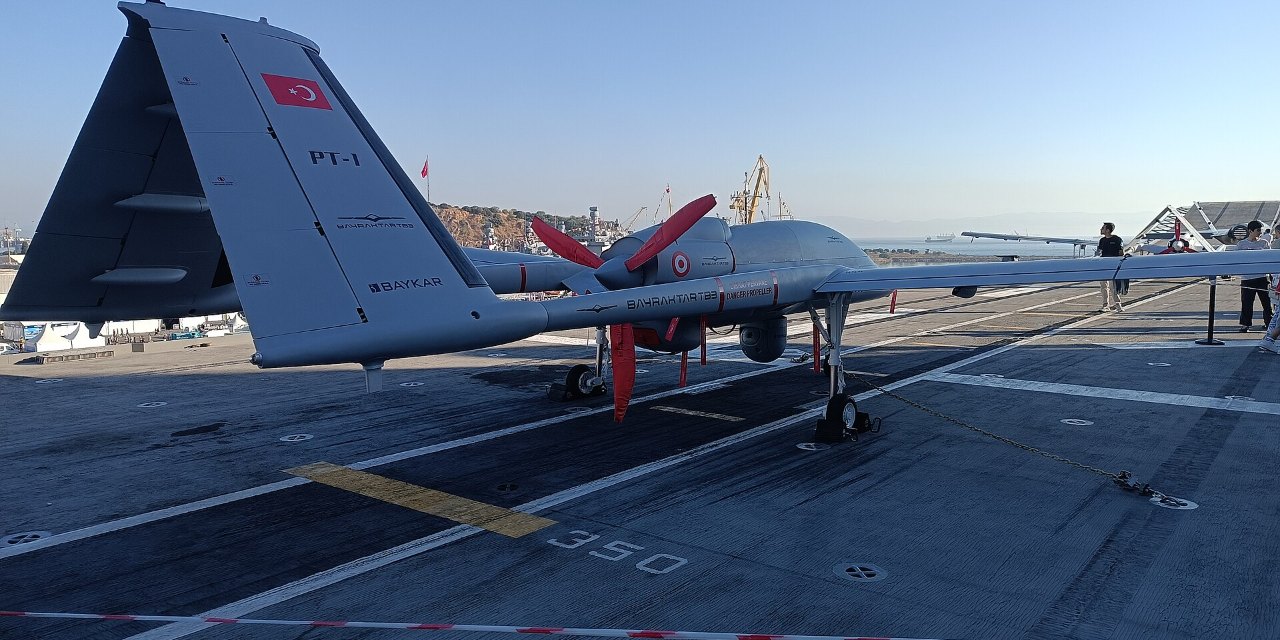
The TB2 is small and slow. It weighs 700 kg, cruises at about 130 km/h, carries four small guided bombs and stays up for more than a day. Its record did the selling. It was used in Syria, Libya and Nagorno-Karabakh in 2020 and by Ukraine in 2022, and the global fleet passed one million flight hours in December 2024. Baykar says 36 countries have signed contracts, among them NATO members Poland, Romania, Croatia and Albania, and that its factory can build about 250 a year. Published contract values work out at roughly $11 million to $20 million per aircraft, ground stations and support included.
The TB3 is the same idea adapted for ships. Its wings fold, it weighs 1,450 kg and it carries 280 kg. On 19 November 2024 it took off from and landed on the amphibious assault ship TCG Anadolu, and it entered Turkish service in September 2025. During NATO’s Steadfast Dart exercise in February 2026, a TB3 launched from Anadolu in the Baltic flew an eight-hour sortie with German Typhoons and hit targets at sea with two MAM-L bombs. Indonesia agreed in 2025 to buy 60, with local production.
Akıncı, Anka and Aksungur: the heavy end
Akıncı is a different class of aircraft. It has two turboprops, a 20-metre wing, a take-off weight of six tonnes and its own radar. It is designed to carry the SOM cruise missile and air-to-air missiles as well as the small bombs of the TB2, which makes it a substitute for a strike aircraft where the airspace is not contested. Baykar says it has delivered 110. Saudi Arabia signed a deal in July 2023 that press reports valued at about $3 billion, and local assembly there is expected to begin in 2026. The UAE, Azerbaijan, Kyrgyzstan and Indonesia are also customers.
Turkish Aerospace’s drones sell in smaller numbers. Anka, a 1.7-tonne aircraft in the same class as the TB2, has been exported to Kazakhstan, Indonesia and Malaysia, whose first aircraft flew in April 2026. Aksungur is its twin-engine big brother, built to stay airborne for about two days with 750 kg of sensors or weapons, and the navy uses it for maritime patrol.
Kızılelma and Anka-3: unmanned jets
The next generation gives up the propeller. Kızılelma is an unmanned fighter 14.5 metres long, with a top speed of about Mach 0.9 and a payload of 1,500 kg. It first flew in December 2022. On 30 November 2025 one fired a Gökdoğan missile at a target drone using its own radar, a beyond-visual-range shot that Baykar describes as a first for an unmanned aircraft. Two flew in autonomous close formation in December 2025, and in June 2026 one joined up with a Leonardo M-346 trainer and took formation commands from its crew. The first delivery to Turkish forces is due this year. Indonesia signed for 12 in May 2026, with options that could take the total to 60.
Anka-3 is Turkish Aerospace’s answer: a tailless flying wing shaped for a low radar signature, with an internal weapons bay and a 1,600 kg payload. It first flew on 28 December 2023 and has dropped weapons from its bay, but one of the two prototypes crashed in June 2025. Both jets rely for now on engines from Ukraine’s Ivchenko-Progress, a supply line that runs through a country at war.
Both are meant to fly beside the KAAN fighter as loyal wingmen, the concept the US Air Force is pursuing with its Collaborative Combat Aircraft.
Why do Turkish drones sell?
Price is part of it, and access is the larger part. American armed drones come with export controls and a long approval process. Turkey sells to almost any government, delivers quickly and includes training and munitions in the package. Baykar reports export revenue of $2.2 billion, has bought Italy’s Piaggio Aerospace and has formed a joint venture with Leonardo to build its designs in Europe.
The weakness is just as clear. The TB2 thrived where air defences were thin or badly run. In Ukraine it was pushed back from the front within months, once Russian air defence and jamming were organised, and the same would apply against any well-equipped opponent. That is why Baykar is moving to jets, and why Aselsan is hanging jamming pods on the TB2.
Frequently asked questions
How many drones does Turkey have?
No official total is published. Baykar says it has delivered 110 Akıncıs at home and abroad and can build about 250 TB2s a year.
What is Turkey’s most advanced drone?
The Bayraktar Kızılelma, a jet-powered unmanned fighter that fired a radar-guided air-to-air missile in a test in November 2025. Its first delivery is due in 2026.
How much does a Bayraktar TB2 cost?
Published export contracts work out at roughly $11 million to $20 million per aircraft, including ground stations and support.
Which countries use Bayraktar drones?
Baykar says 36 countries have signed for the TB2. Known users include Ukraine, Azerbaijan, Poland, Romania, Qatar and Kuwait.
Can Turkish drones operate from ships?
Yes. The Bayraktar TB3 flies from the amphibious assault ship TCG Anadolu and entered service in 2025.
Who makes Turkish military drones?
Baykar builds the Bayraktar family and Kızılelma. Turkish Aerospace builds Anka, Aksungur and Anka-3.
- Envanter Medya – Why Turkish armed drones sell worldwide, 2014–2026 (September 2026): envantermedya.com
- AeroCorner – Turkish Air Force: every aircraft in 2026 (October 2026): aerocorner.com
- MiGFlug – Aselsan flies three EW pods on two TB2s (September 2026): migflug.com
- Wikipedia – Bayraktar Kızılelma (test dates and specifications): en.wikipedia.org
- Wikipedia – Baykar Bayraktar TB3 (test dates and specifications): en.wikipedia.org
- Wikipedia – TAI Anka-3 (test dates and specifications): en.wikipedia.org