
WHAT IS THE HK416? INSIDE HECKLER & KOCH’S FLAGSHIP ASSAULT RIFLE
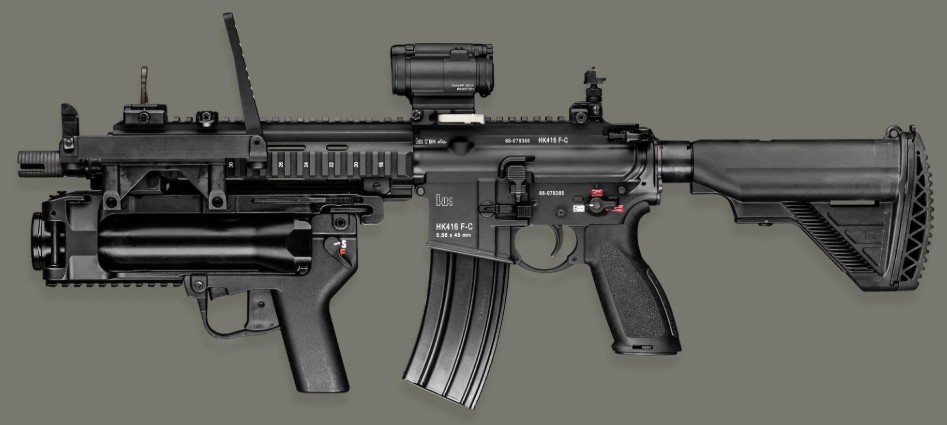
In the high-stakes world of elite infantry combat and counter-terrorism, equipment failure is not an option. Born out of a direct request from United States Special Operations Forces in the early 2000s, the HK416 by German manufacturer Heckler & Koch (H&K) was designed to achieve one singular goal: to create the most reliable AR-15 style rifle on the planet. Today, it stands as the flagship assault rifle for top-tier military units across the globe.
The Engineering Revolution: The Short-Stroke Gas Piston
To understand the significance of the HK416, one must look at what it replaced. The standard American M4 Carbine utilizes a “direct impingement” operating system, which blows hot, carbon-fouled propellant gases directly back into the weapon’s receiver to cycle the action. In sustained firefights, or when using sound suppressors, this causes intense heat buildup, heavy carbon fouling, and an increased risk of catastrophic jamming.
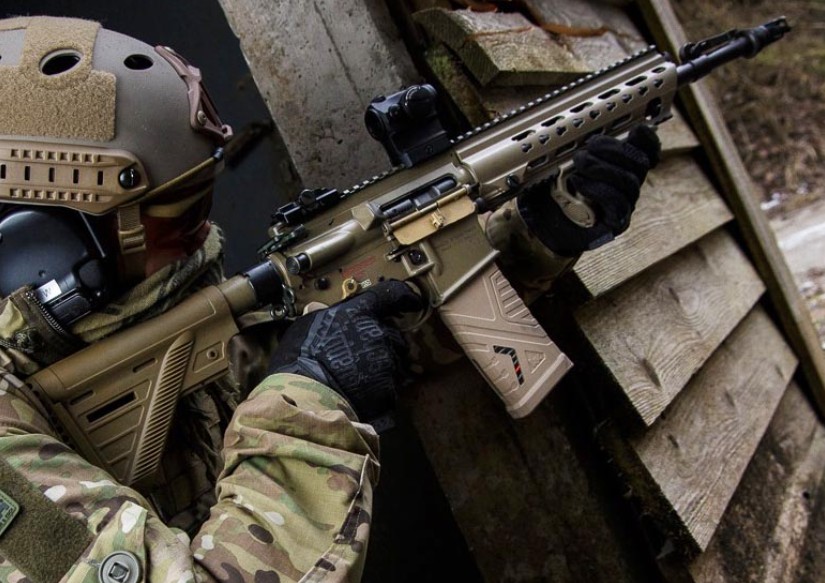
Heckler & Koch solved this by integrating the highly successful short-stroke gas piston system derived from their G36 rifle. In the HK416, the expanding gases push a solid operating rod that physically drives the bolt carrier group rearward. This brilliant engineering tweak keeps the weapon’s internal receiver incredibly cool and remarkably clean, even after firing thousands of rounds. As a result, the HK416 can be fired safely immediately after being submerged in water or buried in mud—scenarios that would routinely destroy traditional M4s.
Elite Operational History and “Over-the-Beach” Capability
The HK416 was initially developed in close collaboration with the U.S. Army’s Delta Force (1st SFOD-D), who sought a weapon that would not fail during high-intensity close-quarters battle (CQB). Its legendary reliability earned it the ultimate operational pedigree. Most famously, it was the weapon used by U.S. Navy SEAL Team Six (DEVGRU) during Operation Neptune Spear, the 2011 raid in Abbottabad, Pakistan.
Furthermore, the HK416 possesses an “Over-the-Beach” (OTB) capability. Special maritime drainage features allow operators to emerge from the water and fire the weapon instantly without the barrel bursting, making it the premier choice for naval commandos.
| Feature | Specification |
| Caliber | 5.56x45mm NATO |
| Operating System | Short-stroke gas piston, rotating bolt |
| Rate of Fire | 700 to 900 rounds per minute |
| Barrel Options | 10.4″, 11″, 14.5″, 16.5″, 20″ (Cold hammer-forged) |
| Feed System | 30-round STANAG magazines |
| Modularity | Free-floating quad-rail or M-LOK handguards |
Key Variants and Global Adoption
The success of the platform has led to widespread global adoption and several major evolutionary variants:
HK416 A5 / A7: The latest generations feature fully ambidextrous controls, modernized gas regulators for optimized suppressor use, and improved ergonomic pistol grips and stocks.
M27 Infantry Automatic Rifle (IAR): The United States Marine Corps adopted a heavy-barreled variant of the HK416 (the M27) to replace the M249 SAW in the squad automatic role, and has since moved to issue it as the standard infantry rifle for all frontline Marines.
French Standard Issue: In 2017, the French Armed Forces selected the HK416F to replace their iconic bullpup FAMAS rifle, integrating the German weapon as the backbone of their conventional infantry.
Norwegian Armed Forces: Norway became the first nation to adopt the HK416 as its standard general-issue assault rifle in 2008.
Conclusion
The HK416 is much more than an incremental upgrade to the AR-15 family; it is a masterclass in tactical firearms engineering. By combining the ergonomic brilliance of the American M4 with the unforgiving reliability of German gas-piston mechanics, Heckler & Koch created a weapon system that defines the absolute bleeding edge of modern infantry lethality.