
Iran’s Secret Weapon: How the “Mosquito Fleet” ?

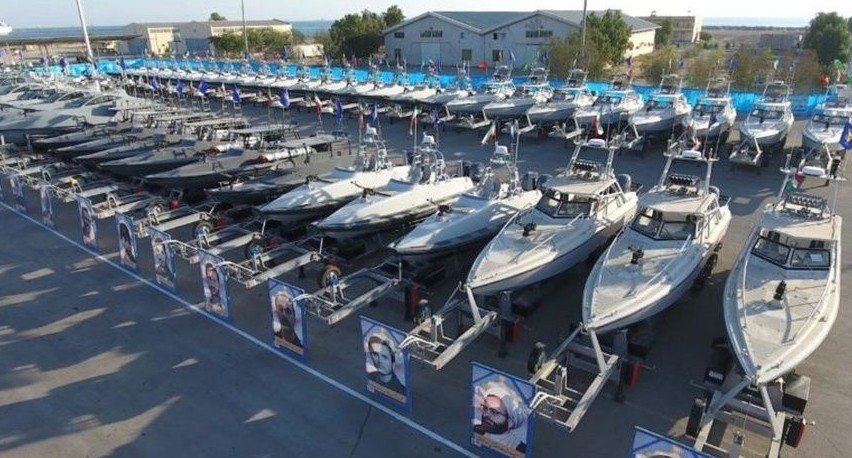
In the modern era of naval warfare, the greatest threat to a hundred-thousand-ton supercarrier is not necessarily a vessel of equal size. As global defense news outlets and military strategists analyze the escalating tensions that could trigger a broader Iran war, focus is turning toward a highly disruptive, asymmetric force operating in the Strait of Hormuz: Iran’s “Mosquito Fleet”.
Operated not by the regular Iranian Navy, but by the Islamic Revolutionary Guard Corps Navy (IRGCN), this flotilla represents a masterclass in guerrilla warfare at sea. It proves that in the confined, shallow waters of the Persian Gulf, sheer quantity and speed can paralyze technological superiority.
The Anatomy of the Swarm
The term “Mosquito Fleet” is a moniker used to describe the sheer volume and size of the ships involved. The foundation of this fleet dates back to the 1980s, during the first major Iran war (the Iran-Iraq War), when the IRGC began modifying commercial recreational speedboats by mounting heavy machine guns and rocket-propelled grenades (RPGs) on them.
Today, that concept has evolved into a highly lethal matrix frequently highlighted in elite defense news briefings. According to recent intelligence assessments, the IRGCN operates anywhere from hundreds to thousands of these nimble fast attack craft (FAC). Stripped of heavy armor, these vessels are built for one purpose: speed. Reaching velocities of up to 100 knots (185 km/h), they are incredibly difficult for standard naval radars to track. Furthermore, to avoid preemptive airstrikes in a potential Iran war scenario, these boats are often hidden deep within excavated caves along Iran’s rocky coastline, capable of being deployed in a matter of minutes.
The A2/AD Trap and Saturation Strikes
The strategic doctrine behind the Mosquito Fleet is rooted in Anti-Access/Area Denial (A2/AD). The IRGCN does not intend to win a classic, broadside naval battle against US or allied destroyers. Instead, they rely on the Saturation Strike.
A modern US destroyer is equipped with the world’s most advanced Aegis combat systems. However, even these systems have a mathematical limit—a “saturation threshold.” If a warship can intercept 40 targets per minute, the Mosquito Fleet’s objective is simply to attack with 60 simultaneous targets from 360 degrees. By compressing the engagement timeline, the swarm guarantees that at least some craft or missiles will break through the defensive screen.
The Drone Evolution: USVs and Floating Kamikazes
What elevates the Mosquito Fleet from a mere harassment force to a strategic peril is the integration of modern technology. Over the past few years, the IRGC has heavily upgraded these small boats with anti-ship cruise missiles.
More alarmingly, the fleet now heavily incorporates Uncrewed Surface Vessels (USVs). Similar to the tactics employed by allied proxy forces in the Red Sea, these drone boats are packed with hundreds of kilograms of explosives and guided remotely to ram into their targets. These “floating kamikazes” remove the risk of human casualties for the attackers while maximizing physical damage.
Conclusion: A Billion-Dollar Problem
The Mosquito Fleet encapsulates the core dilemma of modern asymmetric warfare. When a global superpower must expend a $2 million interceptor missile to destroy a $50,000 modified speedboat, the economic war is lost long before the kinetic one.
As the geopolitical standoff in the Strait of Hormuz continues, top defense news analysts agree on one stark reality: maintaining open global sea lanes during any future Iran war will not require fighting a single, formidable enemy flagship. Instead, it will require surviving the relentless, synchronized sting of a thousand mosquitoes.