
GLOBAL STRIKE ICON: WHAT IS THE MQ-9 REAPER?

When discussing the evolution of modern unmanned combat aerial vehicles (UCAVs), one platform stands as the definitive global benchmark for persistent strike operations. Developed by General Atomics Aeronautical Systems, the MQ-9 Reaper—originally designated as the “Predator B”—is the flagship hunter-killer drone of the United States Armed Forces and a defining symbol of 21st-century remote warfare.
The Evolution of a Legend
Entering active service in 2007, the MQ-9 was conceived as a massive evolutionary leap over its predecessor, the iconic MQ-1 Predator. While the original Predator was primarily an intelligence-gathering asset retrofitted with light weaponry, the Reaper was engineered from the ground up as a heavy, hunter-killer platform.
Powered by a robust Honeywell TPE331-10 turboprop engine generating 900 shaft horsepower, the Reaper swapped the piston engine of the older generation for pure, turbine-driven performance. Boasting a wingspan of over 20 meters, the MQ-9 firmly established the standard for Medium-Altitude, Long-Endurance (MALE) operations, capable of operating at altitudes up to 50,000 feet (15,240 meters) where it remains invisible and inaudible to ground targets.
Unmatched Payload and Precision Arsenal
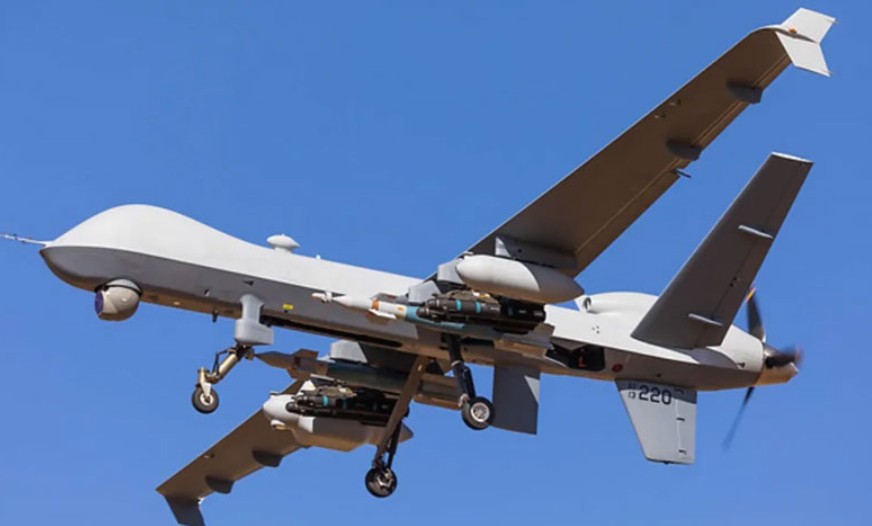
The transition to turboprop power granted the Reaper an incredible payload capacity of 1,700 kilograms (3,750 pounds). This allows the UCAV to carry an array of highly sophisticated, precision-guided munitions across its six under-wing hardpoints.
Its arsenal is highly adaptable, ranging from laser-guided AGM-114 Hellfire air-to-ground missiles for low-collateral surgical strikes, to GBU-12 Paveway II laser-guided bombs and GPS-guided GBU-38 JDAMs for hardened structures. For specialized missions, it can even deploy the AGM-179 JAGM (Joint Air-to-Ground Missile) or carry AIM-9X Sidewinder missiles for air-to-air self-defense. This immense firepower is guided by the AN/DAS-1 Multi-Spectral Targeting System, which integrates infrared sensors, color/monochrome TV cameras, and a laser designator/illuminator.
The Arsenal of Targeted Killing
The Reaper’s primary strategic value lies in its 27-hour flight endurance and satellite-controlled operational radius of 1,850 kilometers. Operated via secure satellite links by flight crews stationed thousands of miles away in the United States, the MQ-9 became the centerpiece of Washington’s “targeted killing” counter-terrorism strategy.
The platform has logged millions of combat hours across highly contested theaters including Yemen, Afghanistan, Pakistan, Iraq, Syria, Libya, Somalia, and Mali. It has been the executing platform for some of the most high-profile decapitation strikes in modern military history, including the precision elimination of Iranian Quds Force Commander Qasem Soleimani in Baghdad (2020) and Al-Qaeda leader Ayman al-Zawahiri in Kabul (2022).
| Feature | Specification |
| Endurance | Up to 27 hours |
| Payload Capacity | 1,700 kg (Internal & External) |
| Operational Ceiling | 15,240 meters (50,000 feet) |
| Maximum Speed | 482 km/h |
| Combat Radius | 1,850 km (Via Beyond-Line-of-Sight Satellite Control) |
| Total Fleet Production | ~300+ units (US Air Force & Global Export Customers) |
Next-Generation Variants and Global Legacy
As the threat matrix of modern warfare shifts from counter-insurgency toward near-peer conflict, the Reaper platform continues to evolve. General Atomics has successfully fielded the MQ-9B SkyGuardian and its maritime counterpart, the SeaGuardian. These next-generation variants feature redesigned wings, all-weather flight certification, automatic take-off and landing capabilities, and specialized anti-submarine warfare (ASW) sonobuoy dispensers.
With over 300 units produced, the MQ-9 family has become a highly successful export asset. Beyond the United States, elite militaries including the United Kingdom, France, Italy, Spain, the Netherlands, and Japan rely on the Reaper lineage to secure their borders, conduct maritime patrol, and project precision airpower across the globe.