
What is an Optical Drone? The “Unjammable” Evolution of FPV Warfare
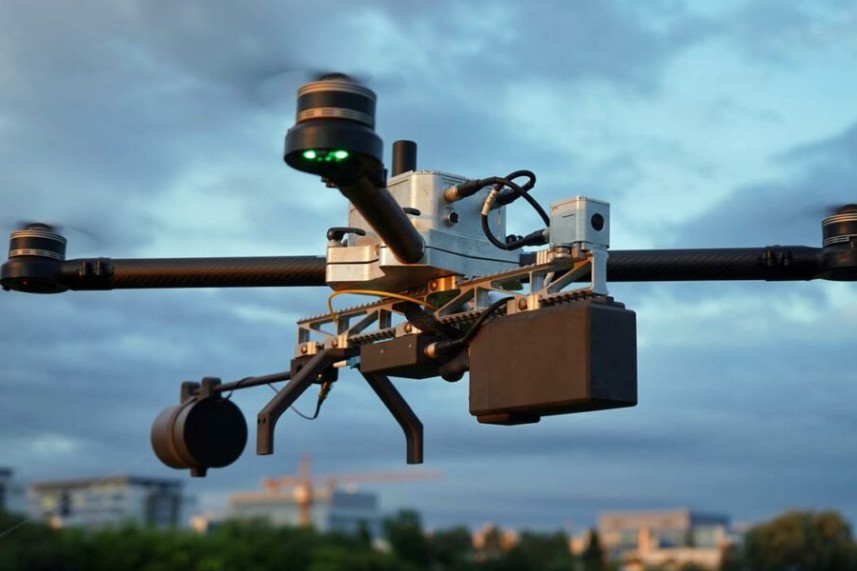
In the rapidly evolving landscape of 2026 battlefield technology, the term “Optical Drone” (specifically Fiber-Optic FPV Drones) has moved from a niche concept to a strategic game-changer. As seen in recent high-profile strikes in Northern Israel, these tethered hunters are doing what high-tech signals could not: bypassing the world’s most advanced Electronic Warfare (EW) umbrellas.
But what exactly makes an optical drone different from a standard UAV, and why is it suddenly the most feared weapon in urban warfare?
Defining the Optical Drone
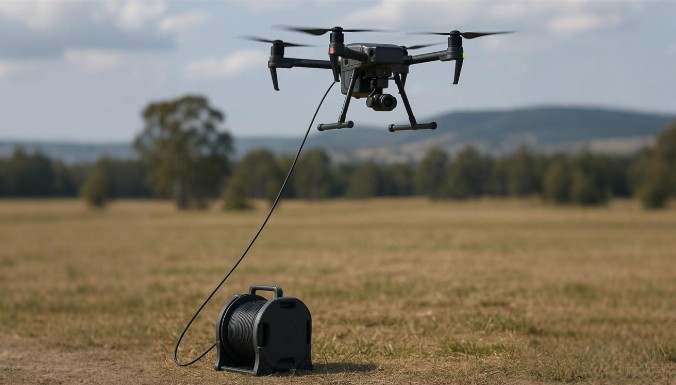
At its core, an optical drone is an FPV (First Person View) UAV that is physically connected to the pilot via a micro-fiber optic cable.
Unlike traditional drones that communicate using Radio Frequency (RF) signals (like 2.4GHz or 5.8GHz), the optical drone unspools a hair-thin glass fiber as it flies. Commands from the pilot and high-definition video from the drone travel as pulses of light through this cable, rather than waves through the air.
The Tactical Advantages: Why Light Wins
The move toward fiber optics is a direct response to the saturation of the electromagnetic spectrum on the modern battlefield.
Total Immunity to Jamming: Because there is no wireless signal, GPS spoofing, frequency hopping, and broad-spectrum jammers are completely useless. If there is no “radio link” to break, the drone cannot be electronically downed.
Zero Electronic Signature: Traditional drones are easy to detect using EW sensors because they “scream” in radio frequencies. An optical drone is “silent.” It emits no RF, making it nearly impossible for the enemy to locate the pilot or the drone’s flight path.
Unmatched Video Quality: RF signals degrade behind walls, inside tunnels, or in high-noise environments. Fiber optics provide a consistent, lag-free 4K video feed, allowing the pilot to perform surgical maneuvers inside buildings or through narrow openings.
Resistance to Cyber-Hijacking: Without a wireless entry point, the drone’s control system is physically protected from hacking or “hijacking” attempts by enemy cyber-units.
| Disadvantage | Technical Explanation |
| Range Limitations | The drone is limited by the length of the cable on its bobbin (typically $5$ to $10$ km). |
| Weight Penalty | Carrying $10$ km of fiber-optic wire adds weight, reducing flight time and battery efficiency. |
| Snagging Risk | The wire can become tangled in trees, power lines, or sharp debris, potentially snapping the connection. |
| One-Way Mission | Once the wire is unspooled, recovering the drone is nearly impossible without tangling. These are almost always “one-way” suicide drones. |
The 2026 Strategic Context: From Ukraine to the Levant
The rapid deployment of optical drones by groups like Hezbollah marks a “trickle-down” of technology from the Ukraine-Russia theater. As high-end defense systems like the Golden Dome or Aegis become better at intercepting radio-linked threats, asymmetric actors are moving “offline.”
The optical drone is proof that in the age of total electronic warfare, the most sophisticated solution is sometimes a physical tether. It forces a rethink of modern air defense: if you cannot jam the signal, you must physically destroy the drone—a task that is notoriously difficult when the target is navigating at $100$ km/h through a window.
Editor’s Note: As of April 2026, defense contractors are already experimenting with “hybrid” systems—drones that use RF for initial flight and switch to fiber optics for the final, jammed phase of an attack.