T-14 Armata, the Revolutionary Tank Russia Could Not Build
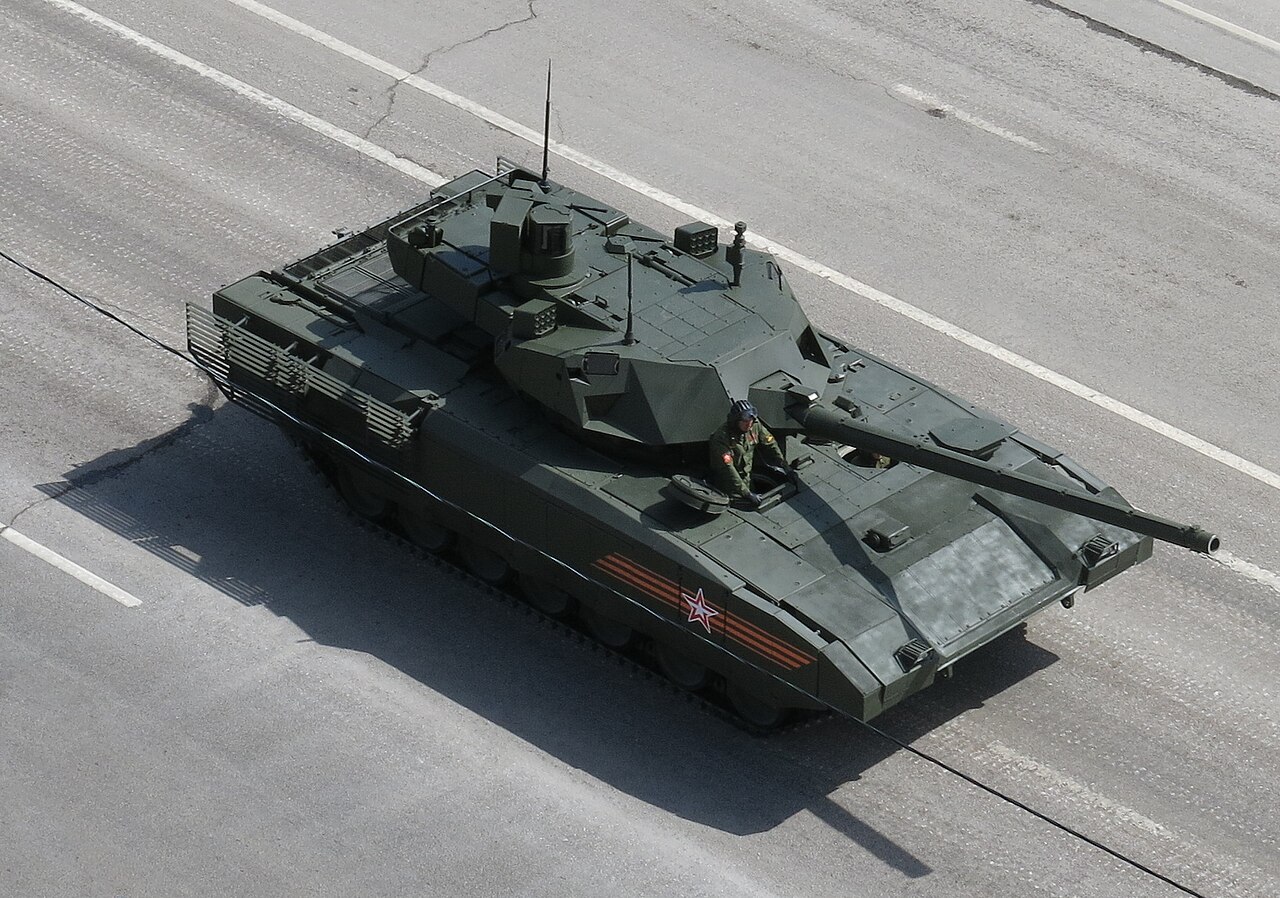
The T-14 Armata was unveiled in 2015 as the world’s first serial tank with an unmanned turret, yet a decade later fewer than a few dozen are believed to exist and Russia has publicly shelved wider production. This guide lays out what the T-14 is, what Uralvagonzavod claims it can do, and the honest state of a program that promised a revolution and delivered a prototype fleet.
T-14 Armata at a glance
The T-14 is the tank member of the Armata universal tracked platform, developed by Uralvagonzavod as a clean-sheet replacement for the T-72 lineage. Its debut was memorable for the wrong reason, a vehicle stalling during parade rehearsal, but the engineering ambition was real: crew survivability through separation from the ammunition, sensors over armor mass, and a chassis meant to spawn a whole vehicle family, including the T-15 heavy infantry fighting vehicle that shares its hull.
What makes the T-14 different
Three ideas set the T-14 apart from every Russian tank before it. First, the unmanned turret: all three crew sit low in the hull inside an armored capsule, aiming through cameras and sights rather than eyes on glass, which removes the classic Russian vulnerability of crew sitting atop a carousel of propellant. Second, the Afghanit active protection system, radar-cued hard-kill charges claimed to intercept incoming rockets and missiles, layered over Malachit reactive armor. Third, digital architecture, a claimed AESA radar, panoramic sights and vetronics intended to make the tank a networked sensor node. Each claim carries the same caveat: demonstrated mostly in controlled settings, verified nowhere harder.
T-14 Armata specifications
| Specification | Value (manufacturer claims) |
|---|---|
| Role | Main battle tank, unmanned turret |
| Developer | Uralvagonzavod, Nizhny Tagil, Russia |
| Combat weight | About 55 tonnes |
| Crew | 3, in an armored hull capsule |
| Main gun | 125mm 2A82-1M smoothbore, autoloaded; 152mm variant discussed |
| Engine | A-85-3A (12N360) X-diesel, quoted at 1,500 hp class |
| Road speed | Claimed up to about 80 km/h |
| Protection | Malachit ERA, Afghanit hard-kill APS, capsule crew protection |
| Sensors | Panoramic commander sight, claimed radar-based situational awareness |
| Unit cost | Reported around $4 million or more; Russian officials have called it too expensive |
Why is the T-14 not in mass production
The original state armament plan spoke of 2,300 Armatas by 2020. Reality delivered a trickle: a 2018 contract reported at 132 vehicles across the T-14 and T-15, repeated delivery slips, and open acknowledgments from Rostec that the tank costs too much for mass fielding. The reasons stack up: an unproven engine and transmission that reportedly plagued trials, sanctions choking imported electronics and optics after 2014 and again after 2022, and a wartime economy that needed tanks immediately, which favored refurbishing T-72s and building the proven T-90M instead of maturing a new design. By 2023-24, Russian officials were stating openly that Armata production was effectively paused in favor of cheaper types.
Has the T-14 fought in Ukraine
Barely, if at all. Russian state media claimed in 2023 that T-14s were used briefly for indirect fire support in the Zaporizhzhia direction, and Western officials assessed any employment as limited and short-lived; no verified combat engagement, loss or kill involving a T-14 has appeared in open sources. Rostec’s own chief said the tank was withheld because losing one would be a propaganda gift. For a vehicle marketed as a generation ahead of the Leopard 2 and M1 Abrams, absence from Russia’s defining tank war is the loudest data point available.
What happens to the Armata program now
The design ideas are not dead, they are migrating. Unmanned or reduced-crew turrets, capsule protection and hard-kill APS now define next-generation tank concepts from Western programs to South Korea’s and China’s development efforts, a vindication of the T-14’s direction if not its execution. Russia keeps the Armata alive as a technology showcase and export talking point, India and others have been courted for years without a contract, while its production lines earn their keep on T-90Ms. A post-war Russia with rebuilt finances could revive it; the current one cannot afford to.
T-14 Armata frequently asked questions
What is the T-14 Armata?
Russia’s clean-sheet main battle tank with an unmanned turret and a three-man crew capsule, unveiled in 2015 by Uralvagonzavod.
How many T-14 tanks does Russia have?
Open estimates put the fleet in the dozens, largely pre-production vehicles; the once-planned 2,300 were never built.
Has the T-14 been used in Ukraine?
Russian state media claimed brief fire-support use in 2023; no verified combat engagement or loss has been documented publicly.
Why did Russia stop T-14 production?
Cost, sanctions-hit components and wartime urgency; officials said openly it was too expensive, and resources went to T-90M production.
Is the T-14 the most advanced tank in the world?
Its architecture was pioneering, but its claimed capabilities are unverified and its numbers tiny, so the title belongs to fielded, proven designs.
- Uralvagonzavod and Rostec statements via Russian state media (manufacturer claims)
- Wikipedia – T-14 Armata (accessed October 2026)
- Western defense intelligence assessments of Armata production and employment
- Defence & Tech reporting on Russian armored vehicle programs