Can the F-35 Carry Nuclear Weapons? The B61-12 Mission
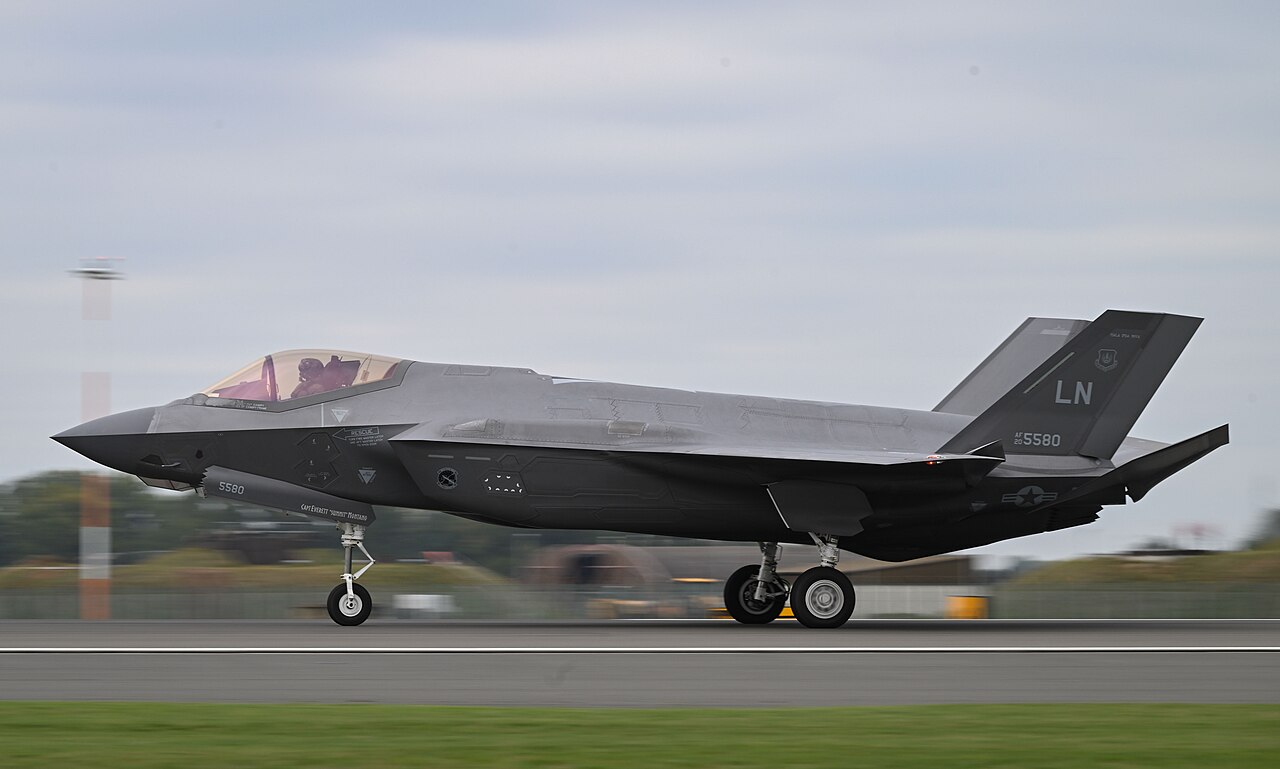
Yes. The F-35A is certified to carry the B61-12 nuclear gravity bomb, a clearance that was completed in October 2023 and made public in March 2024. It is the first stealth fighter with a nuclear role, and only the A model has it; the F-35B and F-35C are not certified.
The certification matters most in Europe. The F-35A is replacing the F-16s and Tornados that NATO members have kept ready for decades to deliver US nuclear bombs stored on their soil. This guide explains how the F-35 nuclear weapons mission works, who is part of it and why it is debated.
Which F-35 can carry nuclear weapons?
Only the F-35A, the conventional takeoff version. Aircraft given this role are called dual-capable, meaning they can carry conventional or nuclear weapons. They need extra wiring and software to communicate with the bomb, and crews and units must pass separate nuclear certification inspections.
Flight testing with inert bombs ran from 2019 to 2021 at the Tonopah Test Range in Nevada. The Joint Program Office confirmed in March 2024 that the design certification had been completed on 12 October 2023, ahead of a deadline promised to NATO allies. The bomb is carried in the weapons bays, one on each side, so the jet keeps its stealth while armed. Conventional loads are covered in F-35 weapons.
What is the B61-12?
It is the current version of the B61, a nuclear bomb first fielded in the 1960s. The Mod 12 was produced by rebuilding older bombs with new components and a guided tail kit made by Boeing. The first production unit was completed in November 2021 and the last at the end of 2024.
| Item | Detail |
|---|---|
| Type | Nuclear gravity bomb with a guided tail kit |
| Yield | Selectable: 0.3, 1.5, 10 or 50 kilotons |
| Length and weight | About 12 ft (3.6 m); about 825 lb (374 kg) |
| Accuracy | About 30 metres, against well over 100 metres for older versions |
| Production | About 400 to 500 planned; completed in 2024 |
| Aircraft | F-35A, F-15E, F-16, Tornado, B-2; B-21 in future |
Two features draw attention. The tail kit lets the bomb glide to a point with roughly the accuracy of a satellite-guided conventional bomb. And the lowest yield setting is a small fraction of the Hiroshima bomb. Combined with a stealth aircraft, that produces a weapon that is more likely to reach its target and does less damage beyond it.
Which countries use the F-35 in the nuclear role?
Under NATO’s nuclear sharing arrangements the United States stores B61 bombs at bases in five countries. In a war, and only if the US president released them, pilots from the host nations would deliver some of them. Independent estimates put the stockpile in Europe at about 100 bombs.
| Country | Base | Aircraft |
|---|---|---|
| Netherlands | Volkel | F-35A; took over the role from the F-16 in June 2024 |
| Belgium | Kleine Brogel | F-35A replacing the F-16 |
| Germany | Büchel | 35 F-35As ordered to replace the Tornado in this role |
| Italy | Ghedi and Aviano | F-35A replacing the Tornado at Ghedi; US aircraft at Aviano |
| Turkey | Incirlik | Bombs stored; no Turkish aircraft assigned |
| United Kingdom | Lakenheath | US Air Force F-35As; Britain is buying 12 F-35As to join the mission |
Germany’s order shows how much the mission drives procurement. Berlin had not planned to buy the F-35 at all, and chose it in 2022 largely because it was the only new aircraft certified, or about to be certified, for the B61-12. Britain’s decision in June 2025 to add 12 F-35As to its F-35B fleet was made for the same reason. The list of operators is in which countries have the F-35.
Who controls the bombs?
The United States. The bombs stay in US custody in underground vaults, guarded by US personnel, and cannot be armed without codes held by Washington. A host nation’s F-35 can carry one only after a decision by the US president and consultation within NATO.
This is one reason the debate about American control over the F-35 has an extra edge in Europe. A country that relies on the jet for the nuclear mission depends on the United States twice: for the weapon and for the aircraft’s software and support.
Why does the nuclear role matter?
For NATO it modernises a mission that had become hard to sustain. A Tornado or F-16 would struggle to get through modern air defences. An F-35 has a much better chance, as explained in how F-35 stealth works, which makes the threat more credible.
Critics, including the Federation of American Scientists, argue that an accurate, low-yield bomb on a stealth aircraft is easier to consider using and so lowers the threshold. Supporters reply that deterrence depends on the other side believing the weapon would arrive. Russia has cited the upgrade in its own nuclear statements. The aircraft’s general role is set out in what the F-35 is.
Frequently asked questions
Can the F-35 carry nuclear bombs?
Yes. The F-35A is certified to carry the B61-12 nuclear gravity bomb.
Can the F-35B or F-35C carry nuclear weapons?
No. Only the F-35A has been certified.
How many nuclear bombs can an F-35A carry?
Two B61-12s, one in each internal weapons bay.
When was the F-35 certified for nuclear weapons?
The certification was completed on 12 October 2023 and announced in March 2024.
Which countries would use the F-35 to deliver nuclear weapons?
The United States, and under NATO nuclear sharing the Netherlands, Belgium, Germany and Italy. Britain is buying F-35As to join the mission.
What is the yield of the B61-12?
It is selectable. Reported settings are 0.3, 1.5, 10 and 50 kilotons.
- Breaking Defense – F-35A officially certified to carry nuclear bomb (March 2024): breakingdefense.com
- Wikipedia – B61 nuclear bomb: en.wikipedia.org
- Wikipedia – Lockheed Martin F-35 Lightning II: en.wikipedia.org
- Wikipedia – Lockheed Martin F-35 Lightning II operators: en.wikipedia.org