GM Defense Company Profile, Products, Vehicles and Programs
GM Defense is General Motors’ military subsidiary, relaunched in 2017 and best known for winning the US Army’s Infantry Squad Vehicle program in 2020 with a $214 million award for up to 649 trucks built from 90 percent commercial parts. The Concord, North Carolina operation is Detroit’s bet that commercial automotive scale, batteries and autonomy can be sold to armies at a fraction of bespoke defense prices.
GM Defense at a glance
| Item | Detail |
|---|---|
| Full name | GM Defense LLC |
| Parent | General Motors Company |
| Relaunched | 2017; the original GM defense business was sold to General Dynamics in 2003 |
| Headquarters | Washington, DC area; production in Concord, North Carolina |
| Flagship program | US Army Infantry Squad Vehicle (ISV) |
| Other lines | Heavy-duty armored SUVs, tactical EV demonstrators, batteries and autonomy work |
| Scale | A small subsidiary measured against GM’s roughly $180 billion automotive business |
What happened to the original GM Defense
General Motors was once a giant of military production, from World War II aircraft and trucks through Cold War armored vehicles, and its GM Defense unit built the LAV family that still underpins the Stryker. GM sold that business to General Dynamics in 2003 for about $1.1 billion, exiting defense for a generation. The 2017 relaunch was a deliberate re-entry aimed not at armor but at what GM does uniquely well, high-volume trucks, batteries and autonomy from its commercial ecosystem.
What is the Infantry Squad Vehicle
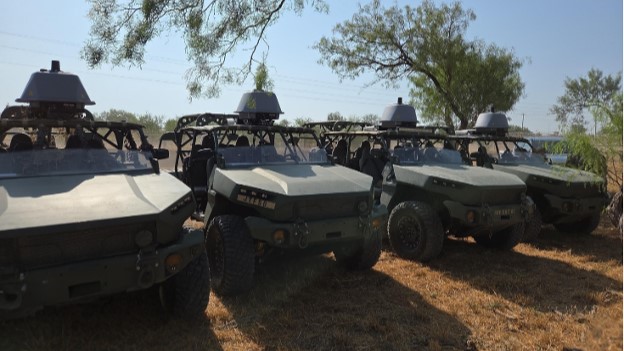
The ISV is a nine-soldier air-droppable truck derived from the Chevrolet Colorado ZR2, sharing roughly 90 percent of its parts with commercial vehicles, including race-proven suspension. It weighs about 2.3 tonnes, slings under a UH-60 Black Hawk, fits inside a CH-47 and can be dropped by parachute from a C-130 or C-17. The Army’s 2020 award, $214.3 million for an initial 649 vehicles against a total requirement of 2,065, chose GM Defense over an Oshkosh-Flyer team and others, and deliveries began the same year at Concord.
| Item | Value |
|---|---|
| Role | Light infantry mobility, nine-soldier squad |
| Base platform | Chevrolet Colorado ZR2 architecture, ~90% commercial parts |
| Weight | Roughly 2.3 tonnes, air-droppable |
| Transport | Sling load under UH-60; internal in CH-47; airdrop from C-130/C-17 |
| Program | US Army requirement of 2,065 vehicles; initial award 2020 |
| Variants | Troop carrier plus weapons-carrier and specialty configurations in development |
The ISV has also become a host platform for new payloads, including counter-drone systems, US units have fielded DroneShield sensors mounted on ISVs, and GM Defense markets electrified and autonomous derivatives of the same chassis.
GM Defense other programs
Beyond the ISV, GM Defense won a ten-year US State Department contract in 2023 to supply Heavy-Duty armored Suburban SUVs for diplomatic security, a program that created a dedicated low-rate production line. The company pitches electric and hybrid tactical vehicles, battery packs drawn from GM’s Ultium technology for silent watch and exportable power, and autonomy demonstrators, and it has campaigned ISV derivatives internationally, including for Canada’s light utility vehicle needs. None of these yet rivals the ISV in scale, but together they sketch the portfolio GM wants, vehicles and power, not weapons.
GM Defense outlook
GM Defense’s advantage is its parent’s industrial base, no pure defense firm can match commercial automotive costs, supply chains or battery volumes, the same logic that makes Oshkosh formidable in trucks. Its challenge is that defense procurement rewards patience and lobbying as much as engineering, and a small subsidiary inside a car company must keep proving it deserves capital against electric pickups and robotaxis. The ISV’s success, and the Army’s appetite for cheap, light mobility after watching Ukraine, suggest the niche is real and growing.
GM Defense frequently asked questions
What does GM Defense make?
The US Army’s Infantry Squad Vehicle, armored Heavy-Duty Suburbans for the State Department, and demonstrators for electric and autonomous tactical vehicles and military battery power.
Is GM Defense part of General Motors?
Yes, it is a wholly owned subsidiary, relaunched in 2017 after GM sold its original defense business to General Dynamics in 2003.
What is the Infantry Squad Vehicle based on?
The Chevrolet Colorado ZR2 pickup architecture, with roughly 90 percent commercial parts and racing-derived suspension.
How many ISVs is the Army buying?
The stated requirement is 2,065 vehicles; the initial 2020 award covered up to 649 for $214.3 million, with deliveries ongoing.
Where does GM Defense build its vehicles?
At a dedicated facility in Concord, North Carolina, separate from GM’s commercial plants.
- GM Defense and General Motors announcements
- US Army and US State Department program information
- Wikipedia – GM Defense and Infantry Squad Vehicle (accessed October 2026)
- Defence & Tech reporting on light tactical vehicles