
Saab UK and Kraken Put Giraffe 1X Radar on Drone-Hunting Uncrewed Boat

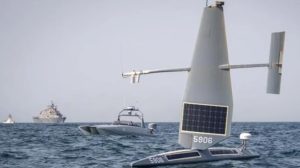
Kraken Technology Group and Saab UK have fitted Saab’s Giraffe 1X air-surveillance radar to an uncrewed surface vessel and taken the combination to sea, creating a prototype “drone seeker” boat intended to give ships, ports and offshore infrastructure early warning of incoming aerial drones. The two companies, both based in Fareham on England’s south coast, said the system went from concept to sea trials in under seven months.
The prototype pairs Kraken’s K3 SCOUT, an eight-meter uncrewed surface vessel (USV), with the compact Giraffe 1X, which is installed in the boat’s modular payload bay. The vessel is designed as a sensor-only node: it detects and tracks airborne targets and passes those tracks to other platforms that carry the weapons to engage them.
How the System Works
Giraffe 1X is the smallest member of Saab’s Giraffe family of three-dimensional air-surveillance radars. Its topside unit weighs roughly 100 kilograms, light enough to be mounted on vehicles, masts and now small boats. The radar is optimized for small, slow and low-flying targets such as commercial and military drones, a category that conventional naval radars have historically struggled to track against sea clutter.
Mounted low on a small hull, the radar’s horizon is limited, and published figures suggest a practical detection range in the region of 28 kilometers against a small drone flying at about 30 meters. The trade-off is that the USV can be pushed out ahead of a crewed ship or anchored off a port entrance, extending the warning line well beyond what a single warship’s sensors can see on their own, while keeping crews out of harm’s way.
The companies have not released detailed trial results, and neither has disclosed where the sea trials took place.
Program Context
The project builds on equipment already in British service. The Royal Navy bought 20 K3 SCOUT boats earlier in 2026 under an effort known as Project Beehive, intended to field uncrewed boats in numbers for surveillance and force-protection tasks. Ashore, the RAF Regiment uses Giraffe 1X as part of its counter-drone capability protecting air bases.
Kraken has positioned itself as one of the fastest-growing European USV makers and has said it is scaling production toward around a thousand boats a year. Saab, meanwhile, has sold Giraffe 1X and its naval variant Sea Giraffe 1X to several armed forces, including the Swedish Navy.
Why It Matters
The project responds to one of the defining naval lessons of recent years: cheap drones and loitering munitions can threaten ships and coastal infrastructure at a cost far below that of the missiles used to defeat them. In the Red Sea, the Black Sea and the Gulf, navies and commercial operators have had to defend against swarms of one-way attack drones and uncrewed boats, often with limited warning.
Spreading sensors across inexpensive uncrewed platforms is one answer. A picket line of radar-equipped USVs could give a task group or a port authority a larger surveillance footprint and more reaction time, while crewed warships conserve their own radar emissions and interceptors. The approach also suits the protection of offshore energy infrastructure such as wind farms, pipelines and subsea cables, which have become a growing security concern for European governments.
The vessel’s sensor-only role reflects a broader shift toward distributed, networked air defense, in which detection, tracking and engagement are split among different platforms. For the concept to work at scale, the radar tracks would need to feed reliably into existing naval combat management and shore-based command systems, an integration step the companies have not yet detailed.
Regional Relevance
Reports on the project have pointed to chokepoints such as the Strait of Hormuz as possible operating areas, where commercial shipping faces drone and missile threats. Closer to home, European navies are looking for affordable ways to watch over North Sea and Baltic infrastructure. A modular, quickly deployable radar boat could be relevant to both missions, as well as to export customers seeking low-cost maritime domain awareness.
Kraken and Saab have not announced a customer for the radar-equipped variant, but the speed of the development and the existing Royal Navy K3 SCOUT fleet give the concept a short path to operational experimentation.
Sources
- Navy Lookout — Kraken and Saab UK test USV-mounted radar
- UK Defence Journal — Kraken and Saab test autonomous drone-seeker vessel
- Saab — Giraffe 1X product information
- Kraken Technology Group — K3 SCOUT product information