Naval Air Defense Layers Explained, From SM-6 to CIWS

Naval air defense layers stack long-range area missiles, medium-range missiles, close-in guns and decoys so that an incoming missile faces several chances to die, from beyond 200 kilometers out to under two kilometers from the ship. No single weapon covers every threat, which is why modern warships carry a mix of interceptors, radars and electronic countermeasures.
What is layered naval air defense
A ship at sea has no mountains to hide behind, no hardened shelters and very little armor. Its survival depends on seeing the threat early and killing it quickly. Layering is the answer: the outer layer engages aircraft and ballistic missiles at long range, the middle layer handles cruise missiles and drones, and the inner layer covers whatever leaks through. Each layer also has a different cost, since long-range interceptors are expensive and gun rounds are cheap.
| Layer | Typical range | Examples |
|---|---|---|
| Area defense | Roughly 100 to 400 km, depending on the missile | SM-6, SM-2, Aster 30, S-300F family (Russian claims) |
| Medium range | Roughly 20 to 50 km | ESSM Block 2, Sea Ceptor CAMM, Aster 15 |
| Point defense | Roughly 5 to 15 km | RIM-116 RAM, short-range versions of CAMM |
| Close-in guns | Under about 3 km | Phalanx, Goalkeeper, Millennium Gun |
| Soft kill | Varies | Chaff, flares, decoy launchers, jamming |
Long-range area defense missiles
The outer layer protects the entire task force. The US Navy’s Standard Missile family, including the SM-2 and SM-6, leads this field, and the SM-6 can also engage some ballistic and maneuvering targets in the terminal phase. European navies use the Aster 30, the same missile family behind the land-based system in our SAMP/T guide. China’s HHQ-9 and Russia’s S-300F derivatives fill similar roles, though their performance numbers are manufacturer claims and have rarely been verified in combat.
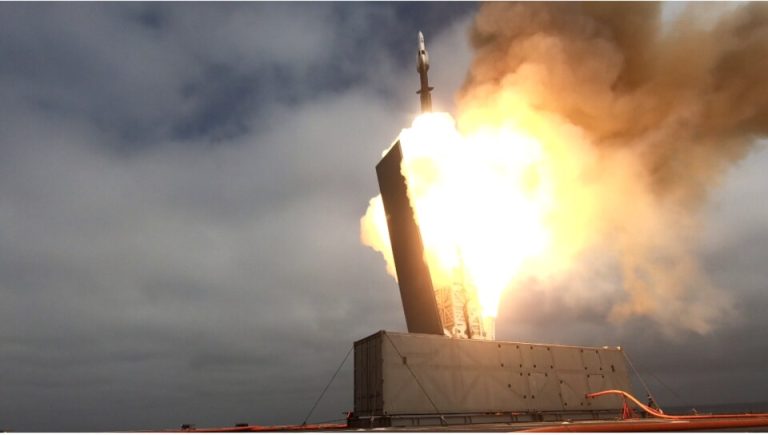
These missiles are launched from vertical cells, described in our explainer on the Mk 41 vertical launch system. A destroyer or cruiser may carry 90 to 120 cells, mixing long- and medium-range missiles depending on the expected threat.
Medium-range naval air defense
The medium layer targets sea-skimming cruise missiles and aircraft that have gotten past the outer ring. The Evolved Sea Sparrow Missile, detailed in our ESSM Block 2 guide, can be quad-packed in a single Mk 41 cell, so a ship can fit four missiles where one larger interceptor would go. Britain’s Sea Ceptor, built around the Common Anti-air Modular Missile, uses a soft-launch technique to save space and cost, and its extended-range version is aimed at longer engagements.
The key issue is saturation. A volley of missiles arriving from different directions can exceed the number of interceptors a ship can guide at once. That is why modern frigates have radars that track many targets simultaneously and missiles with onboard seekers that need little illumination from the ship.
Close-in weapon systems and soft-kill
| System | Type | Notes |
|---|---|---|
| Phalanx CIWS | 20 mm radar-guided gun | About 4,500 rounds per minute; used by the US and many allies |
| Goalkeeper | 30 mm gun | Dutch system, fast-firing, used by several navies |
| RIM-116 RAM | Infrared-guided missile | 21-round launcher; can be paired with Phalanx |
| Nulka decoy | Active hovering decoy | Lures radar-guided missiles away from the ship |
| Chaff and flares | Passive decoys | Cheap, effective against simple seekers |
The last-ditch layer accepts that some weapons will leak through. Close-in weapon systems use radar and computers to fire streams of rounds at a missile, hoping to destroy it or push debris into its path. Decoys and jammers, covered in our chaff, flares and DIRCM explainer, try to make the missile miss rather than kill it.
How do radars and datalinks tie the layers together
The layers only work when sensors feed them quickly. Phased array radars on the ship’s superstructure scan in all directions, and the combat system assigns the right weapon to each threat. Cooperative engagement links let one ship use another’s radar data, so a missile can be fired from a ship that has not yet seen the target. Airborne early warning aircraft extend the radar horizon far beyond the ship’s own mast.
In the Red Sea, since late 2023, Western warships have defended against drones and anti-ship missiles, in operations that navies describe as among the most intense in decades. Reported interception figures are operator-reported, and exact numbers are not independently verified, but the operations have pushed questions about interceptor stocks and cost exchange into the open.
Naval air defense layers frequently asked questions
What are the layers of naval air defense?
Long-range area defense, medium-range missiles, point defense and close-in guns, plus soft-kill decoys and jamming.
What is the difference between hard kill and soft kill?
Hard kill destroys the threat with missiles or guns, while soft kill seduces or jams it so that it misses.
Why do ships carry so many missile types?
Each missile is optimized for a different range and target, and mixing them balances cost, coverage and magazine depth.
What is a CIWS?
A close-in weapon system is an automated gun, usually 20 to 30 mm, that defends against missiles at very short range.
Can ships stop ballistic missiles?
Some can, using variants such as the SM-3 and SM-6 paired with advanced radars like those in the Aegis system.
- US Navy and Royal Navy fact sheets on shipboard air defense
- Manufacturer product literature (RTX, MBDA, Thales)
- Wikipedia – Naval air defence topics (accessed October 2026)
- Defence & Tech reporting