Top 10 Radar Systems in 2026 Ranked
The AN/SPY-6(V), LTAMDS and AN/TPY-2 lead our ranking of the top 10 radar systems in 2026, a list where gallium nitride AESA technology and 360-degree coverage have become the dividing line between new and older designs. We ranked ten air and missile defense radars by technology, operational record, production and export reach, and we flag every Russian and Chinese figure as a manufacturer claim.
How this ranking works
| Criterion | What we looked at | Approximate weight |
|---|---|---|
| Technology | AESA, gallium nitride, digital beamforming, multi-mission ability | 30% |
| Operational record | Fielding, live-fire testing, reported combat use | 25% |
| Production and export | Units built, number of users, allied adoption | 25% |
| Strategic role | Importance to missile defense, air defense or fighter programs | 20% |
We ranked radar systems, not companies, and only those tied to air, missile or surveillance missions. Range numbers are rarely published in full because they depend on target size and mode, so we avoid them unless a manufacturer has made a specific claim. Consistent with this site’s editorial policy, companies and platforms headquartered in Israel are excluded from consideration.
Top 10 radar systems ranked
| Rank | Radar | Country | Main role |
|---|---|---|---|
| 1 | AN/SPY-6(V) | United States | Naval air and missile defense |
| 2 | LTAMDS | United States | Army air and missile defense, 360 degree |
| 3 | AN/TPY-2 | United States | Ballistic missile tracking for THAAD |
| 4 | AN/APG-81 | United States | F-35 fighter AESA radar |
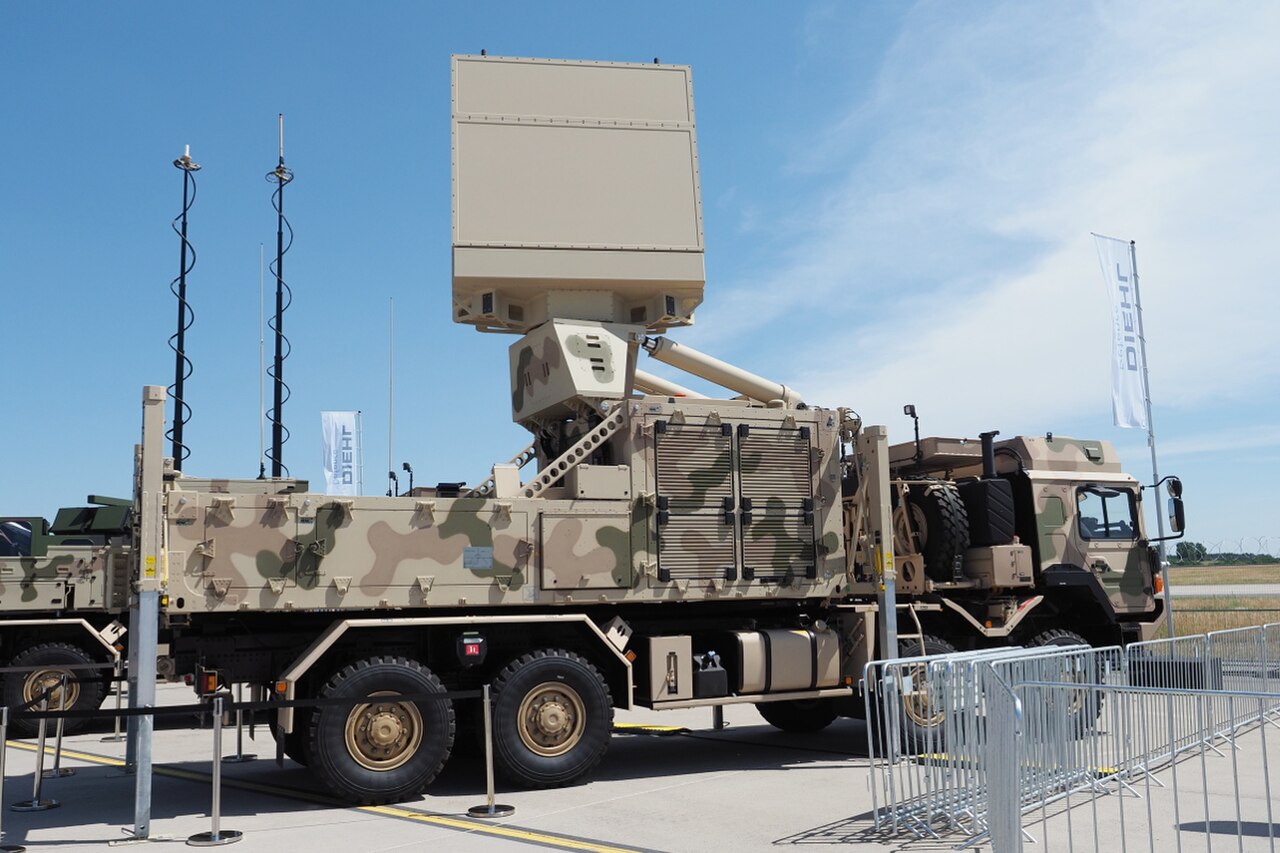
| 5 | Ground Master 400 alpha | France | Long-range 3D air surveillance |
| 6 | TRML-4D | Germany | Air defense fire control and surveillance |
| 7 | Giraffe 4A | Sweden | Medium-range air and counter-drone surveillance |
| 8 | Nebo-M | Russia | Multi-band early warning, manufacturer claims |
| 9 | YLC-8B | China | UHF anti-stealth surveillance, manufacturer claims |
| 10 | KM-SAM multifunction radar | South Korea | Fire control for Cheongung medium-range SAM |
Why these radars rank where they do
The AN/SPY-6(V) takes first place. Built by Raytheon for the US Navy, it is a gallium nitride AESA that the Navy says is far more sensitive than the SPY-1 it replaces, and it is being installed on new and existing destroyers. LTAMDS, from the same company, is the Army’s 360-degree Patriot radar successor and is also ordered by allies such as Poland. The AN/TPY-2 is the X-band radar at the heart of THAAD and has been deployed from Japan to the Middle East. Our gallium nitride radar explainer covers the technology behind all three.
The AN/APG-81 ranks fourth because it is the eyes of the F-35 and is in service with many air forces. Thales’ Ground Master 400 alpha has sold widely in Europe and beyond, and Hensoldt’s TRML-4D is the sensor for Germany’s IRIS-T SLM, a pairing that is also fielded in Ukraine. Saab’s Giraffe 4A is a flexible S-band AESA used for both air surveillance and low-flying threats, including drones.
Russia’s Nebo-M and China’s YLC-8B earn spots on reputation and fielding rather than verified performance. Both countries say the radars can detect stealth aircraft using low frequencies, and Western experts agree that low-frequency radars can give early warning against stealthy targets, although they are not precise enough to guide a weapon on their own. Those claims have not been independently tested. South Korea’s KM-SAM radar closes the list as the eyes of a fast-growing export family of medium-range air defense systems.
What separates the best radars
Three features set the leaders apart. Gallium nitride transmit and receive modules give higher power and efficiency than older gallium arsenide, which supports longer range and better jamming resistance. Digital beamforming lets one radar do several jobs at once, such as search, track and missile guidance. Finally, software matters as much as hardware, because software updates can add new modes such as drone detection without replacing the antenna. The basics of phased-array design are in our explainer on how AESA radar works.
Radars that just missed the top 10
Several radars narrowly missed. The Japanese J/FPS family, Leonardo’s Kronos radars, Thales’ SMART-L, the SAMPSON radar on British Type 45 destroyers and Aselsan’s growing radar line are all strong candidates. Fighter radars such as those on the Rafale and Typhoon also deserve a place, and the Chinese Type 346 naval radar is often cited by analysts but lacks independent data. Our top 10 air defense systems list looks at the missiles behind these sensors.
Top radar systems frequently asked questions
What is the best radar system in the world?
The AN/SPY-6(V) is our top pick for 2026 because of its GaN AESA design and broad naval fielding, though different missions favor different radars.
What is an AESA radar?
An active electronically scanned array radar, which uses thousands of small transmit and receive modules to steer beams electronically.
Can radar detect stealth aircraft?
Low-frequency radars can give early warning against stealth shapes, but they usually cannot guide weapons precisely.
Which radar does the F-35 use?
The AN/APG-81 AESA radar built by Northrop Grumman.
Are Russian and Chinese radar ranges verified?
No. Figures published by Russian and Chinese manufacturers are claims that have not been independently tested.
- Manufacturer and government product information (manufacturer claims)
- US Navy and US Army program fact sheets
- Wikipedia – AN/SPY-6, AN/TPY-2 and radar articles (accessed October 2026)
- Defence & Tech reporting