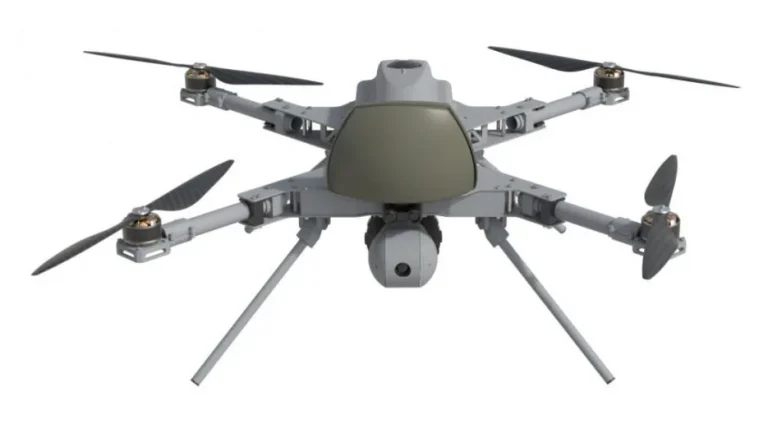
Layered Counter-Drone Defense Explained, How Militaries Stop Drone Swarms

Layered counter-drone defense combines at least four tiers of sensors and weapons, because no single system can stop a swarm of drones costing a few hundred to a few thousand dollars each without bankrupting the defender. The approach mirrors classic air defense, but it adapts to targets that fly low, slow and in large numbers, and it leans on cheaper effectors such as jammers, guns and interceptor drones.
What is layered counter-drone defense
Counter-drone defense, often shortened to C-UAS, is the set of tools used to find, identify and stop hostile uncrewed aircraft. A layered approach stacks different tools so that a drone that slips past one layer meets another. The logic is the same as a castle with a moat, a wall and an inner keep, and it explains why armies deploy mixtures of radars, jammers, guns, missiles and increasingly lasers rather than a single silver bullet.
The urgency comes from the battlefield. In Ukraine, cheap first-person-view drones, long-range one-way attack drones and surveillance quadcopters have forced both sides to adapt. Earlier explainers on how drone swarms work show why the threat keeps growing.
How counter-drone detection works
| Sensor | How it works | Strength | Weakness |
|---|---|---|---|
| Radar | Emits radio waves and tracks small moving echoes | Works in all weather, tracks many targets | Low-flying small drones are hard to separate from birds and clutter |
| Radio-frequency detectors | Listen for control links and video signals | Passive, can locate the pilot | Useless against autonomous or fiber-optic drones |
| Electro-optical and infrared | Cameras identify the drone visually or by heat | Positive identification | Short range, affected by weather |
| Acoustic sensors | Microphone arrays hear rotor noise | Cheap, can be spread widely | Noisy backgrounds limit range |
Compact radars such as those from Echodyne, a US firm whose product line is covered in our article on the Army counter-UAS radar contract, are designed for this mission. Radio-frequency detection and jamming are the specialty of firms such as Australia’s DroneShield. Fiber-optic drones, which have no radio link, weaken the RF approach and push operators toward radar and optical sensors.
How counter-drone weapons work
Defeat methods fall into soft kill and hard kill. Soft kill means jamming the control link or navigation signal, or spoofing GPS so the drone flies away or lands. It is cheap and non-lethal but fails against drones that are autonomous or use optical fiber. Hard kill destroys the airframe using guns, missiles, interceptor drones, lasers or microwaves.
| Method | Examples | Approximate role |
|---|---|---|
| Jamming and spoofing | Handheld and vehicle-mounted jammers | Inner layer, against remote-controlled drones |
| Guns and autocannons | Gepard, Skyranger 30, autonomous remote weapon stations | Middle layer, against drones within a few kilometers |
| Interceptor drones | Ukrainian and US interceptor designs | Middle to outer layer, cheaper than missiles |
| Missiles | Short-range surface-to-air missiles | Outer layer, against larger long-range drones |
| Directed energy | Lasers and high-power microwave systems | Inner layer, low cost per shot but limited by weather and power |
Gun-based systems have had a renaissance. The retired German Gepard, now supplied to Ukraine, became an unlikely star, as described in our piece on the Gepard drone killer. Modern successors include Rheinmetall’s Skyranger family. Autonomous gun stations such as the US Bullfrog, a remote weapon station that uses machine vision to track small targets, show how artificial intelligence is entering the layer.
Counter-drone layers compared
| Layer | Range | Tools | Targets |
|---|---|---|---|
| Outer | 10 km and beyond | Air surveillance radar, missiles, fighter aircraft, long-range interceptors | Large one-way attack drones and cruise-missile-like threats |
| Middle | 1 to 10 km | Gun systems, interceptor drones, mobile fire teams | Medium drones and swarms |
| Inner | Under 1 km | Jammers, nets, lasers, microwaves, small arms | Quadcopters and FPV drones close to the target |
Ukrainian officials say mobile fire groups with machine guns and small interceptor drones account for a significant share of shootdowns, although these operator-reported figures are hard to verify. What is clear is that cheap, distributed defenses are now central to protecting cities, bases and front-line units.
The cost exchange problem
The central challenge is economics. If a drone costs tens of thousands of dollars and the interceptor costs millions, the attacker wins the exchange even if every drone is shot down. Layering helps because cheap tools handle the bulk of threats and expensive missiles are reserved for the rare high-value target. Lasers and microwaves promise very low marginal cost, but they need power, cooling and clear line of sight, and they are still being fielded at small scale.
Operators also need clear rules. A dense sensor network can create false alarms from birds or civilian aircraft, and defending home territory raises legal issues around jamming and shooting near people. These non-technical factors often decide how quickly a system is fielded.
Counter-drone defense frequently asked questions
What is layered counter-drone defense?
A system of systems that uses several sensors and weapons in tiers, so that drones missed by one layer are caught by another.
How do you detect a small drone?
Mainly through radar, radio-frequency detection, cameras and acoustic sensors, usually combined.
Does jamming stop every drone?
No. Autonomous and fiber-optic drones are not affected by radio jamming.
Why not use missiles against every drone?
Missiles cost far more than most drones, so using them on cheap targets loses the cost exchange.
Are lasers ready for counter-drone use?
Early systems are being fielded, but power, weather and line of sight limit them.
- Manufacturer product literature (company claims)
- US Department of Defense and NATO counter-UAS publications
- Wikipedia – Counter-unmanned aerial system (accessed October 2026)
- Defence & Tech reporting