Taigei-Class Submarine: Japan’s Lithium-Ion Powered Hunter Explained
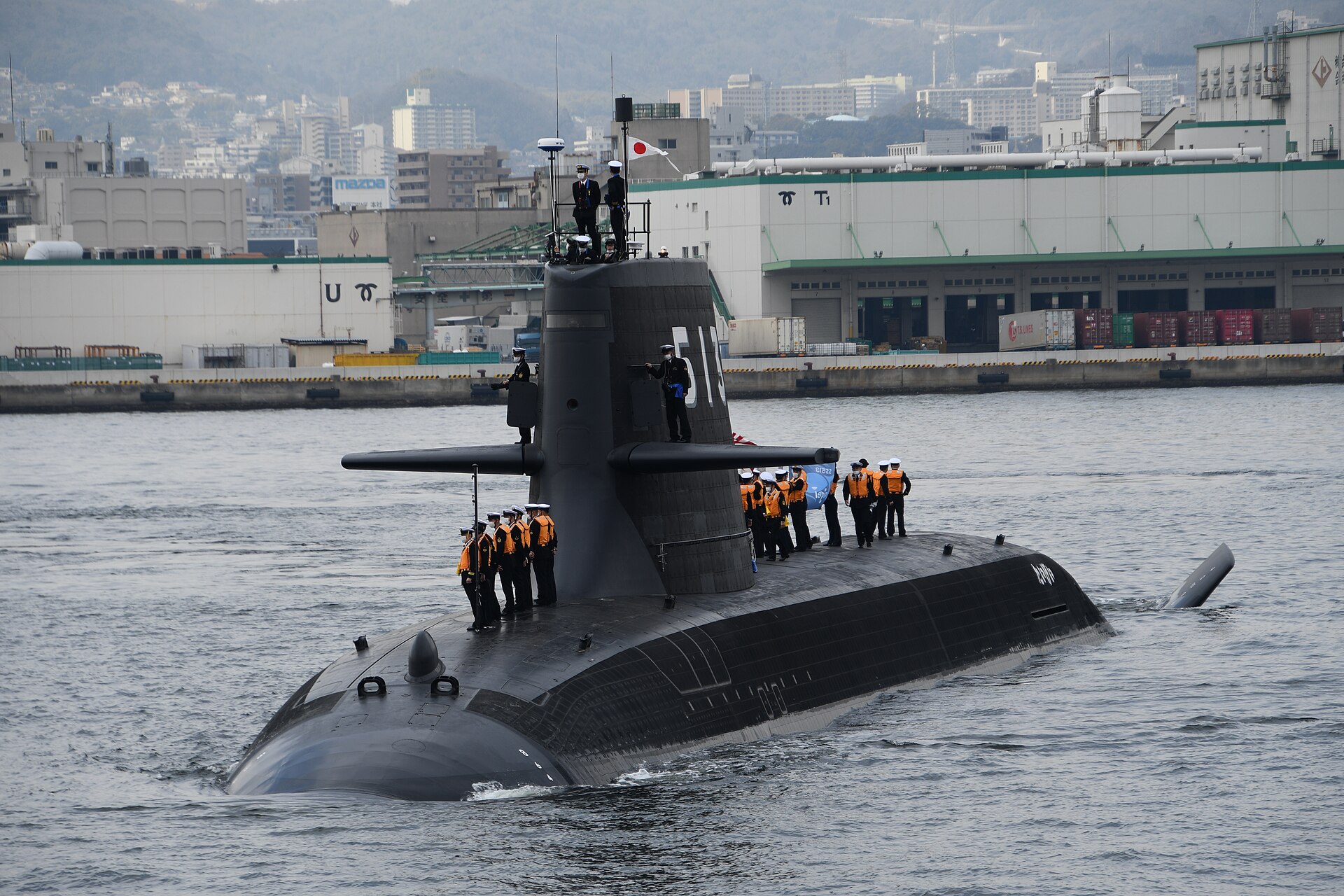
The Taigei class is Japan’s newest attack submarine and one of the most advanced conventional submarines in the world. Its key innovation is propulsion: instead of the air-independent systems used by many navies, it runs entirely on large lithium-ion batteries, giving it more power, speed and stealth underwater than older diesel-electric boats.
- Builders: Mitsubishi and Kawasaki Heavy Industries (Japan)
- First boat commissioned: March 2022
- Displacement: ~3,000 tonnes surfaced; length ~84 m
- Power: lithium-ion batteries (no AIP)
- Weapons: 6 x 533 mm tubes, Type 18 torpedoes, Harpoon
What is the Taigei class?
Built by Mitsubishi Heavy Industries and Kawasaki Heavy Industries in Kobe, the Taigei class succeeds the Sōryū class. The lead boat, JS Taigei, was commissioned in March 2022, and Japan has been adding roughly one new boat a year as part of its plan to keep a fleet of 22 submarines.
Specs
The Taigei is about 84 meters long with a surfaced displacement of around 3,000 tonnes, large for a conventional submarine. It carries a crew of about 70 and is the first Japanese submarine designed with dedicated berths for female sailors.
Lithium-ion power
Japan was the first country to put lithium-ion batteries into operational submarines, starting with the last two Sōryū boats. The Taigei class was designed around them from the start. Compared with traditional lead-acid batteries, lithium-ion cells store far more energy, recharge faster and allow high-speed sprints underwater without exhausting the battery quickly. That reduces the time the submarine must spend near the surface running its diesel generators, when it is most vulnerable to detection.
Weapons and sensors
The Taigei has six 533 mm torpedo tubes for the new Type 18 heavyweight torpedo and sub-launched Harpoon anti-ship missiles. It features improved sonar and better noise reduction than its predecessors.
Why it matters
Submarines are central to Japan’s defense strategy against China’s growing navy, especially around the Ryukyu Islands and the approaches to Taiwan. Quiet, fast and long-enduring, the Taigei class allows Japan to watch chokepoints and threaten enemy ships without being seen.
What’s next
Japan is studying a future submarine that could carry vertical launch systems for long-range missiles, as part of its new counterstrike capability. Lithium-ion technology has also drawn foreign interest: France’s Naval Group has followed with its own lithium-ion Scorpène for Indonesia, and Australia once considered a Japanese design for its submarine program.
Featured image: Hunini / CC BY-SA 4.0, via Wikimedia Commons