Bell V-280 Valor Specs, Speed and Army Selection
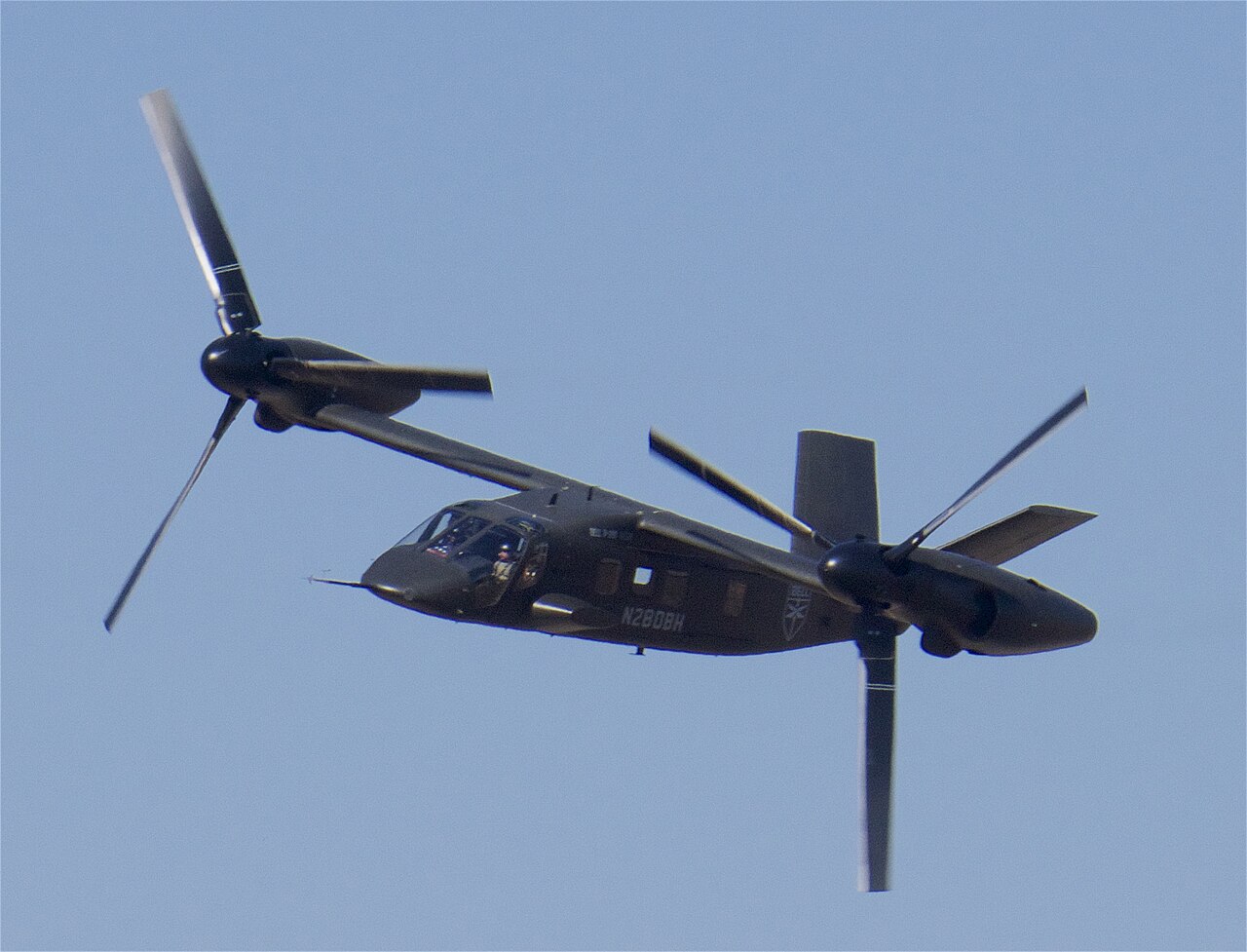
The Bell V-280 Valor is a tiltrotor that Bell says cruises at about 280 knots, roughly twice the speed of a conventional helicopter, and it is the design the US Army selected in 2022 to become its next assault aircraft. Now designated MV-75, it is meant to replace much of the UH-60 Black Hawk fleet over the coming decades.
What is the Bell V-280 Valor
The V-280 is a medium-lift tiltrotor developed by Bell, a Textron company, with Lockheed Martin as a key teammate. It takes off and lands like a helicopter, then tilts its rotors forward to fly like an airplane with a fixed wing. The Army wanted that combination to cross the vast distances of the Indo-Pacific, where a helicopter’s speed and range fall short.
The design differs from the V-22 Osprey in one major way. On the Valor, only the rotors and their gearboxes tilt, while the engines stay fixed in the wing. That simplifies the drive system, keeps exhaust away from the ground and leaves room for a large, unobstructed cabin with wide doors for door gunners and fast loading.
V-280 Valor specifications
| Parameter | Figure |
|---|---|
| Manufacturer | Bell Textron, with Lockheed Martin as a teammate |
| Type | Medium-lift tiltrotor with fixed engines and tilting proprotors |
| Crew | 4 |
| Troops | About 11 to 14, depending on seating, reported |
| Engines | 2 x General Electric T64 turboshafts in fixed nacelles |
| Cruise speed | About 280 knots, manufacturer figure |
| Top speed demonstrated | Bell reported more than 300 knots in testing |
| Combat radius | Army target range of roughly 500 to 800 nautical miles, reported |
| Ferry range | About 2,100 nautical miles, manufacturer claim |
Speed is the selling point. A UH-60M cruises at around 150 knots, so the V-280 roughly doubles that, which shortens the time from staging base to objective and reduces exposure to air defense. The same speed helps with self-deployment over long distances, reducing reliance on ships or transport aircraft.
The airframe also reflects lessons from earlier programs. Bell’s prototype used a largely composite structure, a fly-by-wire control system and a high, straight wing with conventional flaps. The aircraft can fly with its rotors at several tilt angles, which gives the crew a slower, helicopter-like mode for landing in tight zones and a fast, airplane-like mode for the long leg. Door gunners sit at wide side doors, and the cabin is sized for a squad with equipment rather than a few seats crammed around a narrow aisle.
V-280 Valor vs V-22 Osprey
| Feature | V-280 Valor | V-22 Osprey |
|---|---|---|
| Nacelle design | Fixed engines, tilting rotors | Whole nacelles tilt with engines |
| Cruise speed | About 280 knots, claim | About 250 knots class |
| Cabin | Wide doors, unobstructed cabin | Rear ramp, narrower cabin |
| Maturity | Prototype tested; MV-75 in development | In service since 2007 |
| Main users | US Army, planned | US Marine Corps, Air Force, Japan |
Why did the Army choose the V-280
The Future Long-Range Assault Aircraft competition pitted Bell against a Sikorsky and Boeing team proposing the coaxial SB-1 Defiant. Bell’s V-280 flew first, in December 2017, and racked up speed and handling milestones in flight tests. In December 2022 the Army chose the V-280, and a protest by the losing team was denied by the Government Accountability Office in 2023.
The Army cited range and speed as the decisive benefits. Doctrine is now shaped by distance, as in our coverage of modern attack helicopters, which points out that rotorcraft must survive contested airspace, not just fly far.
V-280 Valor program status
The production aircraft carries the designation MV-75. The Army has pushed to accelerate fielding and, in 2025, described plans to move faster than originally scheduled, with first units expected around the end of the decade. Final numbers and timelines depend on budgets, testing and industrial capacity at Bell’s Texas facilities.
The Army’s rotary-wing fleet also includes the AH-64 Apache, which remains its main attack helicopter, and the Black Hawk fleet, which the MV-75 is not expected to replace one for one. Tiltrotors bring their own risks, from drivetrain complexity to cost, and the V-22 program’s safety history is a reminder that maturity takes time.
V-280 Valor frequently asked questions
How fast is the V-280 Valor?
Bell cites a cruise speed of about 280 knots and has reported exceeding 300 knots in flight tests.
Is the V-280 the same as the MV-75?
The MV-75 is the Army’s designation for the production aircraft derived from the V-280 design.
Who builds the V-280 Valor?
Bell, a Textron company, with Lockheed Martin and GE among its teammates.
How is the V-280 different from the Osprey?
Only the rotors tilt on the V-280, while the engines are fixed, which simplifies the drivetrain.
When will the Army get the MV-75?
Fielding is expected around the end of the decade, with the Army seeking to accelerate the schedule.
- US Army program announcements on future long-range assault aircraft
- Manufacturer product literature (Bell Textron)
- Wikipedia – Bell V-280 Valor (accessed October 2026)
- Defence & Tech reporting