CH-53K King Stallion Specs, Payload and Operators
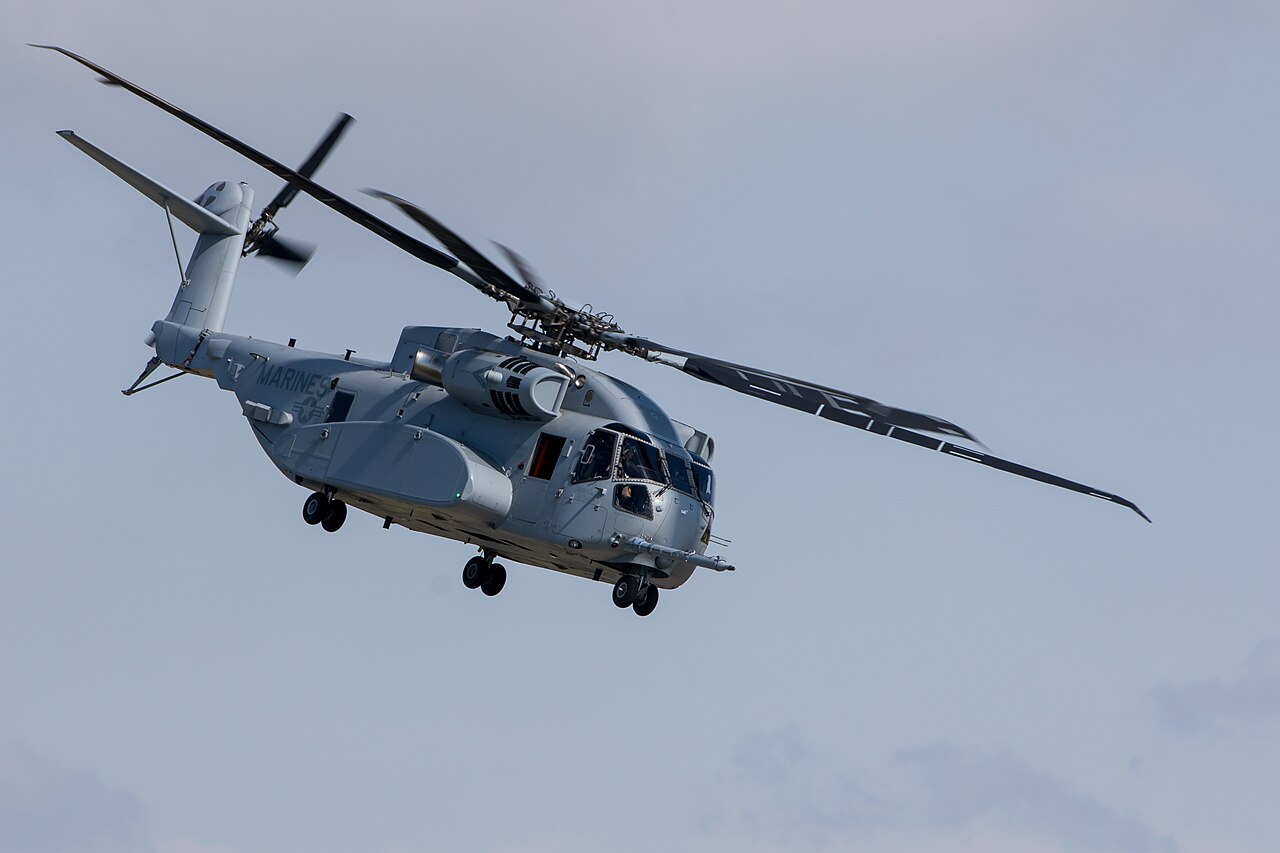
The CH-53K King Stallion is the heaviest helicopter in the US military, a three-engine Sikorsky design that can lift roughly 36,000 pounds externally and carry up to about 30 Marines. Built to replace the aging CH-53E Super Stallion, it entered Marine Corps service in 2022 after a long and costly development.
What is the CH-53K King Stallion
The CH-53K is a heavy-lift transport helicopter developed by Sikorsky, now part of Lockheed Martin. Its job is to move heavy equipment and troops from ships to objectives inland, often in hot, high-altitude conditions where lighter aircraft struggle. Typical loads include a light armored vehicle, a howitzer or a bundle of supplies, slung beneath the fuselage.
Externally it resembles its predecessor, but almost everything inside is new. It has a fly-by-wire flight control system, a composite airframe section, wider rotor blades with swept tips and a glass cockpit. The aircraft is designed for shipboard operations, with a folding rotor head and tail to fit on amphibious assault ships and aircraft carriers.
CH-53K King Stallion specifications
| Parameter | Figure |
|---|---|
| Manufacturer | Sikorsky, a Lockheed Martin company |
| Crew | 3 (pilot, copilot, crew chief) |
| Passengers | Up to about 30 troops in standard seating; higher numbers in high-density layouts |
| Engines | 3 x General Electric T408-GE-400, about 7,500 shp each |
| Main rotor | 7 blades, diameter about 79 ft (24 m) |
| Maximum gross weight | About 88,000 lb (39,900 kg) |
| External load | About 36,000 lb (16,300 kg), manufacturer figure |
| Cruise speed | Roughly 170 knots maximum, reported |
| Range | Reported ferry range above 1,000 nautical miles with aerial refueling |
Power is the headline. The three T408 engines give roughly 50 percent more lifting power than the CH-53E’s engines, and Sikorsky says the K can carry about 12,000 pounds more than the E at typical hot-day conditions over a 110 nautical mile mission. Those are manufacturer claims, but they reflect the design goal: lifting heavier payloads from smaller decks.
CH-53K vs CH-53E
| Feature | CH-53E Super Stallion | CH-53K King Stallion |
|---|---|---|
| First flight | 1974 (original CH-53 lineage) | 2015 |
| Engines | 3 x T64 turboshafts | 3 x T408 turboshafts |
| Flight controls | Mechanical | Fly-by-wire |
| External load | About 27,000 lb class | About 36,000 lb class |
| Cockpit | Analog and early digital | Fully digital, glass cockpit |
The upgrade matters because the E-model fleet has been worn down by decades of hard use, and maintenance hours per flight hour have been a persistent concern. The K incorporates corrosion-resistant materials and condition monitoring intended to cut that burden.
CH-53K development and production
The program began in the early 2000s as the CH-53X. The first flight came in October 2015, later than originally planned, and cost growth drew repeated scrutiny from oversight bodies. The Marine Corps declared initial operational capability in April 2022, and full-rate production followed. In 2025, the US Navy awarded a large multiyear contract covering up to roughly 99 aircraft, valued at around 10 billion dollars, as reported at the time.
The Marine Corps has planned a fleet of about 200 aircraft. Deliveries have been steady but not fast, which matters because the service still depends on the older CH-53E while the new helicopters enter units. The heavy-lift market is narrow, and there is no direct Western competitor in the same class, although other rotorcraft, such as the AH-64 Apache, serve very different missions.
Who operates the CH-53K
The US Marine Corps is the only operator flying the type in service as of this writing. At least one foreign customer has signed for the helicopter under the US Foreign Military Sales process, according to reports, but delivery timelines are later in the decade. The aircraft has no significant combat record yet. Its early operational use has centered on training, amphibious ship trials and deployments with Marine heavy-lift squadrons.
In the broader picture, rotary-wing modernization is a growing theme in defense budgets, as shown in our top 10 attack helicopters ranking, even though the King Stallion is a transport rather than a gunship.
CH-53K King Stallion frequently asked questions
How much can the CH-53K lift?
Sikorsky cites about 36,000 pounds (16,300 kilograms) as an external load under specified conditions.
What engines does the CH-53K use?
Three General Electric T408-GE-400 turboshaft engines, each rated at roughly 7,500 shaft horsepower.
When did the CH-53K enter service?
The Marine Corps declared initial operational capability in April 2022.
How many Marines can the CH-53K carry?
Up to about 30 in standard seating, with higher counts possible in high-density configurations.
Who makes the CH-53K?
Sikorsky, which is part of Lockheed Martin.
- US Marine Corps and US Navy program information
- Manufacturer product literature (Sikorsky, a Lockheed Martin company)
- Wikipedia – Sikorsky CH-53K King Stallion (accessed October 2026)
- Defence & Tech reporting